What Really Broke Bitcoin?
A small sale by Strategy may have rattled investor confidence, but the technical damage was already underway.
You've reached your free article limit
You've read 0 of 1 free Pro articles.

My system isn’t complicated. Most of my short-term trading revolves around the 8-day and 21-day exponential moving averages. Ideally, I prefer trading from the long side when price is above those moving averages as well as the 50-day and 200-day simple moving averages. If volatility is high enough, I’ll buy below the 50- and 200-day averages, provided price remains above the 8- and 21-day EMAs.
That said, if price is trading below the 200-day SMA and I’m long, I generally look to reduce exposure or get flat as that moving average comes into view. Historically, bad things tend to happen beneath the 200-day.
A month ago, Bitcoin (BTC) appeared to be doing everything bulls could reasonably ask for. Buyers consistently defended pullbacks into the rising 8-day and 21-day EMAs, momentum remained constructive, and BTC had rallied back toward major resistance near the 200-day moving average. While my upside target remained in the mid-$80,000 range, the more important level was support near $74,000. As long as Bitcoin held that area, the bullish case remained intact.
The setup looked constructive, but it came with an important condition. Bitcoin needed to defend $74,000. A decisive break below that level would signal that the recovery had failed and that sellers had regained control.
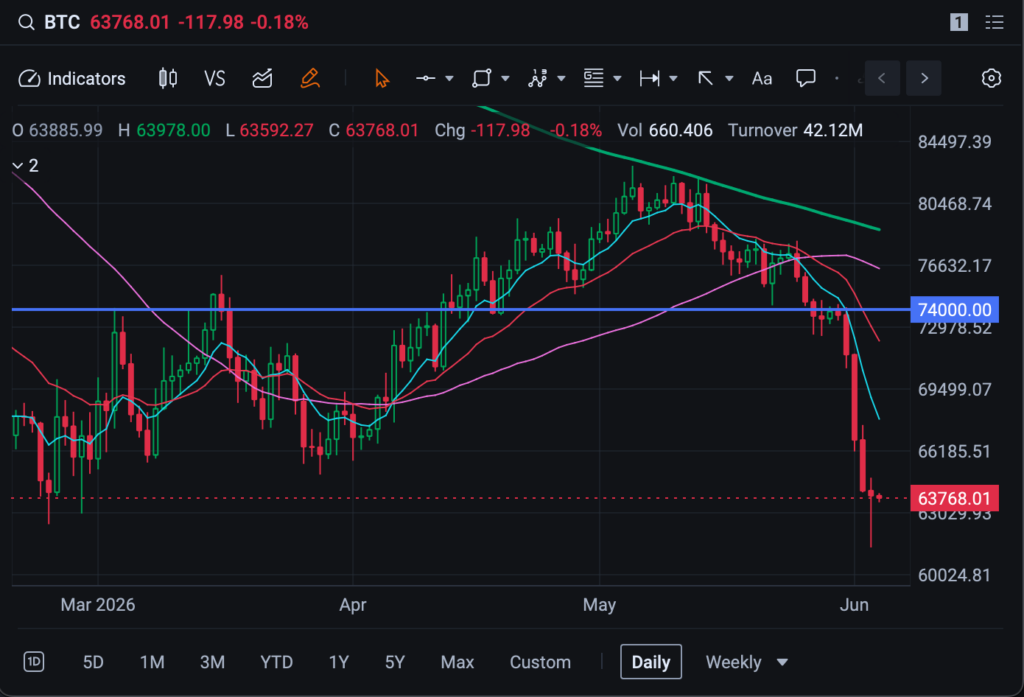
From a trading perspective, the first warning came in mid-May, when BTC slipped below the 8- and 21-day EMAs. That wasn’t enough on its own to turn me bearish, but it was enough to put me on alert. The bulls still had an opportunity to regain control if buyers showed up near support.
They didn’t.
Demand evaporated, support failed, and Bitcoin crashed.
So what happened?
The honest answer is that nobody knows for certain. Some investors believe capital is leaving crypto to make room for investments into SpaceX and potential opportunities in Anthropic and OpenAI. Others argue that traders have simply grown frustrated with crypto’s underperformance and are reallocating toward AI infrastructure, semiconductors, and the broader AI ecosystem.
The most interesting explanation, however, traces back to a comment Michael Saylor made during Strategy’s (MSTR) May 5 earnings call. Coincidentally, that was also the day Bitcoin peaked.
“We will probably sell some bitcoin to pay a dividend just to inoculate the market and send the message that we did it.”
When Strategy later sold 32 BTC, an insignificant amount relative to its overall holdings, the market reacted far more aggressively than the transaction itself justified. In my view, investors weren’t responding to the size of the sale. They were responding to the symbolism. For years, Strategy represented relentless accumulation. The moment investors saw even a small sale, many began questioning assumptions they had previously taken for granted.
At this point, I can’t help but wonder whether the market needs Saylor to be squeezed into a significantly larger sale before a more durable bottom forms.
Whatever the catalyst, the technical damage is now undeniable.
Bitcoin is trading below its short-, intermediate-, and long-term moving averages. Momentum remains negative, and the burden of proof has shifted back to the bulls. Some investors believe Bitcoin could eventually become a meaningful alternative to traditional currencies, and that may ultimately prove true. But I am a trader, plain and simple. My focus is on price action and risk management, not long-term ideological debates.
For now, aside from my long-term iShares Bitcoin Trust ETF (IBIT) position, I have little interest in trading Bitcoin until price stabilizes and begins reclaiming the 8-day and 21-day EMAs.
At the time of publication, Byrne was long IBIT.