This Stock Gained 24% in One Week — Can It Keep Rolling?
Despite competition from Tesla, dominant market share puts this stock in the driver’s seat.
You've reached your free article limit
You've read 0 of 1 free Pro articles.
In the long term, I believe that Tesla’s TSLA self-driving taxi will be a big winner. But will it disrupt the rideshare market in the short term?
Dara Khosrowshahi, CEO of Uber UBER, made some insightful comments about autonomous vehicles and their impact on the rideshare market last week:
“Logic would dictate that if robots are twice as good a driver or three times as good as drivers as humans, that’s good for society going forward, but I honestly don’t know if society’s ready to accept that,” said Khosrowshahi.
Khosrowshahi has a point. Most of us either have been involved in an auto accident, or know someone who was affected by one. Consumers may be reluctant, at least initially, to place their safety in the hands of an autonomous vehicle.
While this reluctance won’t prevent consumer acceptance of such a vehicle, adaptation could happen slowly. This means Tesla’s forthcoming self-driving taxi, often referred to as Robotaxi or CyberCab, isn’t likely to threaten Uber’s dominant market share in the near future.
According to recent data from Bloomberg, Uber holds a 76% market share vs. Lyft LYFT, which controls 24% of the rideshare market. In March, Uber saw a 10% year-over-year sales increase, while Lyft experienced a year-over-year gain of just 3%.
This growth disparity is reflected in the recent performance of these names. Year-to-date, Uber has gained 18%, putting its performance ahead of the S&P 500, which has gained 12.5%. Meanwhile, shares of Lyft have fallen nearly 30% year-to-date.
Uber shares dropped sharply at the start of this month (point A), but this was due to overall market weakness rather than company-specific news. The stock then rocketed higher after an earnings report that saw the market leader beat both earnings and revenue estimates (point B). .
Uber opened at $55.53 on August 5, and closed at $69.27 on August 12 — a gain of 24% in just one week.
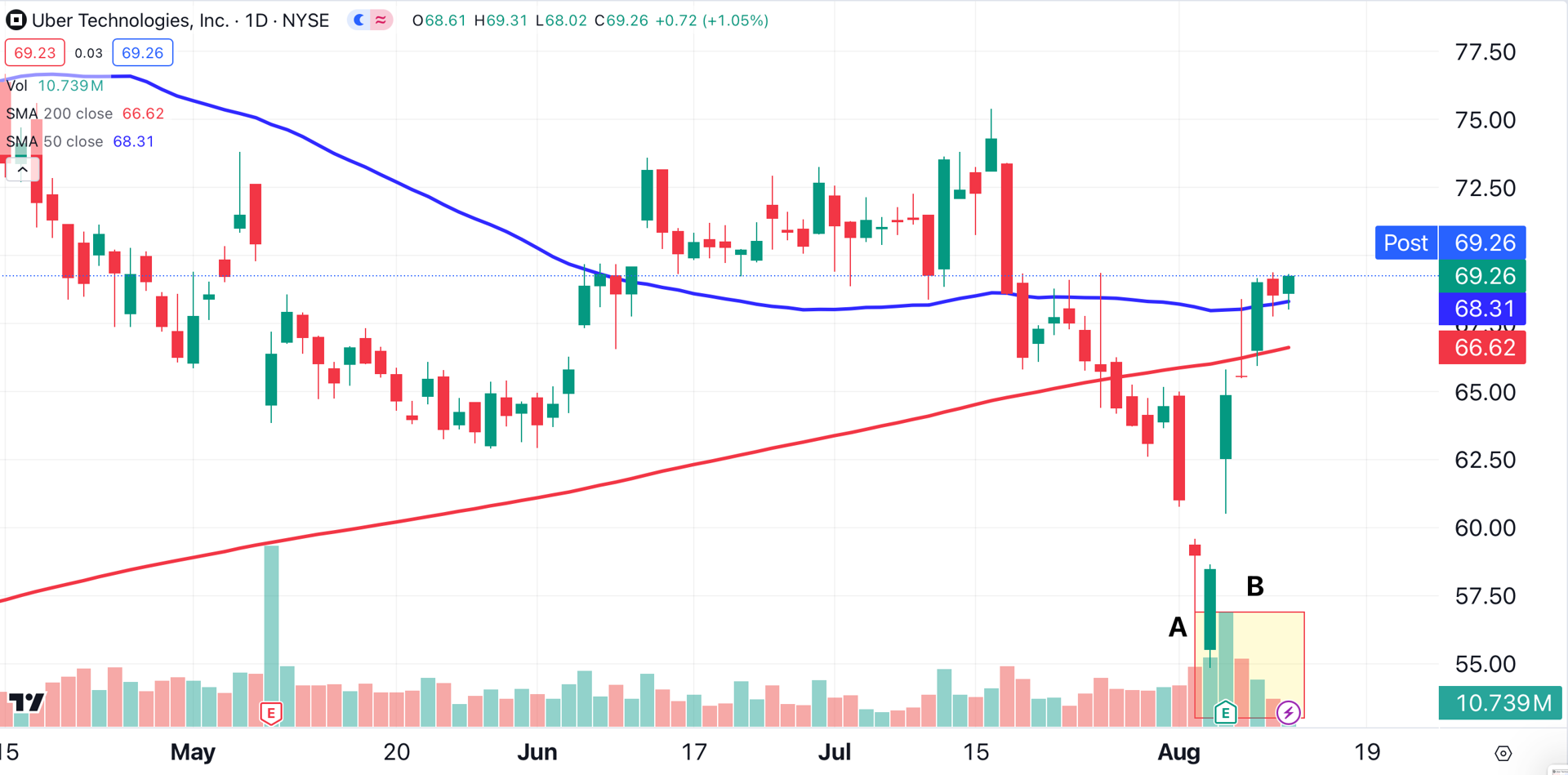
Uber has climbed back above its 50-day (blue) and 200-day (red) moving averages. Since bottoming on August 5, the stock has rallied on heavy volume (shaded yellow), signaling potential institutional buying.
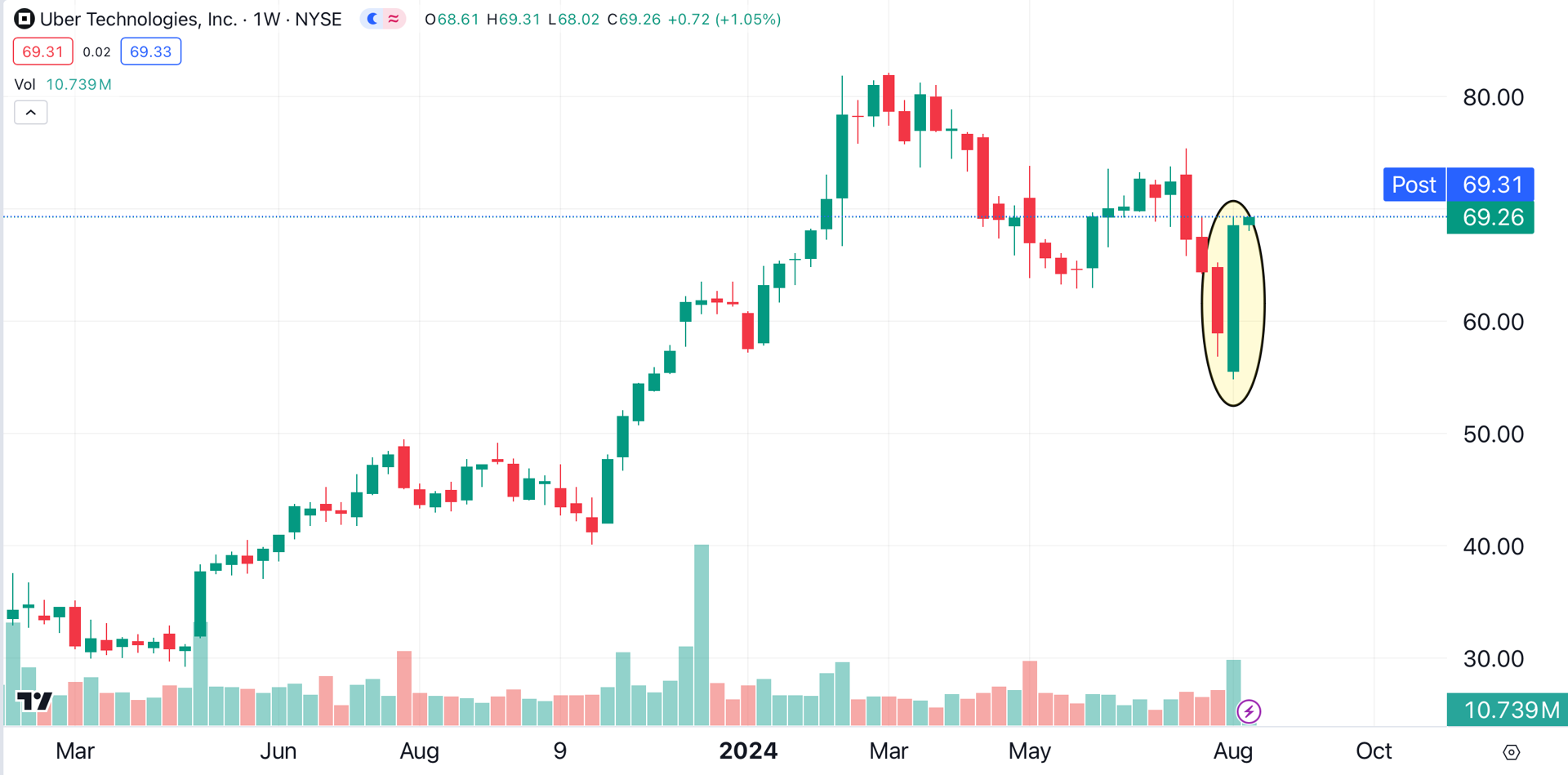
While Uber’s daily chart is showing improvement, the real excitement is visible on the stock’s weekly chart. In this time frame, a massive bullish engulfing formation (circled) is projecting further gains for the stock.
Tesla’s self-driving taxi is a threat that Uber must take seriously, but it is unlikely to have an impact in the near term. The autonomous driving taxi was supposed to be unveiled on August 8, but that date has tentatively been pushed back to October 10.
The vehicle’s introduction in no way means it will soon be available. Tesla’s CyberTruck was unveiled in 2019, but the first deliveries of that futuristic, angular vehicle occurred four years later.
Will it take four years to bring Robotaxi to market? We don’t know, but as Uber CEO Khosrowshahi pointed out, regardless of when the product is introduced, it might take time for consumers to warm up to the idea.
To summarize, Uber is crushing Lyft, and Tesla won’t be a problem for the foreseeable future. This puts Uber solidly in the sweet spot as the market leader in the growing rideshare industry. We’re maintaining our long position in the stock.
More from TheStreet Pro:
- Doug Kass: How Opportunistic Trading Can Boost Investing Returns
- Weekly Portfolio Roundup: Opportunity Was the Name of the Game
- You Want Comfort? Get a Couch.
At the time of publication, Ponsi was long UBER and TSLA.