The Case for GameStop
What if I told you it’s possible to dislike the company, and to like the stock at the same time?
You've reached your free article limit
You've read 0 of 1 free Pro articles.
“I like the stock”
When Keith Gill, aka Roaring Kitty, uttered those words during his testimony before the House Financial Services Committee in 2021, the phrase became immortalized.
Gill’s thesis was that the market was underestimating GameStop’s GME growth potential, and overestimating the likelihood of bankruptcy for the video game retailer.
Gill didn’t just like the stock — he liked GameStop as a company, and this justified his purchase of the stock.
What if I told you it’s possible to dislike the company, and to like the stock at the same time?
Try to think of the company and the stock as two separate entities. To help with this, we’ll refer to the company as GameStop, and the stock as GME.
GameStop — The Company
First let’s talk about the company.
Recently, GameStop raised money via a secondary offering. More recently, the company authorized an additional 75 million share offering.
GameStop issues new shares to raise capital. The company lost over $300 million dollars in fiscal 2022 and 2023 combined.
Good companies earn profits by selling to people who want their products. They don’t need to repeatedly issue new shares to keep the business afloat.
What happens to companies that continually issue new shares? Take a look at the shares outstanding chart of AMC Entertainment Holdings AMC. This chart represents the number of shares held by the public on the open market.
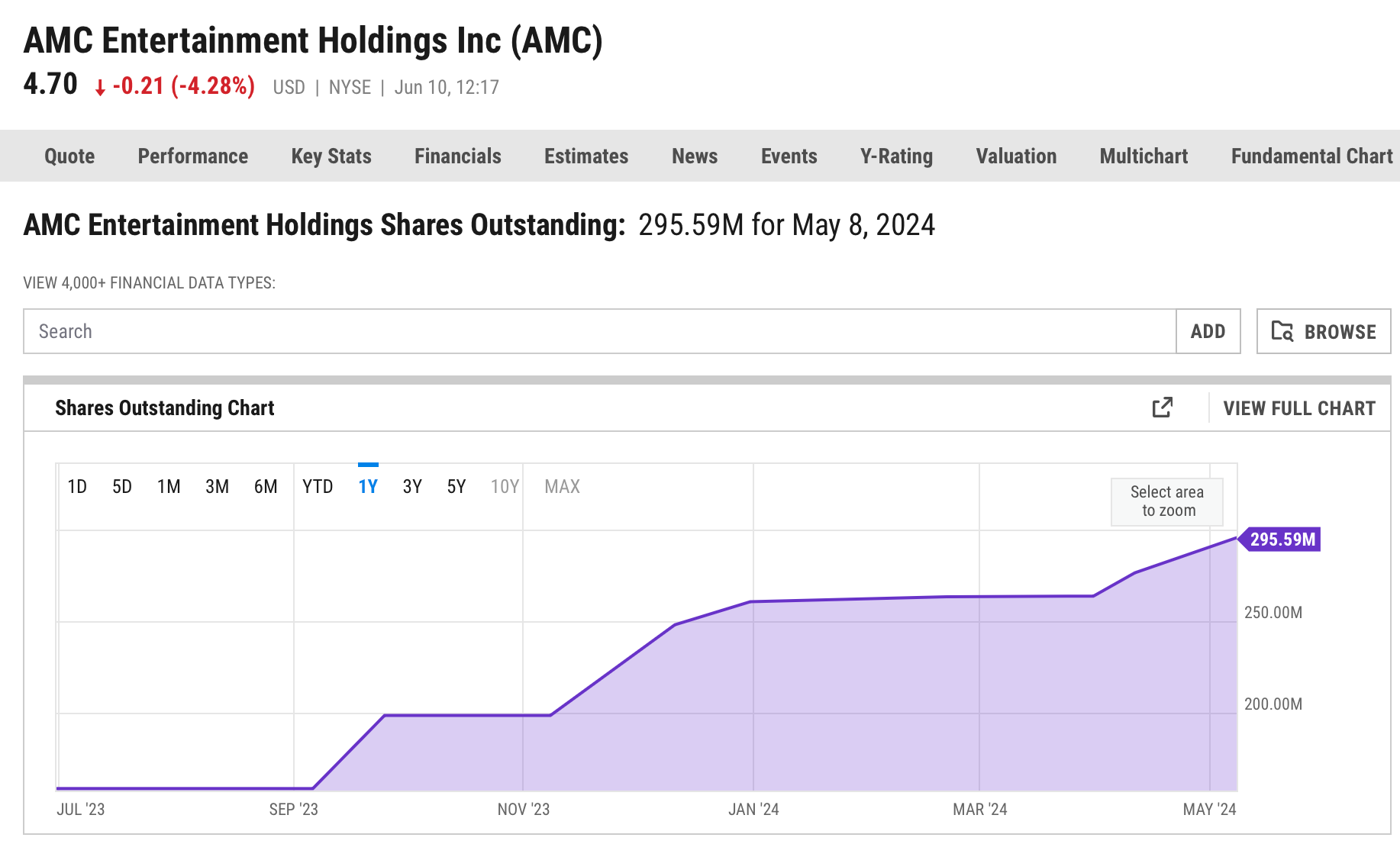
The influx of shares provided AMC with capital, but shareholders paid the price. AMC shares lost 79.85% in 2022, and 84.96% in 2023.
Like AMC, GameStop is raising capital by transferring additional risk to shareholders in the form of diluted shares.
GME — The Stock
It’s hard to imagine buying stock in a company like GameStop, based on the description above.
Fortunately, the stock is not the company. Think of a stock as a piece of paper that represents a tiny portion of that company.
Theoretically, the price of a stock should be based on the quality of the company. But if that were true, would stock prices constantly fluctuate?
If stock prices represented the true value of companies, would it be possible for a stock like GME to rise from $1 to $100 (split adjusted) over the course of a few weeks in early 2021? No.
Stock prices are influenced more by supply and demand than by any other individual factor.
Right now, the potential for an increase in demand for shares of GME is high. Meanwhile, considering everything that has happened over the past few weeks, the current price is not high.
As I write, GME is trading near $23. There is a thick area of support between approximately $10 and $20 (shaded yellow), stretching into last year. The average price of that area is about $15.
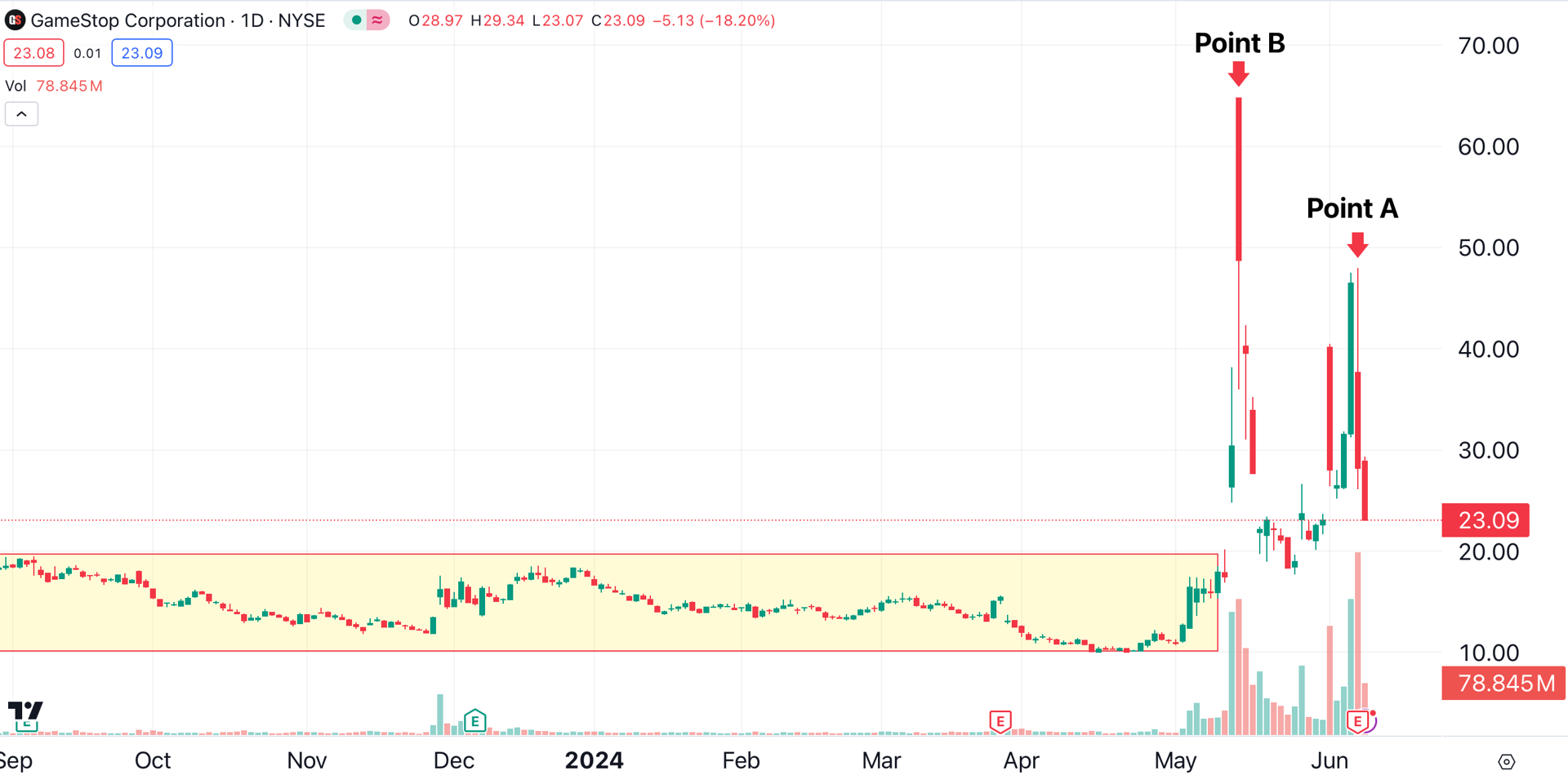
If I buy here at $23, I’d assume a risk of about $8 per share.
What’s my upside? Overhead resistance is located at $48 (point A), and further resistance awaits in the low 60’s (point B). The risk-to-reward ratio is favorable.
I’m not what you’d call a believer. I don’t have diamond hands. I have no intention of holding this stock if it drops below $15.
I do believe the market is underestimating the potential for another shoe to drop. The stock is only $6 to $7 higher than it was just before Gill’s reappearance. Gill’s 120,000 call options expire in less than two weeks.
How will this play out? There are too many possibilities to list. But there is considerably more upside than downside.
I don't like GameStop, the company. But GME, at its current price, for a trade rather than an investment?
I like the stock.
More Gamestop:
- With $2.5 Billion Raise, the GameStop Show Is Over
- Forget Meme Players… What Is GameStop Really Worth?
- More Than a Meme? Don't Bury GameStop Just Yet
At the time of publication, Ponsi was long GME.