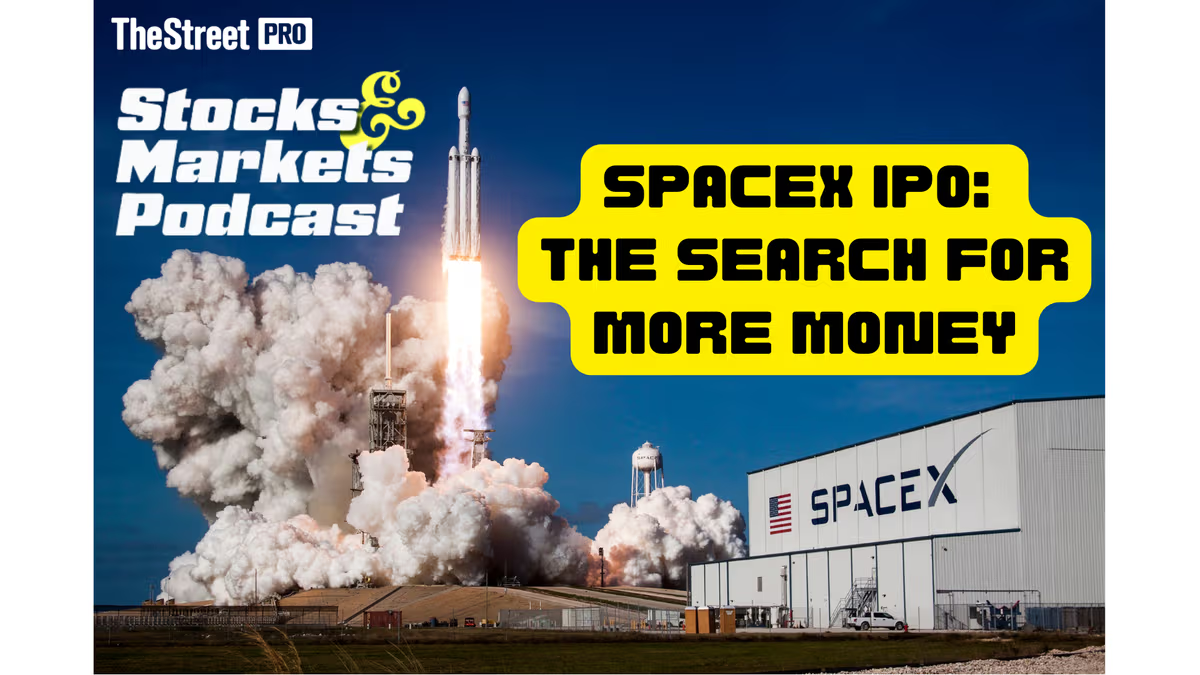
Stocks & Markets Podcast: Is The SpaceX IPO a Search for More Money?
SpaceX founder Elon Musk is a fan of the movie Spaceballs. So, as SpaceX, the sequel to Tesla prepares to IPO, we ask whether this is a search for more money?
You've reached your free article limit
You've read 0 of 1 free Pro articles.
Key Points
- Much hyped IPOs like Meta (META) can be risky buys initially. Meta fell by more than 50% following its IPO. Smart investors were better off waiting until the valuation improved before buying.
- SpaceX isn’t just a spacecraft company. Musk rolled X and his AI business into SpaceX. Those two businesses eat up every dollar of operating profit that SpaceX makes.
- With an estimated valuation approaching $2 trillion, this IPO will be extremely risky.
- Brad discusses why funds that currently hold SpaceX, like the Destiny Tech 100 Fund (DXYZ), should be avoided now.
Introduction
I sat down with contributor Brad Ginesin to discuss the upcoming SpaceX IPO. Brad’s not bullish on this one, at least not at the current valuation. Since SpaceX founder Elon Musk is a Spaceballs fan we used several references from that movie to ask whether the Tesla (TSLA) sequel is a “search for more money.”
Please enjoy and leave comments. Feel free to share this from our YouTube channel, too.
VIDEO
You might also enjoy Brad’s article, SpaceX IPO Hype is Building But Facebook’s ‘Epic Bust’ Offers Warning
Transcript
Jason (00:02.529)
So it’s no secret that Elon Musk is a fan of space balls, right? The Tesla Model S, there’s there’s a version that goes plaid, right, just like the spaceship from Spaceballs did. it’s also not a huge secret that the Spaceballs 2 movie was going to be called, the sequel is going to be called The Search for More Money. So as we talk about SpaceX, which is our topic today, we’ll be talking about is this the search for more money?
my name is Jason Meshnick. I’m the CEO of The Street Pro, and I’m being joined by one of our contributors, Brad Janessin. Brad is the hedge fund manager and founder of Polar Capital, which is a long, short hedge fund. Brad, thank you for joining me today to talk about your article that you just wrote for us about space balls. I mean SpaceX. Yeah.
Brad (00:44.493)
Thank you. Nice to be with you. Yes. Nice to be here, Jason. Thank you.
Jason (00:57.633)
Great. So all right. last week we the the much waited for S one filing, the IPO filing for SpaceX came out. And so the the hype is really building. So Brad, can you tell me what are some of the surprises that you found in that filing? Let’s just dig right in.
Brad (01:18.028)
Well, I guess Elon Musk owns 85 % of the voting shares. I think that’s going to be of interest. The huge losses XAI is contributing to the business. think it was somewhere, yeah, 4 billion in losses just in the first quarter. I think that’s, I mean, I don’t want to harp on the negative, but that’s going to be a problem.
Let’s see, mean, certainly the enterprise value, mean, just the valuation, just how much in revenues that they want investors to underwrite, that it’s maybe something like 50 times next year’s enterprise value and revenues, and that’s things go pretty well.
Jason (02:16.906)
Yeah. One one of the things that they talk about
Brad (02:17.645)
the high CAPEX also. Go ahead.
Jason (02:20.182)
Yeah, one of the things that they talked about was the the TAM, the total addressable market, being something like twenty-eight trillion dollars, which is I I did the math, it’s the the US has a has a GDP of something like it’s over thirty trillion dollars. Europe and China combined, maybe Germany and China combined are somewhere around twenty-eight trillion dollars. so th that’s one of the assumptions that there’s that they’re saying with SpaceX what
Brad (02:49.708)
Yeah, I think 22 billion was in 22, I’m sorry, 22 trillion in enterprise AI applications. So it’s something I don’t think people could really grasp. And it just, I think it hurts credibility when you throw out such a crazy number. I just don’t think it’s legitimate. And anyone that’s excited about it, a TAM is a…
Jason (02:49.768)
Is that is that even reasonable?
Brad (03:18.924)
You know, they’re just buying into the hype.
Jason (03:21.002)
They’re yeah, they’re buying into the hype. one of my favorite quotes, I’m I’m gonna read this. Ed Elson, who is with the Prof. He said that in his reading he felt that the IPO filing was unserious, empty, hallucinatory, and borderline dishonest. it sounds like sounds like you have some of the same thoughts.
Brad (03:44.715)
You know when some things yeah, you know, there is a big cash perm which I didn’t like also I just one of the thing though how many Bitcoin they’re holding was 18,000 or something I I don’t like when somebody something tries to be something for everyone and I I just think that they’re trying to appeal to whomever that appeals to and and I do think it’s there’s some you know, just the exaggeration and is a little, I would call it lacking credibility.
Jason (04:18.922)
Let’s talk really quickly because I think a lot of people don’t really understand what the business is that SpaceX is in. Can you describe a little bit about because you mentioned some of the things, you mentioned some of the revenues that they have, but where where are these revenues or expenses coming from?
Brad (04:39.263)
Well, Starlink is the big business. I have a little over 10 million subscribers and that’s the bulk of the earnings. mean, it’s a phenomenal business. But like anything, it’s a subscriber type of business. And that’s, you that you have the launch business, which is clearly going to be a growing business. It’s
I think they’re really working on increasing the payload that they could take into space. And so that’s going to be a growing business there. obviously, hope to payload expansion and more launches. It’s not an enormous business with a huge TAM, for that matter. The big TAM seems to come from XAI. Also, I mean, you’ve got to throw in Twitter.
that you’re buying into Twitter. I usually draw the line right there, usually, like any company, not buying into Twitter again. I did that years ago and I’m not getting involved in Twitter again. I was a fan at one point, but I just think even the dream of Elon Musk taking Twitter private years ago, just, and trying to make it into an everything app, it’s a failure. So just… not on board. So, you know, there’s some interesting businesses and obviously there’s hype with maybe data centers in space. And of course XAI just leased out one of their big data centers to Anthropic. It’s taken 15 billion a year in revenue and that sounds like a great business. It’s renting out GPUs and it’s hard to get that excited about it at a certain valuation. I mean, but… in general, it’s nice that they have that.
Jason (06:40.714)
Right there, yeah, there’s a price for everything. And and I think we’ll we’ll get to valuation because that is certainly one of the big things. yeah, so the business is basically rockets, right? as you said, the satellite business that they’re launching, which is Starlink, not that they’re launching, that they launch rockets, they launch satellites.
in Starlink that that is a business that, like you said, made four point four billion dollars of operating profit in 2025. the data centers in space is something that you mentioned and and Jeff Bezos, another spacepreneur, can we call him that? space cadet, he said that data centers in space will take far longer than Elon Musk thinks that they will. and then then of course there’s the AI business, X X AI.
Brad (07:22.132)
Sure.
Jason (07:32.554)
includes X and that that’s a huge drag on on the company having lost I think it was six point four billion dollars last year the what it let’s let’s talk about growth for a second is what what parts of this business are are do you know if any parts of the business are are growing or is is is is growth starting to moderate a little bit even?
Brad (07:54.186)
Well, it has moderated. It has been, it is a growth company, but it’s not the growth company that you would think for this sort of multiple. I think the growth is going to be a little slower and you more have to zoom out into the future, well into the future to get some real potential growth to envision that.
And I think that does involve data centers in space and that, you know, what they could bring into space in terms of the new Falcon rocket. And so, you know, I think you’d have to, you have to dream a lot about what can be. And, you know, it does have some monopolistic qualities, which is nice. You know, the launch business, they’re unrivaled.
And again, there’s that payload growth, is a nice business at a certain price.
Jason (09:01.309)
Right. Yeah, so so given that let’s let’s touch on valuation because price is really it it’s the most important thing here, right? there’s a reasonable price for this company. what what valuation are they looking for and how does that fit into the article that you wrote for us?
Brad (09:20.188)
Well, I had a little comparison to Facebook. when just just thinking back to the hype of when Facebook came public and and and very, very similar to today’s hype, it was it was a company that that stayed private a lot longer than most companies back then. And and people were really eager to buy it just as eager to buy SpaceX.
Brad (09:48.853)
and as investors are now. So I think that you can draw a parallel and when Facebook came public, it was about an 80 PE. And this was a very profitable company. had about a billion dollars in profits. They had a billion users. so it was, I guess sometimes when you put a PE on something, people could get very…
specific on maybe where to trade and what your growth rates are, which you really can’t do. That’s why we’re talking multiples to sales with SpaceX, where you’re talking about next year, if things go right in their revenue growth, you’re, know, if it’s at a 1.1 and three quarter trillion dollar market cap, you’re talking about 50 times sales. And it’s not, these are not high margin businesses.
These are capital intensive businesses. So that’s very ambitious, let alone if it trades at a premium after it opens, what the valuation is going to be there. So I’m little skeptical of that.
Jason (11:01.653)
Right, yeah, so yeah, the number the number that I had seen is they’re looking to go out at a hundred times revenues. Right, so yeah. On this year’s. Okay.
Brad (11:08.776)
Yeah, well that’s on this year’s. That’s on this year’s and if you know if everything goes right for next year somewhere, you know could be could be around 50 times you have to include that that anthropic deal also, you know that is going to be a big boost to revenue So so, know somewhere around I’m talking 27 numbers, but yeah hundred times this year a hundred times posted revenue sure
Jason (11:31.175)
Okay. A hundred times this year, fifty times next year. at the same time you you mentioned that expenses are growing, right? all all of this stuff building rockets is very expensive. A lot of RD, a lot of to capital intensive business. Yeah. So
Brad (11:48.69)
Yes, launching satellites, they don’t let you need to replace them. And obviously XAIs are very capital intensive businesses as we’ve seen with open AI and anthropic. They’re just in order to know, house, compute power.
Jason (12:08.909)
So what percentage of the company are are they looking to sell? Because as you mentioned, Elon Musk has well eighty five percent of the voting shares, but they’re they’re selling a a small percentage of the company, correct?
Brad (12:21.989)
Yeah, this is probably going to be one of the smallest floats you’ll ever see on an IPO, under 5%. So as much as the deal is going to be very large, maybe $75 billion, maybe even $85 billion after the green shoe, you’re talking of a very tiny float that’s going public, probably less than 5%.
Jason (12:46.037)
So one of one of my concerns initially when I was thinking about this IPO was that there’d be a big impact, right? You you sell two trillion dollars worth of of a company and and there’s a huge impact on the rest of the market. But this sounds like, given that it’ll be under a hundred billion dollars, there is an impact, right? Mutual funds will will need to if any fund that is fully invested right now in order to buy shares of SpaceX will need to sell something, but they probably won’t need to sell a lot of whatever the thing is. and that includes retail. So so you mentioned there’s a a big demand from retail. What percentage of the company are they looking to sell to retail? Or what percentage of the float, sorry.
Brad (13:26.835)
Well, the numbers aren’t out yet. There were stories, rumors to the effect of maybe up to 30 % to retail. And as I’ve noted in my column, selling to retail a very high percent, 30 % is very high, usually get maybe in the 5 % to 10 % range, is a deal negative. Usually it’s not benevolence.
that they’re handing out shares to retail. It’s usually that they need the demand and that these are the type of investors that aren’t, you know, doing all the numbers where institutions, they have a fiduciary responsibility and to understand the value, valuation. they know this is what happened with Facebook, even at 80 times within 80 P.E.
where a lot of institutions for that IPO backed away because they really just didn’t like the valuation and they couldn’t stomach the valuation or they couldn’t justify the valuation. I think you’re gonna get a lot of that in SpaceX where they’re not gonna be able to justify owning these shares at the valuations coming public where retail just doesn’t have that criteria.
Jason (14:50.398)
Yeah. Okay, that that makes a lot of sense. You’ve got a lot of a a large number of retail people who are the Tesla favorite, Tesla faithful. right, and these and these people idolize Elon Musk and and and they’re they’re excited about it. I know I I’ve received calls from a friend of mine who is you know, nice guy, very smart, but not an investor, you know, has has worked you know, a blue-collar job for his entire life and and and again, you know.
Smart guy, but is not typically looking to buy common stocks. And he called me to say, How do I get in on this IPO? So I think you’re I think you’re right. There’s a lot of people out there who see this hype and they want to get in as much as possible. one of the interesting things though is that, so we’ll take this friend of mine, for example. Let’s say he buys some shares in in the IPO. Is that the only way that he’s going to be owning those shares? Or will he have effectively be over allocating himself.
Brad (15:55.333)
I’m not sure exactly what you mean. Is that the only way he’ll be owning the shares? I don’t know. Not kidding, man.
Jason (15:57.396)
Yeah, one of the one of the things that I was reading about, I know I I asked that question in in a pretty poor way. one of the things I was trying to get at is Elon Musk has worked with the index people to fast track inclusion in sp of of SpaceX in the S P five hundred. So yeah, so how how will that impact some of these smaller investors? will will they if if they buy shares, they should know how much.
Brad (16:14.285)
Okay.
Brad (16:18.905)
Yes.
Jason Meshnick (16:25.215)
Will will they if if they buy shares, they should know how much they’re really going to own, right? they they’re going to own more than they think they do.
Brad (16:31.775)
Yeah, do think the truth is though, let’s say they take public 5 % of the float. Usually these indexes float weighted. So you’re not gonna see a lot of SpaceX go into the index initially. It’s not like, ordinarily if it’s 100 % of the float is in, you might see.
know, upwards of 20 % of the S &P 500 and associated funds. But if the float’s only 5%, it’s just really a tiny amount that’s gonna make it into these indices initially.
Jason (17:07.377)
Okay. That’s good to know ’cause with the two trillion dollar market cap, this this is going to be one of the top ten largest companies in the world and so that would have an outsized impact on the S P five hundred. so that’s that’s good to know.
Brad (17:16.313)
Yes.
The question I have for your friend is why do they want, and why does retail want to buy it? They want to buy it because they think they’re gonna make money. They think they’re gonna see an initial pop. And there’s history that tells us that there’s a pretty good chance of that. you might hear this sort of 15, 20 maybe,
unprecedented amount of oversubscription and maybe 25%. And if it’s, say 20%, that would be just to throw out a number, a trillion and a half of demand. Now I can assure you that’s not real demand. So it’s going to be a real hype number, but I’m sure that people don’t really want to buy a trillion and a half dollars of SpaceX. They expect to get way cut back, but you probably will get some initial hop.
And, you know, there’s some form of greater fool investing when it comes to these IPOs and supply and demand. And I think the people who buy it in the aftermarket, again, they also think that they can make some money on it. So it’s really, you know, is your friend in it for the long term? I just think a lot of retail, they want to buy it for that initial, we expect to make 20, 30, maybe 50%. Who knows what it could pop.
and the demand isn’t really real.
Jason (18:45.245)
Right.
Yeah, and and and I discussed it with him that this is it’s a gamble, right? You you don’t know because what what happened to Facebook and Google after they IPO’d? that’s one of the things that you identify in your article as being as being a large risk is the the history of hot IPOs.
Brad (19:04.216)
Yeah. Well, Facebook, of course, if anyone who remembers from 2012 was an epic disaster. The Facebook when it opened a small premium 10 percent, but it hit it back to its IPO price within the first hour of trading at back to thirty eight dollars. And the next day it broke and it never saw that level of thirty eight. It took another 16 months just to get back to there before getting cut in half. And interestingly, with Facebook,
And it’s the same risk that you run with SpaceX. When you’re paying, you’re getting in at a euphoric moment in time. You run the risk of when you get the opposite of that, when you get the harsh reality part of the market, which is what happened to Facebook when it got cut in half. Even Barron’s had on the cover four months, only four months after the IPO, that it’s worth $15. So you do run that risk.
where when people really crunch the numbers after this initial euphoric phase, you can get a little bit of that harsh reality creeping in where people take a real hard look, they take out a sharp pencil, and they’re not liking the valuation.
Jason (20:22.388)
Okay. Yeah, and and it took, if I recall with in the case of Facebook now Meta, it took more than a year for the stock to recapture its IPO price. Sixteen months. Okay. Yeah, and the business had to prove itself at that point, right? The business has to prove itself.
Brad (20:35.011)
Yep, 16 months to be exact.
talk about? It did and it took a while before the fundamentals really took hold and people were skeptical if they could monetize mobile and for those who were back in it back then and and and how to prove itself exactly.
Jason (20:56.306)
Yeah.
So one of the big reasons why people want to buy this company, this stock, is not just the AI hype and and the success of Starlink, but it’s also the man, the man behind the company. what risks do you see around you know, this idolatry of Musk? or you know, even he he’s he’s a a visionary, very intelligent person, he’s who’s changed our world in so many ways, many of which
Brad (21:17.891)
Thanks.
Jason Meshnick (21:28.214)
are are very good. So what what are some of the risks you see around around Musk’s involvement?
Brad (21:30.345)
Yeah. Well, you’re buying that Musk premium and you you’re buying into his ingenuity and his vision. I think the risks are that he’s, you know, an over promiser on time frame and
You know, I would say at least at a minimum, even with Tesla, it can go down also. We’ve seen it in that euphoric phase when it went to 400 in, let’s say, 2021. And in 2022, went from 400 to 100. Now, it lost three quarters of its value. And, you know, so that’s just the polls. And when it went to 100,
It was there on fundamentals. People were really concerned about their profitability and they’re still concerned about the profitability, even though the stock is trading at 440 ish that there’s still tier one analysts who have $150 target on it. So it’s still does have that Musk premium where it’s a tremendous, tremendous risk when you’re relying on one man to
to create value when if he’s not there, the value would evaporate incredibly quickly.
Jason (22:57.55)
Yeah, you have that key man risk. so much of the company. He controls the board. He seeds the board with people who are friendly to him. there’s always been comments about corporate governance there. Yeah. and then in a lot of it, you know, going back to our original theme, you know, he’s looking for that payoff. so he’s he’s built a wonderful company, he’s built an amazing company, two amazing companies, and it’s and and the this is the sequel, The Search for Money. the other thing,
And we should probably wrap up. another quote from Spaceballs is that Dark Helmet says to Lone Star in their infamous Schwartz sword fighting scene, he says, evil will always triumph because good is dumb. And in this case, in this in this market, you might even say that in this case, momentum or hype will always triumph because valuation is dumb.
the the irony is at the end of that scene, Dark Helmet ends up i exploding the entire their version of the Death Star. and and so good actually does triumph. so do you think that valuation will triumph in the case of SpaceX?
Brad (23:58.667)
Yes.
Brad (24:16.98)
Well, like I said, with Facebook, patience prevailed. When that euphoric phase wore off and it got more to a fundamental phase, that was a really good time to buy in. I just want to make one more point because this deal’s coming and there’s a cohort of sympathy stocks that have rallied. And understandably, people want to get in on those sorts of
you know, anything, you know, SpaceX adjacent. And, uh, know, usually on the IPO, it’s sort of the, the culmination of, of that sort of excitement for the sympathy. Once, once you could buy into, you know, the stock people generally covet, they, they jettison these sorts of sympathy proxy stocks.
So, you know, there’s a lot in those stocks, there’s a lot of greater full type investing and momentum investing. So I would just not overstay your welcome in that cohort.
Jason (25:25.556)
Do you have any names for us there?
Brad (25:28.474)
You know, interestingly, there’s a good proxy stock would be well, this is a closed end fund. It’s Destiny Tech 100. It has about a half a billion dollars in assets, DXYZ. And it’s the NAV was reported at December 31st, last time they reported it, about $20. It’s trading over 50. And yesterday they announced
that they’re going to sell another billion dollars in stock. And they’re basically selling $20 bills for 50 to $60. So, you know, it’s a sort of thing retail should be very cautious of. And it’s the kind of thing they own 12%. I’m sorry, 12 % of their fund is in SpaceX. So you understand these proxy stocks, of course, everyone anyone wants to grab hold of something that’s SpaceX adjacent. But once you could get SpaceX directly, usually they pile out of names like that pretty quickly, because again, 88 % of that fund is other stuff that people really aren’t focused on. they are selling a billion dollars in stock. So things like that, you got to be careful of. And also the ETF, UFO has become very popular. Assets in there and investing is really ramped up and it’s
Also, I don’t think people are really doing the numbers and it’s just something people grab onto in a sort Pavlovian way in these rallies. So I would be careful with that. I get it, people want to be in something associated with space at this point, but when the deal comes, a lot of times these get sold very quickly.
Jason (27:21.661)
That that makes sense and I it it’s also a cautionary item for a lot of investors right now who are trying to get allocations to SpaceX without actually realizing that they already have an allocation. Right? That like you said, they if they own Destiny or some of these other private equity funds even, some of those people already have allocations and they may know it but they not they may not be thinking about it. and so how over allocated do you want to be to this thing?
Brad (27:48.603)
Yes. Well, interestingly for Facebook, you didn’t even have all these institutions who own the stock, but in this case with SpaceX, a lot of institutions, they’ve done a lot of fundraising. XAI did a huge fundraise at beginning of the year. And so a lot of institutions already own it. So it’s true. Yeah. So, so there is a lot of allocation out there on the street already.
Jason (28:12.147)
Great. any last words you’d like to say about SpaceX or anything else in the market right now, Brad?
Brad (28:19.222)
no, I’m really focused on, you know, the, sympathy cohort of, of SpaceX and, and, and, and have it, how the deals received, my strategy generally, is to be, shorting the sympathy cohort into the deal. so, usually, again, that’s the, it’s the,
the culmination of the move. So it’s legitimate to buy them on the way up into the deal, but that’s usually the end of the run when they, once SpaceX comes public and people can buy that directly.
Jason (28:58.868)
Great, good to know. Well, thank you very much for your time, Brad. and I look forward to speaking to you again to you again in the future. All right, so we’ll stop the recording here.
Brad (29:06.344)
Thanks, Jason.