Latest Previews From Two Leading AI Firms Prompt New Price Targets
Speaking from Computex 2024 in Taiwan, executives with Nvidia and Advanced Micro Devices previewed their next AI rollouts.
You've reached your free article limit
You've read 0 of 1 free Pro articles.
Over the weekend, Advanced Micro Devices AMD CEO Lisa Su presented at the Computex 2024 show in Taipei, Taiwan. At what seemed like breakneck speed, Su and AMD revealed the firm's plan for the provision of high-end processors over at least the next couple of years. On the way is the Instinct MI325X and MI350 series accelerators to be built on the firm's CDNA 4 architecture that should be available sometime in Q4 2024, and in 2025 respectively, with a boasting of 35-times generational increase in AI inference performance for the latter.
The firm, according to AMD Vice President for Data Center Accelerated Compute Brad McCredie, has continued to see its MI300X adopted by such cloud players as Microsoft MSFT, Meta Platforms META, Dell Technologies DELL and Hewlett Packard Enterprises HPE. This, while the just-mentioned MI350 is already on the way along with the MI400 series that will be built upon the firm's CDNA "next" architecture, will supposedly be available to clients in calendar year 2026.
Advanced Micro Devices Previews Fifth-Generation Server Processor
AMD previewed its fifth-generation EPYC server processor, to be available H2 2024, while introducing the third generation Ryzen AI 300 Series mobile processor and Ryzen 9000 processor for PCs and laptops.
Nvidia Teases Rubin AI Platform
Nvidia NVDA CEO Jensen Huang spoke on Sunday from the National Taiwan University, delivering the keynote address from that same conference. Huang mentioned his expectations that both commercial enterprises and government entities have no choice but to further embrace AI technology. Those not participating in the spend cycle, according to Huang, will find themselves less competitive in their fields in the not-too-distant future.
Huang spoke of his firm's expected rollout of the Blackwell Ultra chip to be available late this year or early next year and of a "next-generation" platform to be known as "Rubin" for which the firm is targeting a 2026 release date. The Rubin AI platform will apparently make use of a next-generation, high-bandwidth memory referred to as "HBM4" that will place less constraint upon AI accelerators relative to the memory environment currently available for large-language training operations.
Leading AI Processor Designers Could See New Margin Pressure
So, AMD has now detailed its game plan for delivering on performance on a constantly-updating basis, able to accommodate generational increases in generative AI abilities on at least an annual basis. Apparently, NVDA is shortening its release cycle as well, also aiming for an annual release cycle.
This could very well pressure margin at the two leading designers of AI-capable processors as the one tries to catch up and gain share, and the other tries to maintain what appears to be a dominant position in the space and defend its moat in an attempt to preserve its commanding share position over AMD and whomever is a distant third place after that. Maybe that's Qualcomm QCOM, who was also in Taiwan, maybe that's Marvell Technology MRVL.
Interestingly, in response to the Formosan dog-and-pony show, Goldman Sachs GS reiterated its "Conviction Buy" rating on NVDA. Goldman's analyst in the space is the five-star rated (by TipRanks) Toshiya Hari, who has not set a target price on NVDA. Hari is not "just" a five-star rated analyst, he is ranked at number 35 among the 8,876 sell-side analysts rated by TipRanks, so he is really five-plus stars. Hari rates AMD, QCOM and MRVL as "buys" as well.
My feeling is that it's pretty hard to go against Goldman's' ace analyst on this group. Even if an accelerated R&P-to-production cycle ends up pressuring margin, there must be an inelastic demand for what these firms sell, which is exactly what Huang was talking about.
Setting a $196 Target Price for AMD
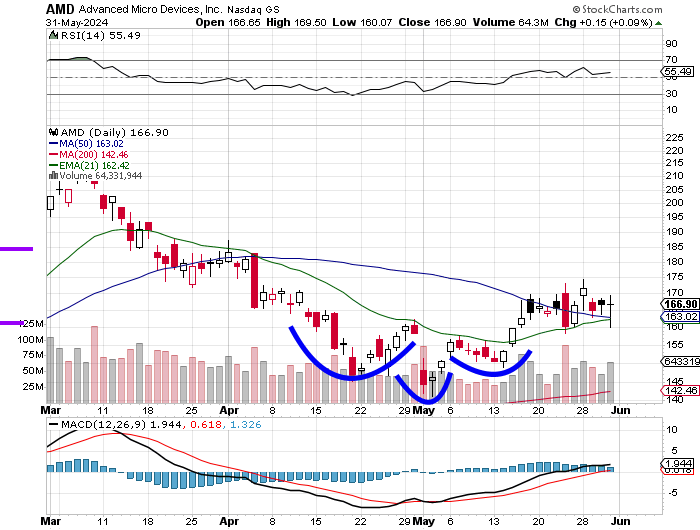
To this point, the inverse head and shoulders pattern that we have been talking about has worked like a charm. The stock has stabilized, with the 21-day exponential moving average (EMA) now attempting to retake the 50-day simple moving average (SMA) (the swing traders' or mini-golden cross). Should this happen, as the 50-day SMA (pivot) holds as support, I would see $196 as my target price for AMD.
Setting a $1,305 Target Price for NVDA
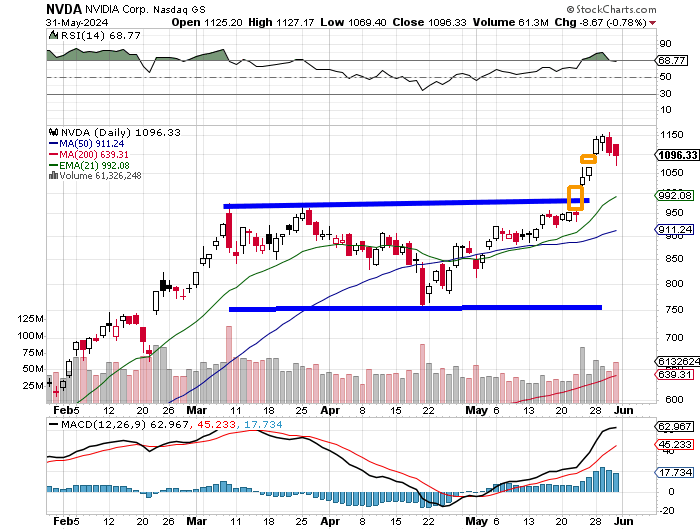
When I last wrote to you concerning NVDA, in the wake of the firm's most recent earnings release and the company moving towards a 10-for-1 stock split, I gave you a $1,125 target price with a last sale of $1.037. The stock apexed at $1,158 last week, which required some action. I really have to stop selling this stock, kids, if I am going to remain long.
NVDA still has two recently-left-behind, unfilled gaps that could be filled. That would require a tick at $1,030 to fill gap one and a tick of $960 or lower to fill gap two. Not that these gaps have to fill soon. They may wait until the split is over and done with. Shareholders of record as of June 6, 2024 (D-Day) will participate in the split. At that point or shortly thereafter, a sell-off would not surprise.
For the time being, until a recognizable pattern develops, which will likely be after the split, I will work with a pre-split target of $1,305 using last week's high as my pivot. I really do not want to sell anymore ahead of the split.
At the time of publication, Guilfoyle was long NVDA and AMD equity.