Is Micron a Trade After Miss on Guidance?
Let's see how to read this tech name after a beat on earnings, but not on its forecast.
You've reached your free article limit
You've read 0 of 1 free Pro articles.
The market had just been dealt a ferocious two-hour beat-down at the hands of Fed Chair Jerome Powell. Micron Technology MU gave up 4.33% during the regular session, fully participating in the market-wide Fed inspired smack-down. Then, after the closing bell, Micron released fiscal first-quarter financial results. Those results were good enough, but guidance clearly was not. The stock jumped out of the frying pan and into the fire. This is that story.
For the three-month period ended Nov. 28, Micron posted an adjusted earnings per share of $1.79 (unadjusted EPS: $1.67) on revenue of $8.709 billion. These top- and bottom-line numbers both beat Wall Street's expectations, while that sales print was good enough for year-over-year growth of 84.3%. Data-center driven revenue popped for growth of 40% sequentially and an incredible 400% year over year. The adjustment made was primarily for the purpose of stock-based compensation expense.
That Guidance...
For the current (fiscal second) quarter, Micron projects total revenue generation of 7.9 billion, give or take $200 million. The firm also sees adjusted EPS of $1.43, give or take a dime, and unadjusted EPS of $1.26, give or take a dime. The revenue guide is significantly below the almost $9 billion that Wall Street had in mind. The expectation for the adjusted EPS was also about a half-dollar below what had been consensus. Though that guidance still provides for revenue growth of roughly 37%, this outlook has to be seen as nearly disastrous.
The CEO
President and CEO Sanjay Mehrotra commented in the press release:
“Micron delivered a record quarter, and our data center revenue surpassed 50% of our total revenue for the first time. While consumer-oriented markets are weaker in the near term, we anticipate a return to growth in the second half of our fiscal year. We continue to gain share in the highest margin and strategically important parts of the market and are exceptionally well positioned to leverage AI-driven growth to create substantial value for all stakeholders.”
The CFO
CFO Mark Murphy commented on the fiscal second quarter guidance during the call... "NAND industry market conditions were weaker than we had expected and that consumer market, PC, smartphones demand is weaker, and inventory adjustments are occurring. Secondly, NAND data center SSD volumes moderated. And so, there’s this period of digestion, and that was, as we know, higher-margin NAND business. So those two things are the principal driver. Of course, with revenue down in the guide $800 million, we see some negative leverage effects on ongoing period costs."
Operations
We could go through the statement of operations as we usually do with earnings, but I'm not sure there would be a point to it. We know that the quarter reported was close to great. We also know that the guidance issued was severely disappointing. I will say that gross margin printed at 38.4% as reported or an adjusted 39.5%, up from 0.8% for the year-ago comparison, and that operating margin printed at 25% as reported or an adjusted 27.5% vs. the year-ago comp of -20.2%. The current quarter guidance included a vision for adjusted gross margin of 38.5%, give or take 100 basis points.
Fundamentals
For the period reported, Micron generated operating cash flow of $3.244 billion. After capital spending of $3.206 billion less proceeds from the company's property and government incentives, free cash flow printed at $112 million, up from a loss of $333 million for the year-ago comparison. The company did pay out $131 million in cash dividends to shareholders during the quarter.
Turning to the balance sheet, Micron has a cash position of $7.588 billion on the books along with inventories of $8.705 billion. This puts current assets at $24.493 billion. Current liabilities add up to $9.015 billion, including $533 million in shorter-term debt. That leaves the firm's current and quick ratios at 2.72 and 1.75. This is a rather strong current situation.
Total assets amount to $71.461 billion, including just a very small number for intangible assets. Total liabilities less equity comes to $24.664 billion, including long-term debt of $13.252 billion. This is not a perfect balance sheet overall, but it is a solid balance sheet. Certainly not a problem.
Wall Street
Not a lot of reaction to this report across the street, which is a little surprising. We did, however, hear from two of Wall Street's very best sell-side analysts. Both are rated at five stars by TipRanks, but that ranking does not do them justice. John Vinh of KeyBanc reiterated his "buy" rating without setting a target price, while Harsh Kumar of Piper Sandler reiterated his "buy" rating as well. Kumar, it should be noted, took his target price down to $120 from $150.
My Thoughts
OK, the NAND weakness is real. The company already knows that it is having a tough quarter. It does expect improvement through the second half of its fiscal year. It does make sense to sit this morning out and let any straggling downgrades or target price reductions find their way into the news cycle. I would have expected a good deal more in the way of response from the community of analysts.
Readers will see the closing pennant formation that preceded the advent of volatility that kicked in earlier this week. At first there was an upside pop. This caught almost everyone in the name off-guard when this lousy guidance hit the tape and those pesky keyword reading algorithms took their pound of flesh from this name.
Obviously, a beat-down like this probably requires the implementation of Jim Cramer's old "three-day rule" where interested parties wait three business days for the dust to settle. I have a different idea. See that double-bottom reversal from back in August through September? That area has provided stiff support in the past. Can it do so again? I think that if MU can hit that level, which is right around $85, I might just initiate a smaller-sized long position just to get some memory in my portfolio. Right now, I do not have any. It's at least food for thought.
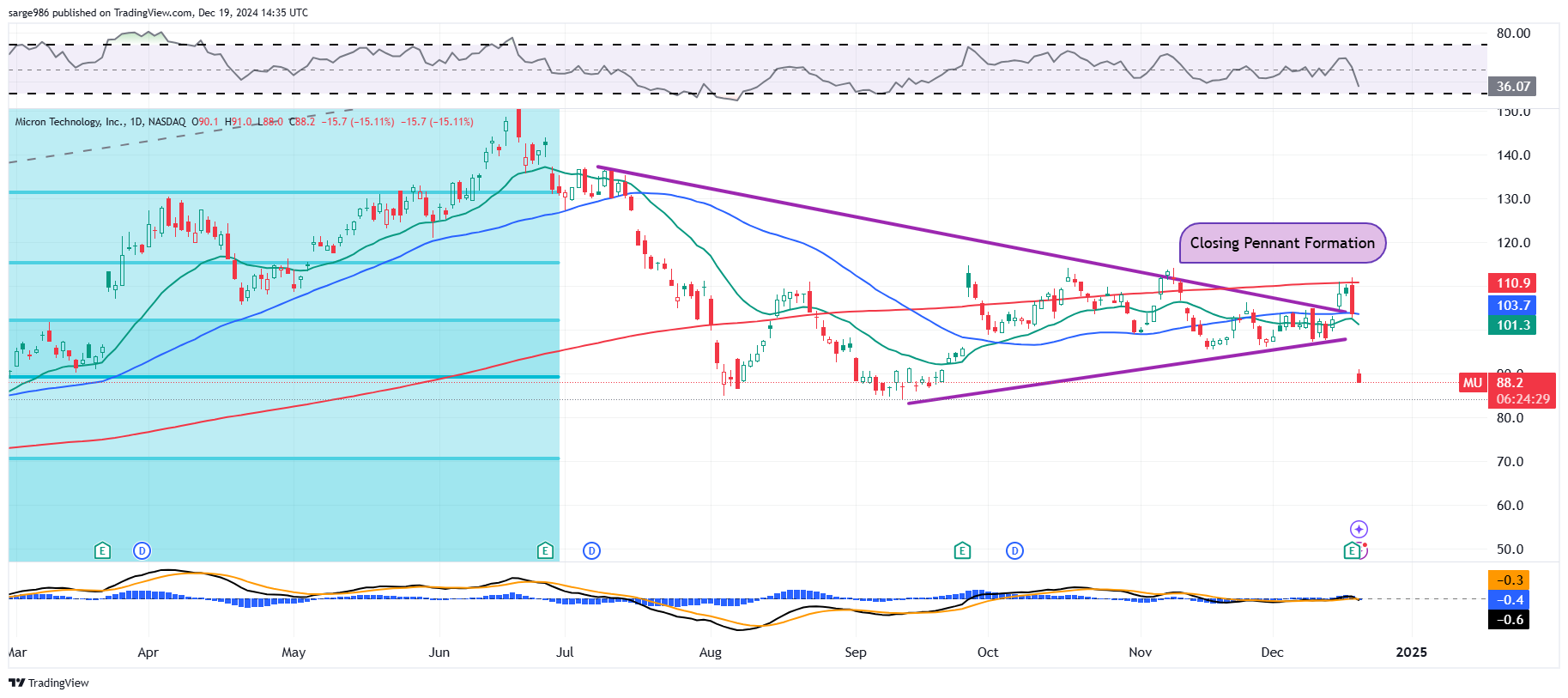
For now, the 200-day simple moving average is still well above the 50-day simple moving average, so we don't have to worry about a "death cross" right now. Just let the portfolio managers who have to reduce long-side risk today because the stock gave up its 50-day SMA get out of the way first.
At the time of publication, Guilfoyle had no position in any security mentioned.