No Comparison: Why I Prefer Visa's Competitor Following Antitrust Suit
After the Department of Justice hit the fintech giant with a major lawsuit, I would much rather buy into its competitor if I'd buy either.
You've reached your free article limit
You've read 0 of 1 free Pro articles.
On Tuesday, ahead of the fact, Bloomberg News reported that the U.S. Department of Justice was planning to file an antitrust lawsuit against credit card and fintech giant Visa V, alleging that the firm had illegally monopolized the debit card market in the U.S.
The Bloomberg report claimed that Visa would be accused of engaging in practices that prevent potential competitors from participating in this market. That would include entering into exclusive contracts that prevent entry by other fintechs and obstruct technology firms from accessing these markets on the behalf of other fintechs as well.
Then There Was Hard News
A short while later, there was a factual story to report. The DoJ, on Tuesday, filed a civil antitrust lawsuit against Visa accusing its payments network of maintaining a monopoly in the U.S. debit card market. The complaint, filed in the U.S. District Court for the Southern District of New York, claimed that Visa has been penalizing merchants and banks opting to do business with competitors in the processing of debit transactions. Visa does earn fees on each transaction processed. The complaint makes the claim that more than 60% of U.S. debit transactions run on Visa's payments network, which in turn, provides a rough $7 billion in revenue on its own.
In a statement, U.S. Attorney General Merrick Garland stated, "We allege that Visa has unlawfully amassed the power to extract fees that far exceed what it could charge in a competitive market. Merchants and banks pass along those costs to consumers, either by raising prices or reducing quality or service. As a result, Visa's unlawful conduct affects not just the price of one thing — but the price of nearly everything."
Wow. Tell me how you really feel. Honestly, folks, I never, ever use my debit cards for anything, except when at an ATM in need of some cash. I would much rather put one of my credit cards, which are limited, at risk of being compromised by the forces of evil, than a debit card linked to one of my savings accounts. No thank you.
The Stock
Visa sold off 5.49% on this news on Tuesday and is trading lower on Wednesday morning. Some investors may have gotten wind that something was coming down the pike, as Visa is now trading 7.9% below where the stock peaked a week ago, on Tuesday, September 17. For comparison's sake, the S&P 500 is up 1.1% since its September 17 high and key competitor Mastercard MA is down 2.9% since its high of that day.
Does This Go Away?
How can I make comments on legal matters where I have no expertise? I will say this: in 2020, the same DoJ filed suit against Visa's attempt to acquire Japanese fintech startup Plaid. That acquisition eventually fell apart and, to this day, Plaid remains privately held.
On the other hand, in response to the DoJ"s lawsuit, Morgan Stanley analyst James Faucette, who is rated at five stars (out of five) by TipRanks, reiterated his "overweight" rating (buy-equivalent) on Visa along with his $322 target price. Faucette believes that the suit has led to this decrease in Visa’s stock price, and presents an attractive point of entry for investors.
Additionally, Faucette seems to see the DoJ’s allegations as unlikely to disrupt Visa’s dominant position in terms of market share anytime soon. Faucette seems to feel that Visa already has an established network, and competitors would face difficulty in entering this market and scaling to a degree where Visa's place of industry leadership is threatened. All in all, Faucette appears to feel that Visa will be able to navigate this legal battle without suffering any serious diminishment in its ability to compete.
Analyst Timothy Chiodo, of UBS, who is rated at four stars by TipRanks, also on Tuesday reiterated his "buy" rating on Visa as well as his $320 target price.
My Thoughts
Visa is expected to report on October 24, 2024 — still a month away. We definitely will hear something from the company at that time. Wall Street is looking for an EPS of $2.58 on revenue of $9.48 billion. That would compare to EPS of $2.13 on revenue of $7.85 billion for the year-ago period. This would equate to earnings growth of 21% on revenue growth of 21%, which would be pretty darned healthy.
Operating and free cash flows have remained very strong, and the balance sheet is in better-than-decent shape as well. The stock trades at 27-times forward-looking earnings and pays a dividend that yields 0.76%. Competitor Mastercard trades at a more expensive 34-times forward-looking earnings, while yielding 0.54%.
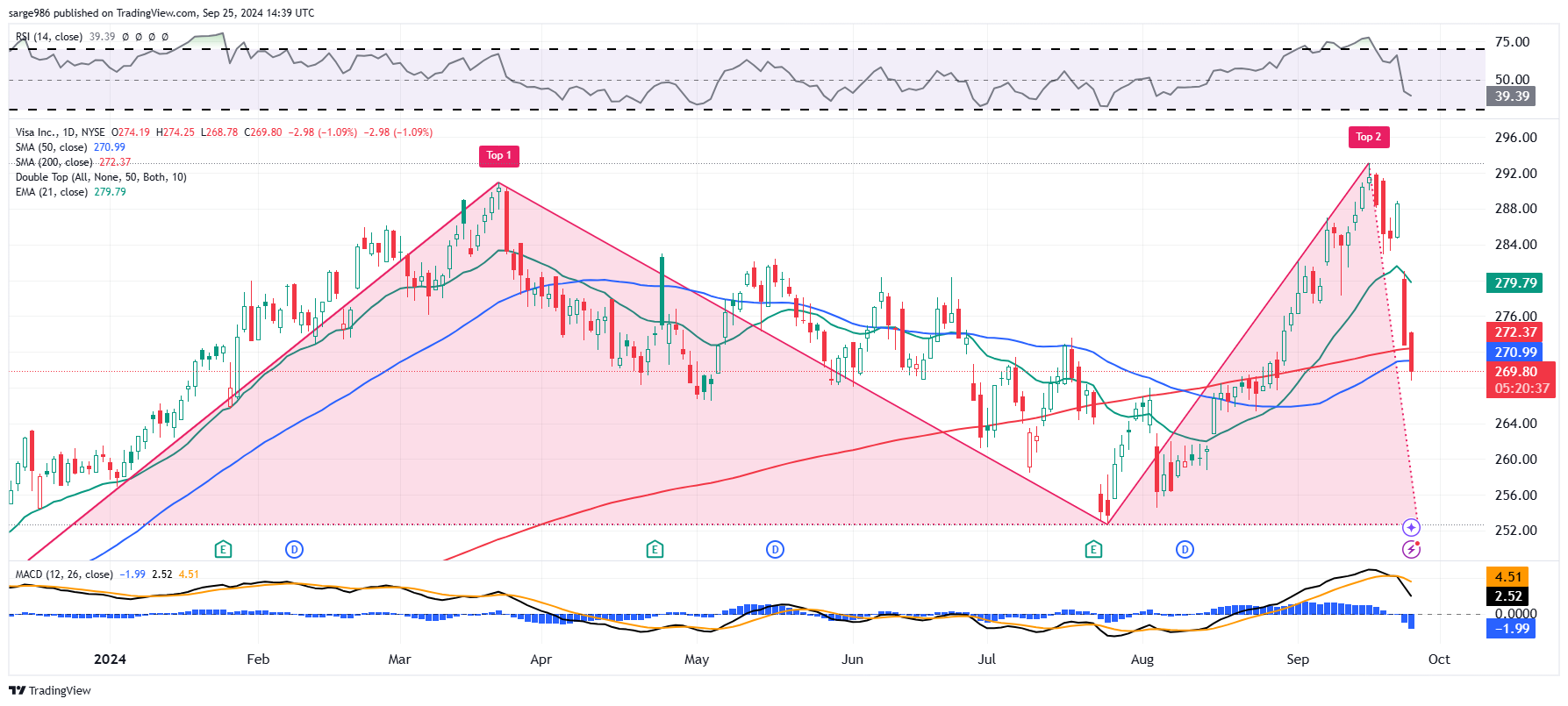
While this dip may very well serve to provide an improved point of entry for buyers as Faucette suggests, I see problems in the chart above. One: the most obvious negative is the double-top pattern of reversal that seems to kick in on September 17. The downside pivot of $252 taken from that pattern has not been reached just yet.
Perhaps there are other things to worry about. I am sure you saw the conference board's survey for September consumer confidence on Tuesday. The U.S. consumer has been damaged. That could mean that an increase in credit card delinquencies is on the way, or at a minimum, at least a sharp reduction in discretionary spending.
Back to the chart, we see a rapidly-weakening reading for relative strength and a daily MACD that has gone from a bullish posture to a decisively-bearish posture in just a few days. On top of that, this morning, the stock surrendered both its 50-day and 200-day SMAs. A failure to retake these levels in short order will force a number of portfolio managers to reduce exposure.
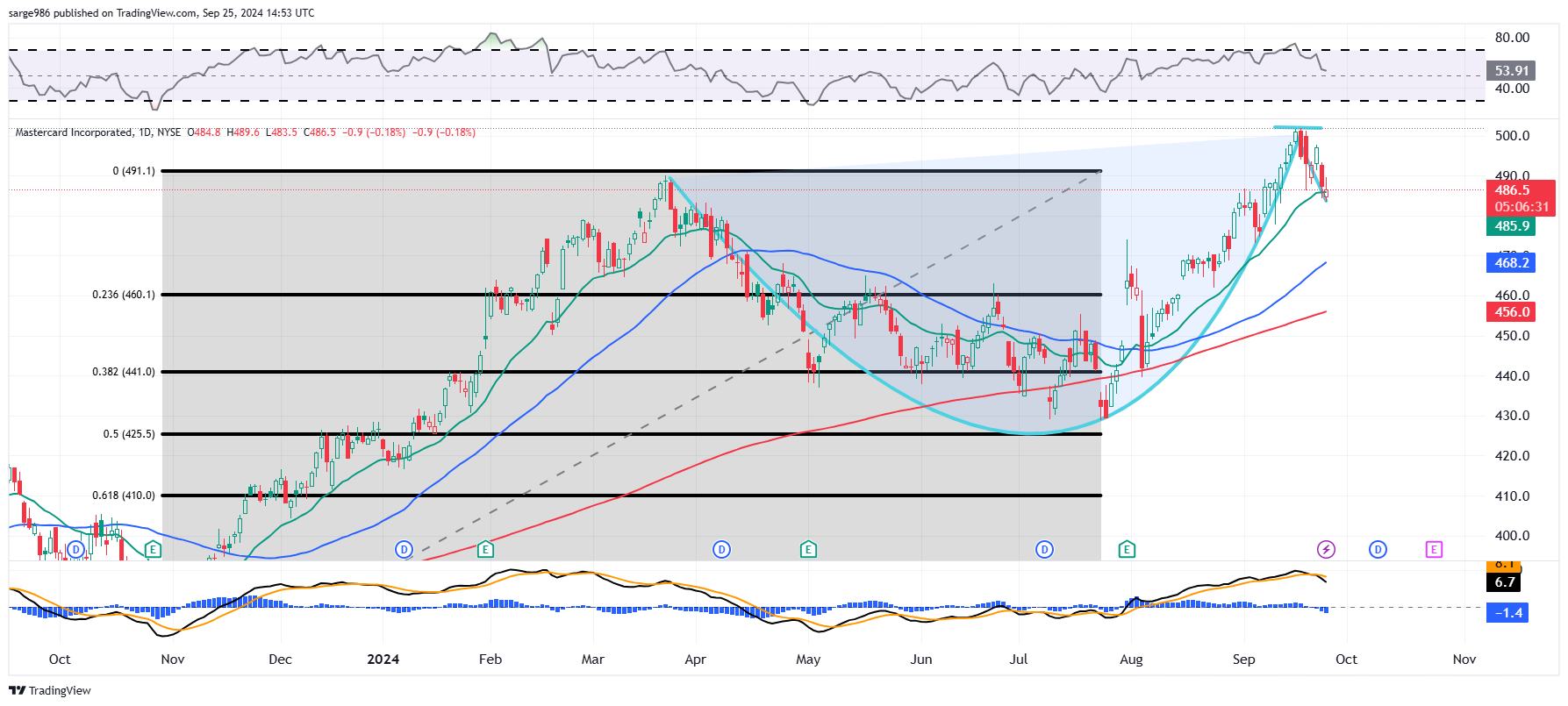
Glancing over at the chart of Mastercard, we see that what has occurred looks more like a cup-with-handle pattern (with a $502 pivot) than a double top. This is generally thought of as bullish, not bearish. Additionally, there has been no loss of any key moving averages, relative strength is falling, but is still better than neutral, and the daily MACD has turned for the worse, but still has two components in positive territory.
In my opinion, there is no comparison. Mastercard is in much better shape technically than Visa. If I had to buy one, it would be MA with a target price up above $550. That said, I don't have to buy either, and U.S. consumers may be at their tipping point.
At the time of publication, Guilfoyle had no positions in any securities mentioned.