Has Boeing Finally Hit Bottom?
After a major agreement between beleaguered aerospace giant Boeing and Spirit, there could be an opportunity for investors to profit.
You've reached your free article limit
You've read 0 of 1 free Pro articles.
There was some news for aerospace giant Boeing BA — was there ever.
Is this it? Is this what had to happen for this defense-contracting, civilian-jetliner-manufacturing, space-exploring industrial behemoth to finally bottom? Is the freak show over?
This we just do not know; this we cannot know just yet. We are talking about a company that, since the tragic and fatal crashes of two 737 Max 8 aircraft in late 2018 and early 2019, has consistently failed to get its collective and corporate head out of its proverbial armpit.
From spaceships that just can't get off of the ground, and then when they do, just can't come home in a timely manner, to doors falling off of aircraft while in flight, the string of embarrassing occurrences has lasted as long or longer than the tenures of its most recent CEOs. Dennis Muilenburg was fired as chief executive in the wake of those two fatal crashes after taking the reins in 2015. Muilenburg was succeeded by Dave Calhoun as CEO after he had already served as board chair at the firm. Calhoun has served as president and CEO up until the present day, while downgrading his board position to non-executive chair. Calhoun announced in March 2024 that he will step down from his leadership role at the end of the year after a string of embarrassing and potentially serious mishaps continued to plague Boeing during his tenure.
News
News broke overnight that Boeing and Spirit AeroSystems SPR had agreed to an all-stock deal where Boeing re-acquired Spirit for $37.25 per share. SPR closed at $32.87 on Friday afternoon, making this deal price a 13% premium to the last sale. Readers will likely remember that Boeing and Spirit were both involved in a mid-air blowout of a door panel on an Alaska Air ALK 737-Max 9 aircraft in January 2024. The National Transportation Safety Board is still investigating that incident with a hearing set for early August 2024. Those with sharp memories may remember that Boeing had spun Spirit off in 2005 as a cost-cutting measure, technically outsourcing the manufacture of fuselages and other aircraft parts.
This deal values Spirit at $4.7 billion. Once including all of Spirit's debt, the value of the transaction is a rough $8.3 billion. Additionally, Boeing's European competitor Airbus EADSY has entered into a binding term sheet where Airbus winds up acquiring some of Spirit's assets that support Airbus programs, upon the closing of the Boeing re-acquisition.
More Trouble? Or Trouble Over?
Over the weekend, ahead of that Spirit news, headlines crossed that Boeing was in talks meant to resolve "potential" charges related to those 2018 and 2019 fatal crashes of the 737 Max aircraft. A 2021 deferred-prosecution agreement between Boeing and the Department of Justice was said to be at the center of those discussions. Under a three-year deal at that time, Boeing was able to avoid criminal charges over suspected conspiracy to commit fraud connected to those crashes. Boeing agreed to pay a $2.5 billion fine at that time while also improving the firm's internal control, while submitting regular updates.
By Sunday, it was clear that the DOJ will charge Boeing with criminal fraud after it had concluded that Boeing had failed to meet a requirement to implement an effective compliance program to prevent and detect violations of U.S. laws covering fraud. Boeing will have until the end of this week to decide whether or not to plead guilty or risk going to trial. The Department is looking for an additional fine of $487.2 million, of which Boeing could pay just half, while also having to hire a corporate monitor for the next three years. The deal would not acknowledge that Boeing's crime or crimes killed 346 people.
What's Boeing's motivation for avoiding a trial? The families of the 346 individuals who were on those planes are seeking nearly $25 billion with a possibility of suspending some of that if Boeing were to devote those funds to an independent corporate monitor and making quantifiable improvements to the firm's safety programs.
Earnings and Fundamentals
Boeing is set to report the firm's second quarter in about three weeks. Wall Street is looking for an adjusted EPS of about $-1.10 on revenue of roughly $17.95 billion. This would be an 11th-consecutive quarter of negative net income for Boeing on revenue "growth" of about -9%. This would be a second straight quarter of contracting year over year sales.
As of the March quarter, Boeing had $7.529 billion in cash on the books along with $83.471 billion in inventories. That brings current assets to $106.532 billion. Current liabilities amount to $93.258 billion that includes unearned revenue of $58.972 billion. Remember, unearned revenue represents goods and services owed and is not a truly financial obligation as long as what's owed is delivered.
This puts the firm's current and quick ratios at a passable 1.14 and a paltry-looking 0.25, respectively. Once adjusted for unearned revenues, those ratios improve sharply to 3.1 and 0.67, respectively. Not spectacular, but also not alarming.
Total assets amount to $134.484 billion, including just $10.123 billion in intangibles, which is fine. Total liabilities less equity comes to $151.5 billion, including $46.626 billion in longer-term debt. That's a load, but it should not prevent Boeing from performing if the firm can just stop screwing up in the real world.
Free cash flow is positive over the past 12 months. The firm has obviously not paid a dividend to shareholders for quite some time nor has it repurchased common stock for its own Treasury for years now. It did pay down more than $5B in debt during fiscal 2023, which is disciplined cash flow management.
My Thoughts
Boeing closed at $182.01 on Friday. I see that the shares have opened up about 3% on the hopes that a good chunk of this more than five-year corporate nightmare might be over. The shares peaked at $267.54 in late 2023 and at $446.01 in March 2019. That's just a hit of more than 59% over five-plus years while the rest of the market roared. The stock found support close to $120 on multiple occurrences in 2022.
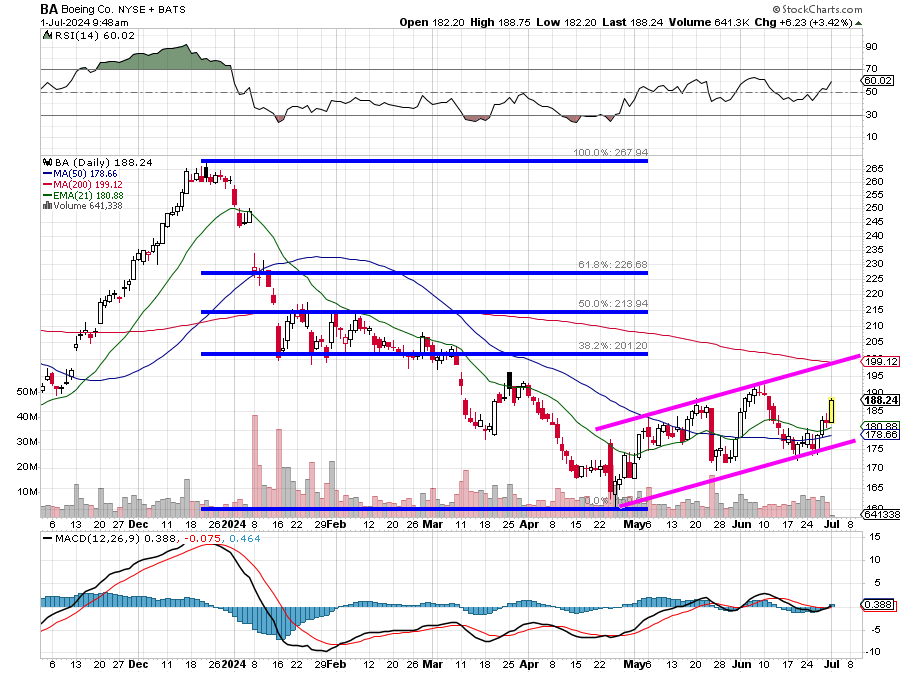
The stock has been in a gradually-rising ascending price channel since late April 2024 after suffering a terrific sell-off from December 2023. The shares have retaken their 50-day SMA after getting help from the swing crowd at the 210-day EMA. Where is resistance? The 200-day SMA is lined up to run almost congruent with the 31.8% Fibonacci retracement level of that December 2023 to April 2024 sell-off. It's there that one getting long the equity might seek to sell covered calls in what is referred to as a "buy-write."
A trader/investor interested in getting long Boeing stock here could (in minimal lots):
- Buy 100 shares of BA at or close to $188.75.
- Sell (write) one July 26, 2024 (post-earnings) $200 call for about $2.80.
Net basis: $185.95
Max profit by expiration: +7.6%.
Idea: Replace the July 26, 2024 $200 call with an August 16, 2024 $200 call and the premium received moves up to a rough $4,45, dropping net basis to $184.30 and increases the max profit by expiration to 8.5%.
Note: An earlier version of this article incorrectly stated the firm had repurchased shares in the past year.
At the time of publication, Guilfoyle had no positions in any securities mentioned.