FedEx Delivered Disappointment. Could We Repackage That Into a Trade?
Let's unpack these quarterly results and see how to play this stock now.
You've reached your free article limit
You've read 0 of 1 free Pro articles.
Can disappointment in FedEx FDX breed opportunity? That's a good question. Let's find out.
FedEx on Thursday night revealed fiscal first-quarter financial results showing adjusted earnings per share of $3.60 (unadjusted EPS of $3.21) on revenue of $21.579 billion. These top- and bottom-line results both fell short of Wall Street's consensus view, the bottom-line print by well more than a dollar per share, which is quite disastrous.
The revenue print reflected a year-over-year contraction of 0.5%. After actually growing revenues on a year-over-year basis, the company returned to its losing ways. This was the seventh quarter in the past eight to show a year-over-year contraction. The adjustment of $0.39 per share was made for business optimization costs.
FedEx completed a $1 billion accelerated share repurchase transaction during the quarter. This delivered a rough 3.4 million shares, resulting in a positive earnings per share boost of $0.03 per diluted share. The company expects to repurchase an additional $1.5 billion worth of common stock during fiscal year 2025 to bring the buyback up to $2.5 billion. As of the end of the reported period, FedEx left $4.1 billion in its current repurchase authorization.
Operations: Operating Income Shrinks
As revenue contracted 0.5% to $21.579 billion, operating expenses increased 1.5% to $20.499 billion. This left unadjusted operating income of $1.08 billion, which was down a whopping 27.3% from the year-ago comparison as unadjusted operating margin slipped from 6.8% to 5.0%. Once adjusted operating income dropped 23.9% to $1.21 billion, as operating margin dropped from 7.3% to 5.6%. No way to sugarcoat that.
After accounting for interest, taxes and other income / expenses, unadjusted net income hit the tape at $794 million (-26.3%), which works out to $3.21 per fully diluted share. Once adjusted, net income fell 23.3% to $892 million, which works out to $3.60 per diluted share.
The Merging of Ground and Services
On June 1, the start of the fiscal quarter reported, FedEx Ground and FedEx Services were merged into one entity now known as Federal Express. FedEx Freight continues to provide "less than truckload" freight transportation services as a separate subsidiary. The new Federal Express and FedEx Freight now represent the company's major service lines. FedEx Custom Critical is now included in the FedEx Freight segment.
For Guidance ... Look Down
For the full fiscal year, FedEx now expects low-single digit percentage revenue growth, down from previous guidance of low to mid-single digit percentage growth. Full year earnings per share before mark-to-market retirement plans accounting adjustments are now seen at $17.90 to $18.90, down from previously issued guidance of $18.25 to $20.25. Once excluding business optimization costs, full year EPS is seen at $20.00 to $21.00, down from the previous outlook of $20.00 to $22.00. Wall Street had been in the $20.90s on this number, so this is one big reason of several reasons for the stock's overnight beat-down.
FedEx did reaffirm its forecasts of permanent cost cuts from the DRIVE transformation program of $2.2 billion and capital spending of $5.2 billion with a priority on investments in network optimization and improved efficiency.
Fundamentals: Hmmm...
For the quarter reported, FedEx generated operating cash flow of $1.187 billion. Out of that number came capital spending of $767 million, which left free cash flow of $420 million, down from $940 million for the same period a year ago. Out of that $420 million, FedEx paid out $339 million in cash dividends to shareholders and repurchased $1 billion worth of common stock. Things that make you go hmmm.
Turning to the balance sheet, FedEx runs with a cash position of $5.943 billion and spare parts, supplies and fuel (inventories) on hand of $611 million. Receivables made up the lion's share of current assets that add up to $18.094 billion. Current liabilities total $14.111 billion including just $622 million in short-term debt. This puts the current ratio at an acceptable 1.28 and its quick ratio at a just as acceptable 1.24.
Total assets amount to $86.711 billion, which include just $6.512 billion in goodwill and no other intangible assets. Total liabilities less equity comes to $59.535 billion including $19.664 billion in long-term debt. Is this a great balance sheet? Not even close. Is it awful? No, this balance sheet is not awful. The size of the debt-load could be an issue, but management appears to understand this. Not only is cost-cutting a priority, but FedEx has actually been paying down debt.
Wall Street's Take
Since these earnings were released last night, I have come across 15 highly rated sell-side analysts who have opined on FedEx. After allowing for changes, across the 15, there are eleven "buy" or buy-equivalent ratings and four "hold" or hold-equivalent ratings. One buy rating and one hold rating did not come with a target price, leaving us 13 target prices to work with.
Across these 13 analysts, the average target price is $318.92 with a high of $350 twice (Brandon Oglenski of Barclays and Brian Ossenbeck of JP Morgan) and a low of $300 three times (Christian Wetherbee of Wells Fargo, Parash Jain of HSBC and Fadi Chamoun of BMO Capital). The average buy target is $324.60, while the average hold target is obviously an even $300.
My Take: The CEO, the Chart, the Chance
The business is in contraction and has been for two years. The still semi-newish CEO Raj Subramaniam, who started on June 2022, is serious about cleaning up what had become an inefficient, costly behemoth late in Fred Smith's tenure. I mean not to disparage Fred Smith. He founded the company and led it until passing the baton to Subramaniam. Smith was a combat Marine and was awarded the silver star for his actions in Vietnam. He just ran FedEx a little too long.
The cost cutting campaign is Subramaniam's and he is serious about that. On that track, during the call, Subramaniam said, "As we shared last quarter, we're conducting an assessment of the role of FedEx Freight in our portfolio structure. The assessment is well underway and on track to be completed by the end of the calendar year, all while we continue to deliver safe and reliable service to our customers."
What we have to decide is this ... Is FedEx way past its prime as a company, and with an economy about to contract, will the transports, especially delivery services suffer as consumers and business rein in expenses? Or... is FedEx akin to a "coiled spring" (Jim Cramer's words) with costs coming down and interest rates quickly becoming far more accommodative?
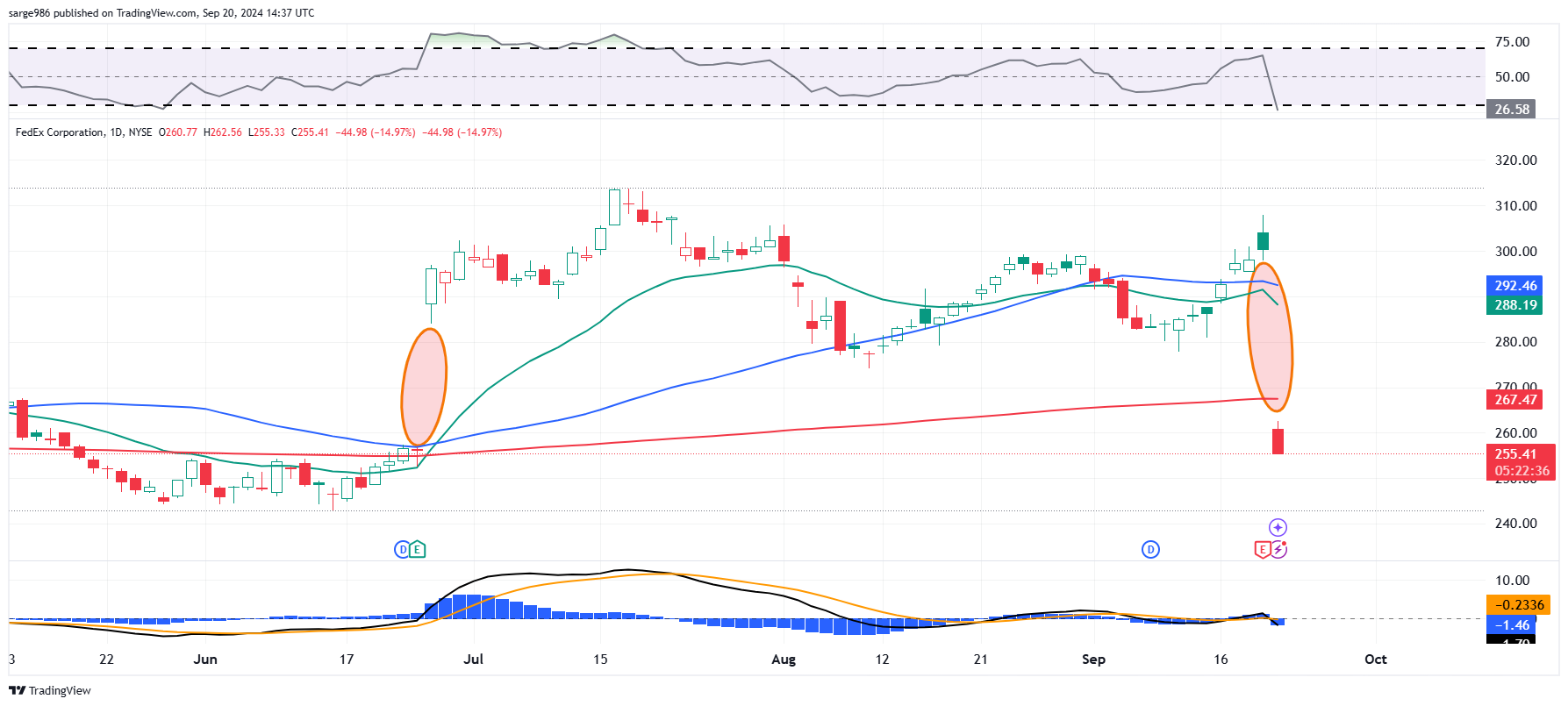
You've all heard of an "island topping" but this is ridiculous. What you have is an island exactly three months long, created by a gap up in response to the optimistic quarter reported in June and now ended buy the gap down response to last night's pessimistic earnings release. I have long been more apt to invest in United Parcel Service UPS than in FedEx when investing in this space, but I am very disappointed in the job Carol Tome is doing over there.
So, is FDX inevitable now that the air has been let out of the tires? FDX needed to trade at $256 or lower today to fill that June gap. Mission accomplished there. The stock trades at 14-times forward looking earnings vs. more than 20-times for the S&P 500 and almost 18 times for UPS. UPS yields better in terms of dividends paid, but FDX is no slouch. That said, if the company wants to keep buying back shares aggressively, free cash flow is going to have to recover, but FDX pays shareholders $5.52 annually for a yield of 1.84%.
I think it's time to dip my toe in the water with this one, only if I can get it at $255 or lower after this article becomes public information. I may even wait until Monday, after the triple-witching hour. That way, I can see just how damaging it was to lose both the 50-day simple moving average and 200-day simple moving average in the same day, even though the two lines are $25 apart. No target price yet, as I don't know where my net basis will be. I will tell you this... the 20-day line will almost certainly be the pivot.
At the time of publication, Guilfoyle had no position in any security mentioned.