Commodities Plays Are Ready to Shine: Here's How to Profit
As gold breaks out, three investment experts discuss an undervalued gold miner, a deep sea and onshore oil services name, and other ways investors can potentially benefit.
You've reached your free article limit
You've read 0 of 1 free Pro articles.
In this market, all that glitters is gold! Not to mention crude oil, copper, and other commodities.
What’s driving the powerful run in resources, including a breakout to all-time highs for bullion? How will central bank and currency moves impact these markets? Which companies stand to profit the most?
Find out from these MoneyShow expert contributors.
Bruce Kaser Cabot Value Investor
An Undervalued Gold Mining Giant That Should Prosper in a Higher-Inflation Era
Barrick Gold Corp. (GOLD) is one of the world’s largest and highest-quality gold mining companies. About 50% of its production comes from North America, with the balance from Africa/Middle East (32%) and Latin America/Asia Pacific (18%). Barrick will continue to improve its operating performance (led by its highly capable CEO), opines Bruce Kaser, editor of Cabot Value Investor.
It should also generate strong free cash flow at current gold prices – and return much of that free cash flow to investors while making minor but sensible acquisitions. Also, Barrick shares offer optionality. If today’s unusual economic and fiscal conditions drive up the price of gold, Barrick’s shares will rise with it.
Given their attractive valuation, the shares don’t need this second (optionality) point to work. It just offers extra upside. Barrick’s balance sheet has nearly zero debt net of cash. Major risks include the possibility of a decline in gold prices, production problems at its mines, a major acquisition, and/or an expropriation of one or more of its mines.
Gold is holding its $2,000+ pricing despite what is increasingly becoming a higher-for-longer US interest rate environment. Gold’s new, higher range may be driven by enduring domestic and international government fiscal deficits as well as from enduring inflation. Reasonably reliable official data also indicates that central banks, particularly China’s, are stepping up their gold purchases.
Additionally, there may be a correlation trade among hedge funds that links gold and Bitcoin. Bitcoin is surging as demand has been remarkably strong for newly approved Bitcoin ETFs. Most previous institutional holdouts, including BlackRock BLK, have become supporters of Bitcoin. The correlation trade would carry gold upward with Bitcoin prices.
Our view on gold prices is based on what we believe is a structural upshift in inflation. These changes include war, government spending, crime, oil prices, and past-the-peak fading of the benefits of global free trade, in addition to a tight labor market. There is a reasonably good chance that inflation will remain above a 3% pace indefinitely. This would imply permanent 4%-6% interest rates.
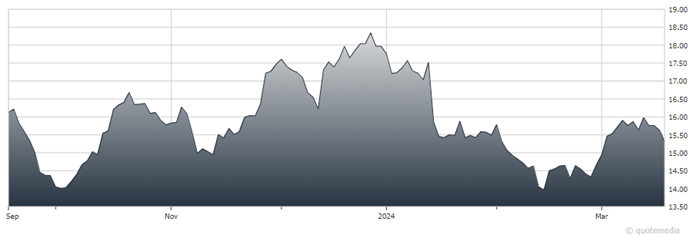
Barrick shares have roughly 72% upside to our $27 price target. The shares remain depressed despite gold prices trading near $2,200, indicating that investors have no confidence in gold prices and little confidence in the company’s ability to generate higher cash flow.
Recommended Action: Buy GOLD.
Tim Melvin Takeover Letter
A Deep Sea and Onshore Oil Services Firm That Could Attract a Buyer
I have adopted many of the principles of one of the greatest figures to emerge from the history of Wall Street, Bernard Baruch, in the approach I use here at the Takeover Letter. The most significant adaptation is a stoic, numbers-based approach that relies heavily on the math of credit analysis and corporate valuation. One name I like is Oil States International Inc. OIS, notes Tim Melvin, editor of Takeover Letter.
I have no interest in short-term uniform speculation and only care about short-term price movements when they give us a chance to buy quality at a bargain price. I go to great lengths to use numbers to remove bias and emotion from the analysis and investing process. Like Baruch, I use the same math and reason when evaluating companies that potential purchasers use, such as larger competitors and private equity firms.
Regarding OIS, hopefully the addition of another energy stock is not a big surprise. We continue to see robust mergers and acquisitions activity across the energy patch, and this should be another big year for oil and gas takeover activity.
OIS is an oil services company exposed to onshore fracking and drilling operations, offshore drilling, and alternative energy. The continued global population growth will drive higher energy demand, leading to a long runway for the demand growth for Oil States International’s services.
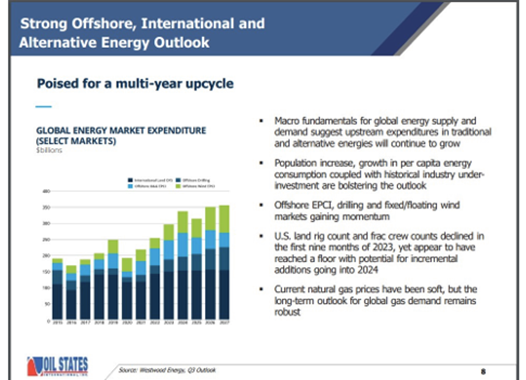
Oil States International is active in all the major US shale fields for oil and gas. The company is also developing a deep-sea mineral mining business that could lead to quantum growth. The global demand for rare earth and critical metals to meet the demand for renewable energy and electric vehicles continues to increase.
Materials found on the ocean floor include high-demand resources, including cobalt, manganese, nickel, rare earth elements, titanium, copper, lead, lithium, platinum, and zinc. This company’s strong presence in both on and offshore drilling markets, along with the potential of the deep sea mineral business, will likely attract potential buyers as the energy industry continues to consolidate.
Finally, the business’s financials are excellent. It uses its cash flow to reward shareholders, reduce debt, and grow the company.
Recommended Action: Buy OIS.
Eoin Treacy Fuller Treacy Money
Oil, Other Commodities Moving Higher as Volatility Trades Go Awry; Here's How to Capitalize
Bloomberg recently reported that commodities are getting sucked into a global short volatility trade. But what does that mean – and how can you capitalize? Here are my thoughts, explains Eoin Treacy, editor of Fuller Treacy Money.
This is a section of the Bloomberg article:
“Low macro volatility is definitely contributing to lower implied volatility in oil, but the fact that prices have been rangebound over the past few weeks is likely the strongest reason for it,” said Anurag Maheshwari, head of oil options at Optiver. “Systematic volatility selling strategies have also dominated the flow.”
One of the biggest lessons from my chart seminars is that inside a range, expectations for future potential decline. Ranges are boring relative to the trending phase of a trend. That means volatility strategies stop working and traders have to adapt.
Selling volatility is a symptom of having a short-term time horizon. You would only do that because your expectation for future volatility has been influenced by the absence of volatility in the short term.
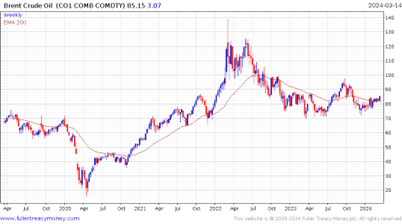
This pattern of behavior contributes to the tendency of inert periods of trading leading to explosive breakouts. As short volatility positions are unwound, they fuel the breakout by creating new demand. That’s exactly what recently happened in copper and brent crude oil.
Natural gas also rebounded to post a higher reaction low. That suggests support building is underway. Natural rubber is one of the few quoted in Yen, but it too is breaking out of a decade-long base formation.
The CRB Index peaked in 2022 and has been in a range for much of the last year. It has unwound the overextension relative to the 1,000-day MA and is now firming. A clear downward dynamic will be required to check the potential for a further recovery.
The clear conclusion from the action I mentioned is that we should be prepared for the possibility of commodity price inflation becoming a headline-grabbing story over the next couple of months.