Coffee Prices Are High Now... Wait Till You See Where They're Headed
On occasion, there are unusual opportunities worth being aware of and maybe even dabbling in. We think coffee futures will soon present such a scenario.
You've reached your free article limit
You've read 0 of 1 free Pro articles.
We don’t highlight the soft markets often for many reasons, including the fact that they trade on a different exchange than most products (ICE). In our view, this futures exchange is unfriendly to retail traders (who are our bread and butter).
The ICE exchange charges wildly high fees for live price data, which leaves the majority of retail traders utilizing 10 to 15-minute delayed data to make trading decisions; in the 1990s, this was fine, but in the 2020s, it’s subpar. Further, they cater to overseas clientele, which means the trading hours are inconvenient at best but prohibitive at worst. For instance, sugar traders on the East Coast need to get up at 3:30 a.m. to catch the open, but if you are on the Best/West Coast, like me, the market begins trading at 12:30 am.
Lastly, these markets close early relative to most U.S.-traded futures contracts and generally suffer from lower liquidity. In a nutshell, they are not the ideal products for most speculators. Nevertheless, on occasion, there are unusual opportunities that are worth being aware of and maybe even dabbling in. We think coffee futures will soon present such a scenario.
Agricultural commodities are generally renewable annually. This allows markets to recover from a bumper crop or low-yielding harvest within a year or two. However, coffee plants take about two years to produce beans and about five years to produce marketable beans. Thus, supply issues often linger a little longer. Yet, they never linger forever.
The all-time high is about 337.00 in the late 70s and hasn’t returned since. It is no wonder coffee producers and commercial users have a tough time in the business; coffee prices have been at 260.00 or above six times in the last 50 years but have never stayed there. Subsequent declines have made their way to 100.00 or below each and every time. With the early 2000s seeing about 50.00!
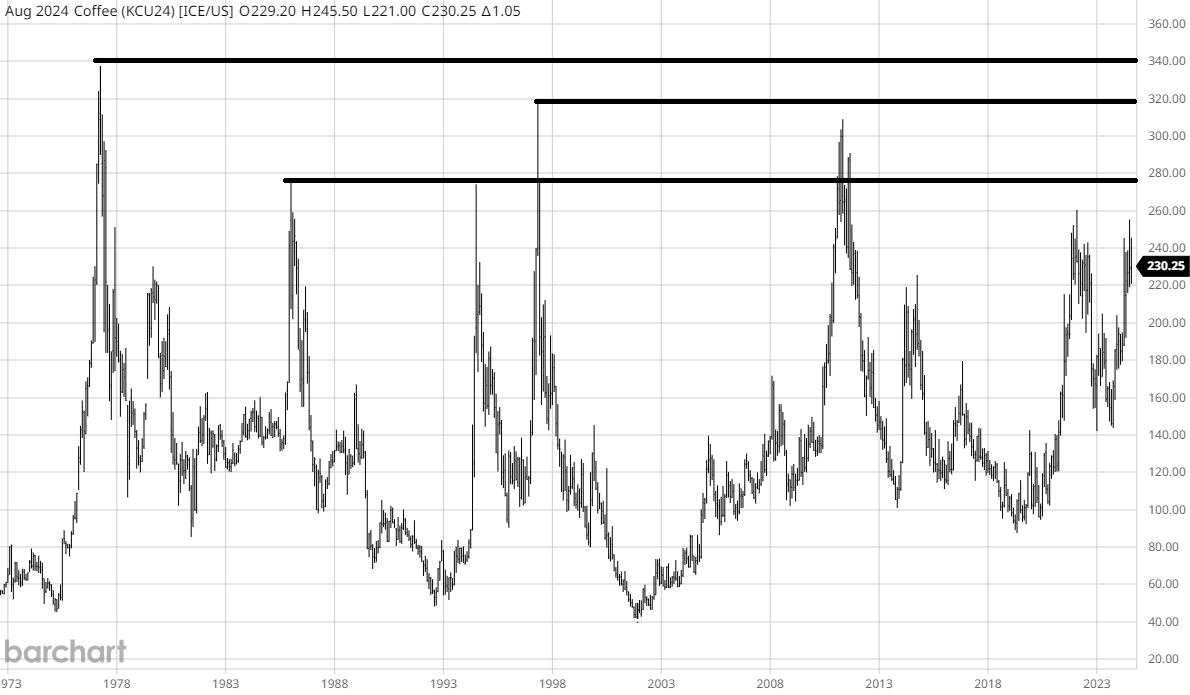
Coffee demand is often considered inelastic because of its popularity, but even so, demand is not guaranteed. As the 50-year chart above proves, high coffee prices do, in fact, cure high prices.
Nobody wants to admit it, but coffee is a want, not a need. In other words, it is a luxury. At some point, consumers look for alternatives (matcha/tea, etc.). On the other hand, like other agricultural commodities, coffee trades sideways overall because farmers get better and better at growing as time goes on. Improvements in technology, science, and equipment prevent prices from holding unruly rallies.
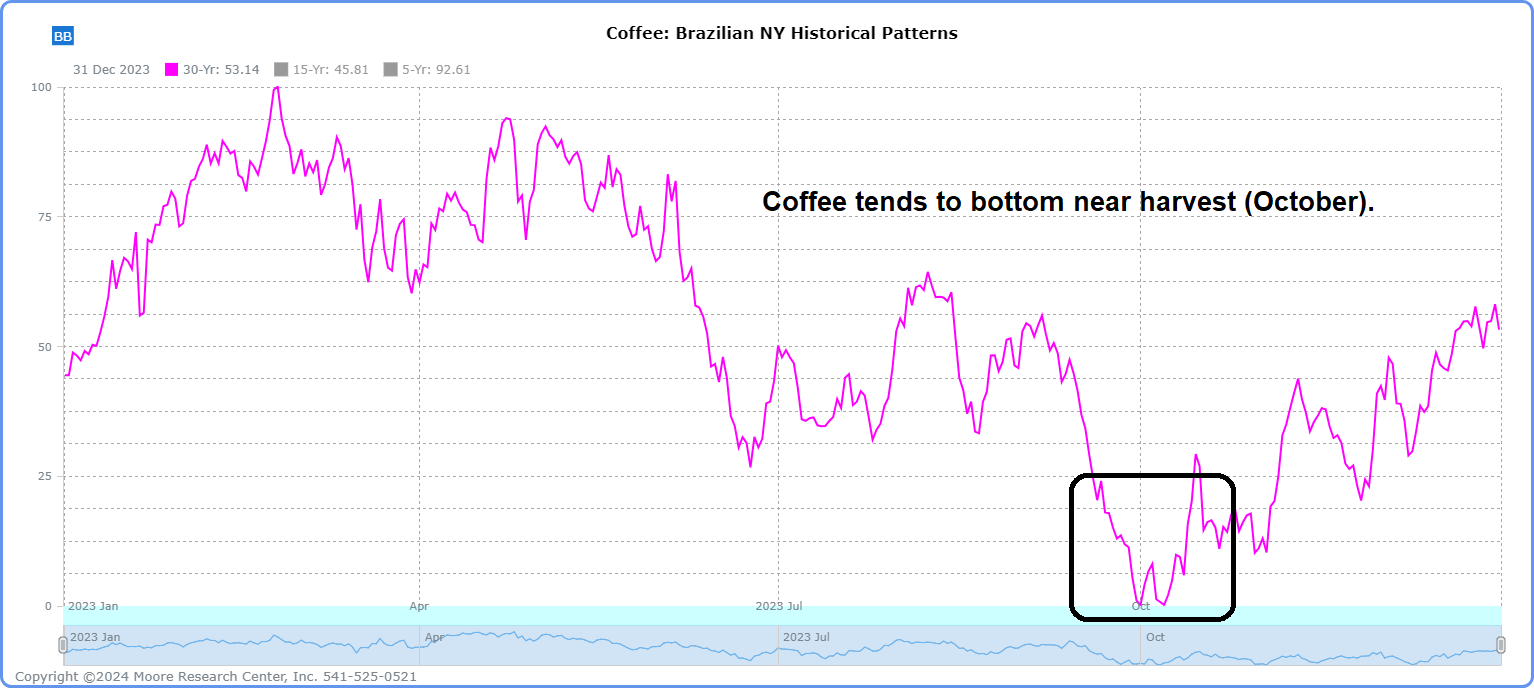
Seasonality is bearish until late October or early November when most growers are completing their harvest. This is when the supply is often most plentiful for the year, and prices usually reflect that.
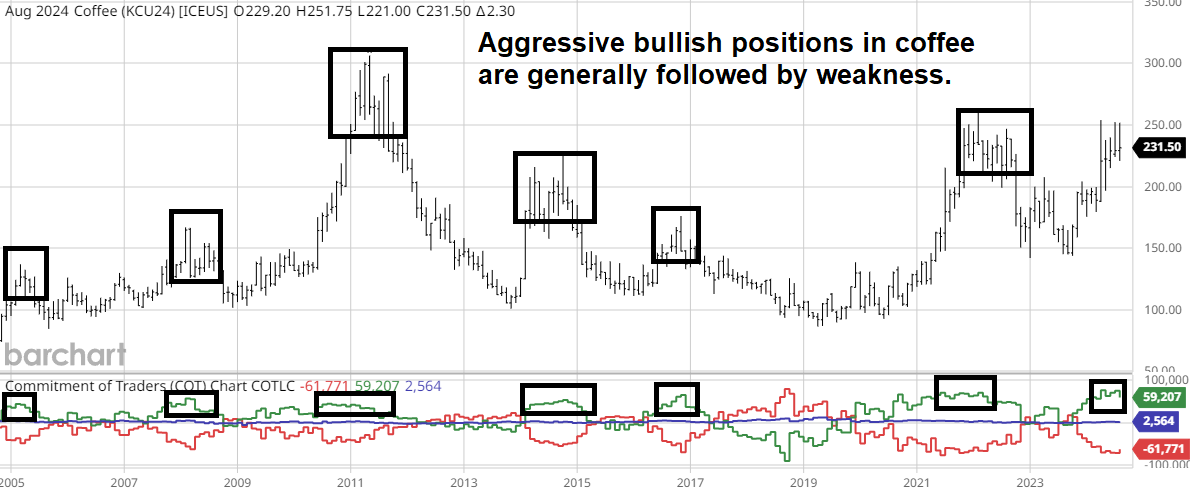
According to the COT Report, large speculators are holding one of the largest net long positions in history. Previously, these types of aggressive bullish positions are followed by weakness. Thus, an overall bullish narrative might not be enough to prevent a large pullback before the rally resumes (assuming it does).
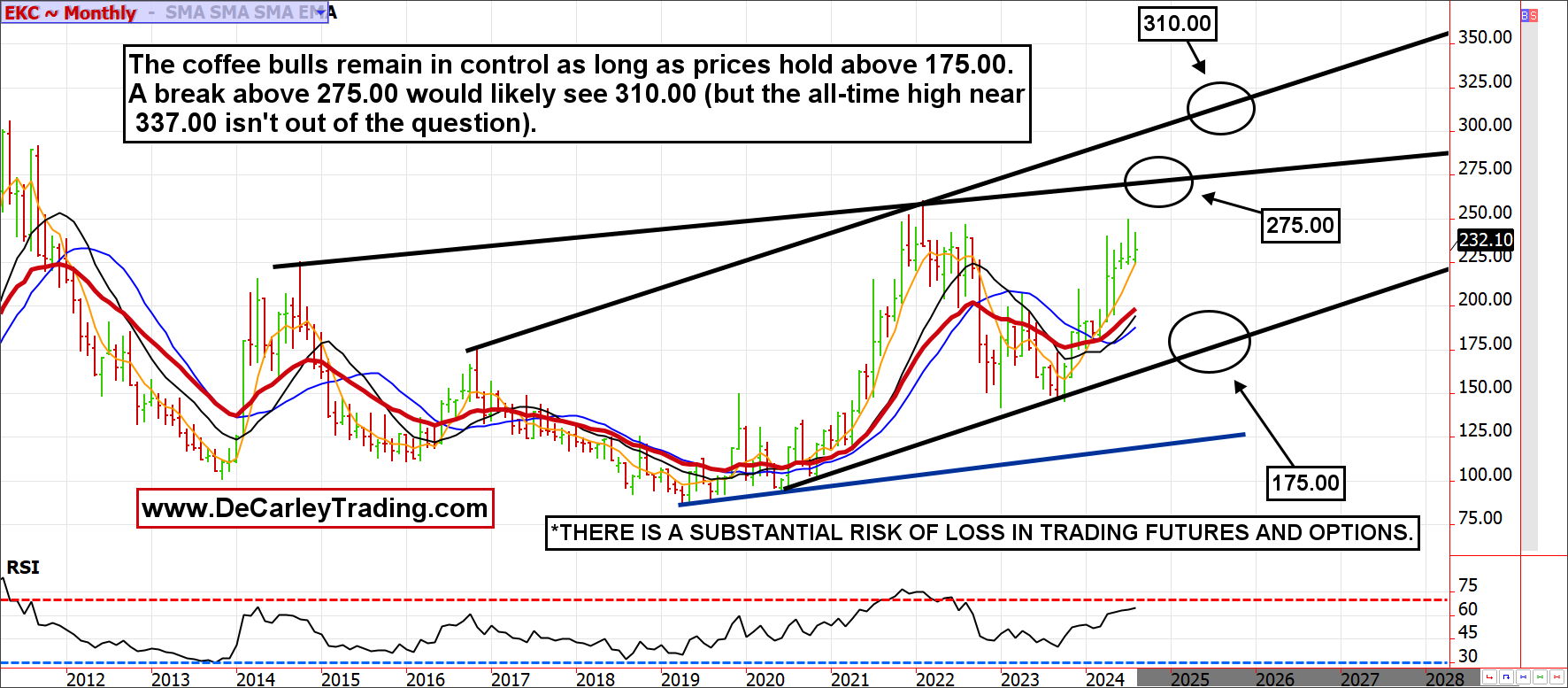
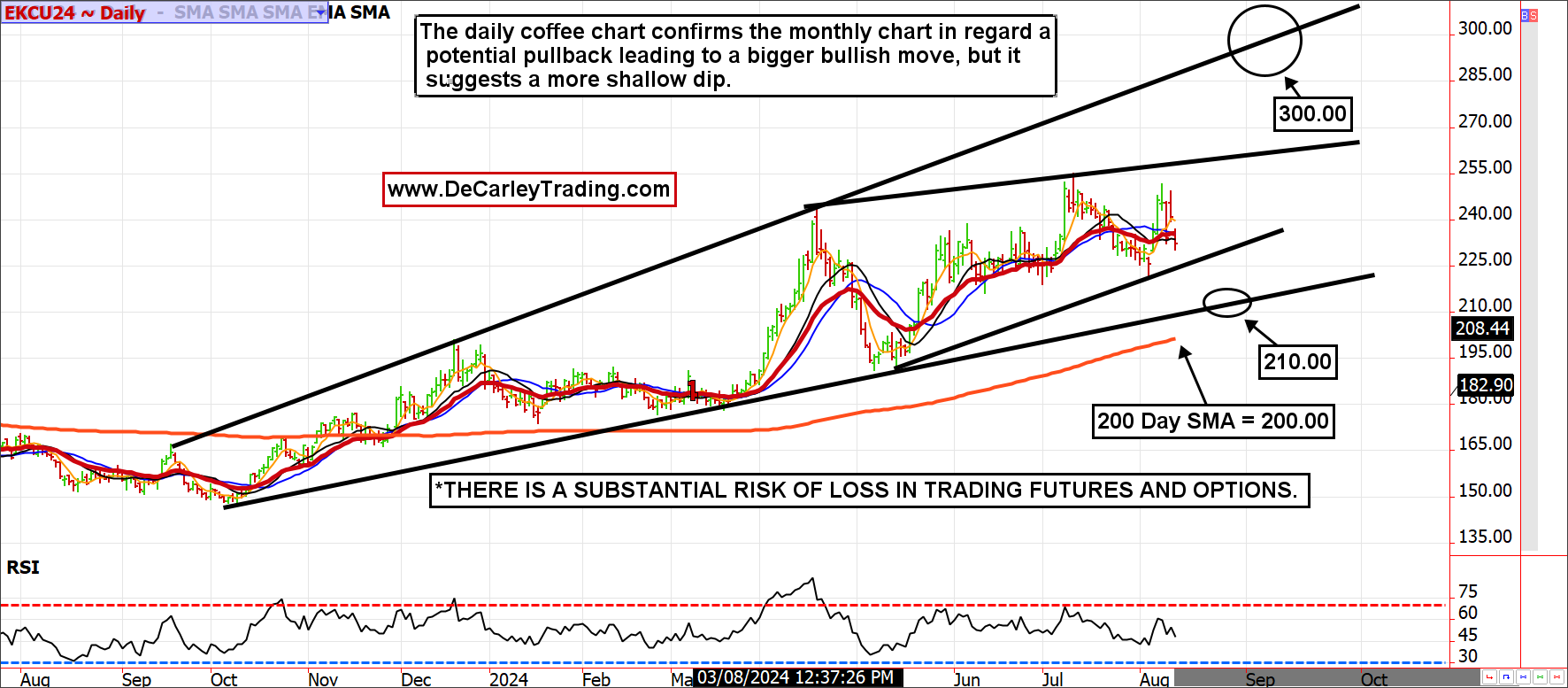
The monthly coffee chart is relatively neutral, but with bearish seasonality and aggressively positioned bulls, the odds suggest we test the lower end of the trading range before what could be an impressive spring rally.
The daily chart points toward a less dramatic pullback into the low-200.00s; either way, coffee bulls should consider getting positioned on significant dips in the coming months.
Bottom Line
Whether you are speculating in coffee or coffee-related stocks, or are a producer or end-user needing to hedge price risk, it can be helpful to know where the price of coffee has been. More importantly, how the market has behaved historically based on the current situation.
To summarize, here is our best guess at what comes next for the commodity responsible for one of our favorite beverages: The median coffee price is about 175.00, so current pricing near 235.00 is lofty and should be respected as such. That said, we have seen other commodities post all-time highs, particularly in the softs complex, which trade on the same exchange and often share a more positive correlation than they reasonably should (cocoa, orange juice).
We suspect large dips in coffee futures will likely be bought into and think the 300.00/330.00 area is possible by next spring (typical seasonal high). This would probably be a last hurrah rally.