Cerebras Hits an All-Time Low on Margins. I’m Not Rattled.
Sales projections are strong and the demand is there. Here’s how I plan to get ‘involved.’
You've reached your free article limit
You've read 0 of 1 free Pro articles.
Cerebras Systems (CBRS) has only been trading publicly since mid-May despite having existed since 2015. The Sunnyvale, California-based AI infrastructure company focuses on the design of and manufacture of specialized semiconductor chips, supercomputers and cloud services in addition to software meant to accommodate artificial intelligence driven workloads.
Cerebras has created the world’s largest single monolithic processor. This chip provides greatly increased on-chip memory while enabling a higher level of efficiency relative to other GPUs.
On Tuesday evening, Cerebras released its fiscal first quarter (period ended March 31) financial results, posting a GAAP loss per share of $0.22 on revenue of $193.406 million. These numbers easily beat Wall Street expectations while the top-line print was good for year-over-year growth of 94.4%. On an adjusted basis, the loss per share was $0.04, which was also a beat.
Co-Founder and CEO Andrew Feldman commented in the Form 8-K:
“Cerebras’ wafer-scale technology delivers the fastest AI in the world. And fast AI is more valuable than slow AI because it is more productive. It provides answers in less time. It delivers solutions in less time. This in turn has created significant momentum with pioneering customers like OpenAI and AWS and emerging customers as well. The growing importance of AI in our economy requires AI infrastructure that can power the most advanced applications at unprecedented speed. This is the Cerebras mission.”
Keep in Mind…
Cerebras could potentially become a major rival to both Nvidia (NVDA) and Advanced Micro Devices (AMD).
The company already has under its belt a couple of major commercial victories. These include a multi-year agreement with OpenAI worth more than $20 billion to deploy 750 megawatts of inference capacity, as well as a new partnership with Amazon’s (AMZN) AWS.
Operations
While revenue was growing 94.4% to $193.406 million, the cost of that revenue landed at $107.23 million (+85.2%). This left a gross profit of $86.176 million (+107.1%) as gross margin widened from 41.8% to 44.6%. This became an issue last night. Core gross margin printed at 47% on core hardware gross margin of 42% and core cloud gross margin of 53%. That was more or less fine, but in the guidance, readers will see the company’s expectations for significantly lower core gross margins. That is what is hitting the stock Wednesday.
GAAP operating expenses hit the tape at $101.213 million (+44.4%). This left a GAAP operating loss of $15.037 million, versus a loss of $28.47 million. After accounting for other income & expenses, interest and taxes, GAAP net loss posted at $14.006 million, narrowing from a loss of $23.867 million. This resulted in a GAAP loss of $0.22 per share versus the year-ago comp of a $0.46 loss per share.
Adjustments for pass-through revenue, pass-through costs, stock-based compensation and the amortization of warrant assets left core net loss at $2.48 million, versus last year’s $14.713 million loss and worked out to a $0.04 loss per fully diluted share.
Guidance
Last night, Cerebras projected Q2 core gross margin of between 36% and 38%, down sharply from the above-mentioned 47% for the quarter reported. For traders and investors, this appeared to overshadow what was upbeat guidance for 88% annual revenue growth.
Fundamentals
For the period reported, Cerebras generated operating cash flow of $12.335 million, versus -$54.937 million a year ago. Out of that number came capex spending of $131.97 million, leaving free cash flow of -$119.635 million (versus last year’s -$153.181 million). The company is obviously not yet in a position to return capital to shareholders.
Turning to the balance sheet, Cerebras ended the period with a cash position (including restricted cash) of $3.261 billion and inventories of $89.04 million. Including warrants held, current assets add up to $3.581 billion. Current liabilities run at $1.427 billion and include short-term debt of $621.306 million, but also deferred revenue of $149.918 million. This puts its adjusted current and quick ratios at 2.80 and 2.73, respectively.
The company’s financial condition is strong.
Total assets stand at $4.948 billion, none of which is labeled as either goodwill or as intangible. Total liabilities less equity comes to $2.196 billion, including another $361.617 million in longer-term debt, but also some more deferred revenue.
This balance sheet is in pristine condition.
Opinion
Personally, I am not that rattled by the margin guidance. Sales projections are strong. We know that the demand is there. Cash flows are improving. Hence, the cash position dwarfs the debt load. The balance sheet is mighty. I like all of these items.
In addition, I see that six of six sell-side analysts rated at five out of five stars by TipRanks that opined on this stock today, reiterated “buy” or buy-equipment ratings. All six also reiterated already lofty price targets or increased their targets. The average target across the six is now roughly $293.
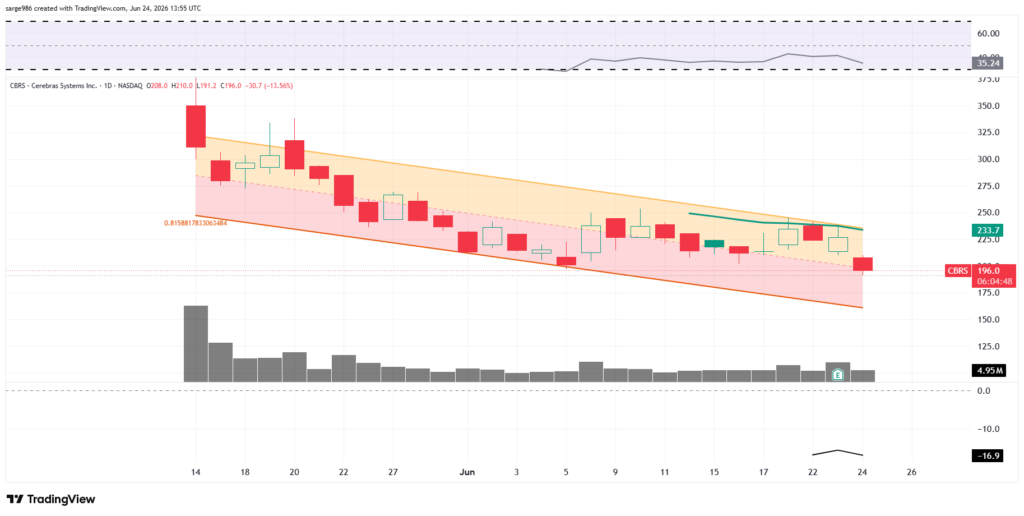
Readers will see that with only six weeks of trading under its belt, it’s too early to do any credible technical analysis on CBRS. The stock has no 50-day or 200-day simple moving average (SMA). The stock also does not yet bear a daily moving average convergence divergence (MACD) to speak of.
The shares have so far remained on trend and that trend has been lower. Wednesday morning, the shares have already traded at an all-time low.
Am I willing to own these shares? I would like to own these shares. That does not mean that I am willing to take on equity right here, though. However, I might be willing to write a bull put spread that buys some time and pays a little something.
Maybe I sell July 17th $175 puts for about $10 if I can buy the $160s for less than $5. That would be taking a calculated risk that could net me more than $5 in net premiums while potentially costing me no more than a net $10 in a worst case-scenario.
At the time of publication, Guilfoyle was long NVDA, AMD and AMZN equity. ‘