ASML’s ‘Bull Flag’ and Guidance Has My Attention: Here’s My Plan
When a ‘monopoly’ offers expansion plans like this it piques my interest.
You've reached your free article limit
You've read 0 of 1 free Pro articles.

Overnight, Dutch semiconductor equipment maker ASML Holding (ASML) released its second-quarter financial results. The company posted GAAP EPS of €7.59 on revenue of €9.33 billion. These top and bottom-line results both easily beat Wall Street expectations while the sales print was good enough for year-over-year growth of 21.3%.
In addition, ASML lifted its full-year sales forecast for the second time this year. Net sales for the year are now seen in a range spanning from €43 billion to €45 billion. This is significantly better than the €39.8 billion that Wall Street had in mind. The company also plans to increase production to meet surging demand as capex spending on the expansion of artificial intelligence marches on.
Things to Understand
Readers most likely noticed that the above numbers have been recorded and reported in euros. Ordinary ASML shares are listed at Euronext Amsterdam in the Netherlands. Its secondary listing is at the Nasdaq in New York City.
The shares that trade here in the U.S. are the American Depositary Shares. There’s not that much of a difference, as each ADS represents one ordinary share but they are issued by a depositary bank and this makes it easier for market participants in the U.S. to trade and hold ASML without dealing with foreign exchange rates or regulatory differences.
Secondly, while ASML is a semiconductor equipment provider, the company is not a direct competitor to Lam Research (LRCX), Applied Materials (AMAT) or KLA Corp. (KLAC). ASML focuses on lithography and has a literal monopoly in the extreme ultraviolet systems required to create AI-capable chips.
Lam focuses on etch and deposition with strength in plasma. KLA focuses on process control and yield management and AMAT is kind of a jack of all trades. None of the three are strong enough in lithography to pose a threat to ASML’s core business.
The CEO
President and CEO Christopher Fouquet commented in the press release:
“Ongoing AI-related investments and continued progress in AI technologies are driving demand for advanced Logic and Memory chips, further strengthening the semiconductor industry’s growth outlook. Our customers, in turn, continue to accelerate their capacity expansion plans. This is translating into customer commitments across our product portfolio, providing ASML with increased visibility into longer-term demand.”
On Production…
Fouquet added, “We are planning to add 30% to our 2026 low NA EUV capacity of around 65 for 2027, and we are investigating to increase capacity with another 30% for 2028. Similarly, we plan to add 30% to our 2026 DUV immersion capacity of around 130 for 2027, and we are investigating to increase capacity with another 30% in 2028. In addition, we are continuing to significantly expand our upgrade portfolio.”
On Revenue Guidance…
Fouquet, in a statement that many CEOs could learn from, wrapped up… “We expect third-quarter 2026 total net sales between €11.0B and €12.0B, with a gross margin between 55% and 57%. We expect R&D costs of around €1.2B and SG&A costs of around €0.4B. Given the business dynamics discussed above, we now expect total net sales for 2026 to be between €43B and €45B, with a gross margin between 54% and 56%.”
The Chart
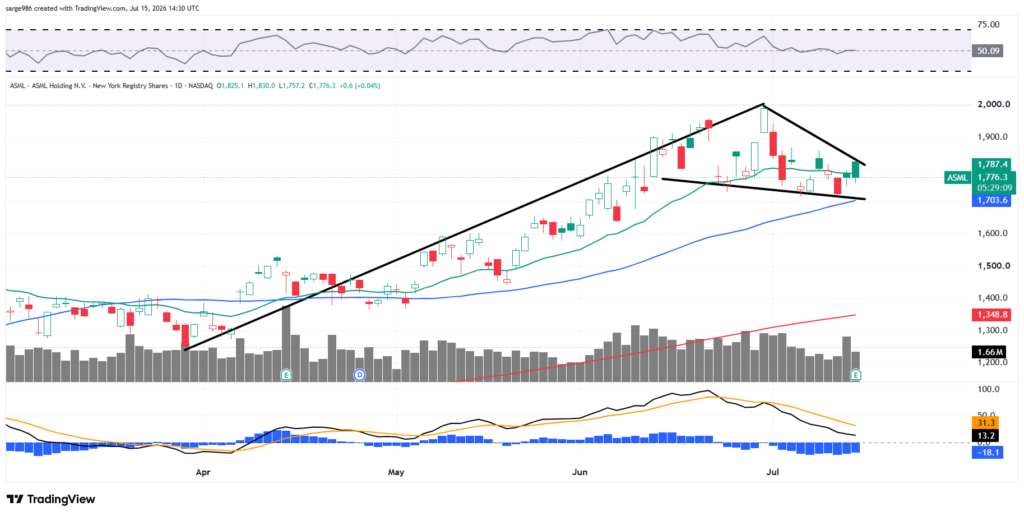
Forgive me. I couldn’t get my program to cooperate this morning, so I had to draw this chart by hand. On this daily chart of ASML, I think I see the development of a “Bull Flag.” That is a pattern of trend continuance, which would, as the name implies, be positive for the share price. What’s needed is for support to hold at the stock’s 50-day simple moving average ($1,704). So far on Wednesday, the 21-day SMA has been tested, but held. This implies that the swing crowd is playing some offense here.
My plan?
Not to buy the shares above the 21-day exponential moving average. Perhaps start buying small at that line and if it cracks, scale the stock all the way down to that 50-day line.
Do I think that line cracks? If it does, we’ll have some risk to manage, but it does not sound like the pros won’t be defending this one.
For those interested and perhaps bold, August 21 $1,700 puts are paying around $97 to $98 a contract, and they are a little bit liquid. That’s some serious food for thought right there.
At the time of publication, Guilfoyle had no positions in any securities mentioned.