How Apple’s Modem Rollout Can Impact Three Holdings
Apple’s reported plans to bring its cellular modem business in-house could have major implications across the tech landscape.
You've reached your free article limit
You've read 0 of 1 free Pro articles.
In today’s Daily Rundown video, we discussed the weekend Bloomberg article that touched on Apple’s AAPL three-year rollout to bring its cellular modem business in-house.
We’ve discussed this multiple times when it comes to the multi-year impact on Qualcomm’s QCOM business and revisited that with our recent post Analyst Day note that laid out the company’s multi-year, multi-faceted diversification plan. Let’s turn and talk about this modem move from Apple’s perspective, including why it could help improve its iPhone cost structure.
Begin the Begin
Apple is expected to start rolling out its proprietary modem effort as part of its Apple Silicon initiative in late 2025 with a revamped low-end iPhone SE. In 2026, Apple targets its second-generation modem that could find its way into other iPhone and iPad models in 2026 and potentially Macs as well as the Vision Pro. That would be the first time that Apple has brought cellular connectivity to the Mac, and should it happen, alongside AI usage, including Apple Intelligence, it’s a development that reinforces our view about the accelerating pace of digital content creation and consumption that will continue to pressure digital infrastructure. In other words, such a move would keep us bullish on Marvell’s MRVL three largest chip businesses — data center, enterprise networking and cellular infrastructure.
From Apple’s perspective, developing its own chips is akin to the comment made by Jeff Bezos that “your margin is my opportunity.” We say that because Qualcomm’s next flagship chip, the Snapdragon 8 Elite, will utilize Taiwan Semi’s TSM N3P process and deliver at least a 20% performance improvement and will cost more than $200. That’s roughly a 20% price increase and includes Qualcomm’s AI engine, 5G-modem and RF systems, Wi-Fi, Bluetooth, Ultra-Wide Band and the CPU. Clearly, a bundled package, but when we look at a bill of materials for the iPhone 16 Pro, Apple Insider pegs that standalone 5G modem costs nearly $30.
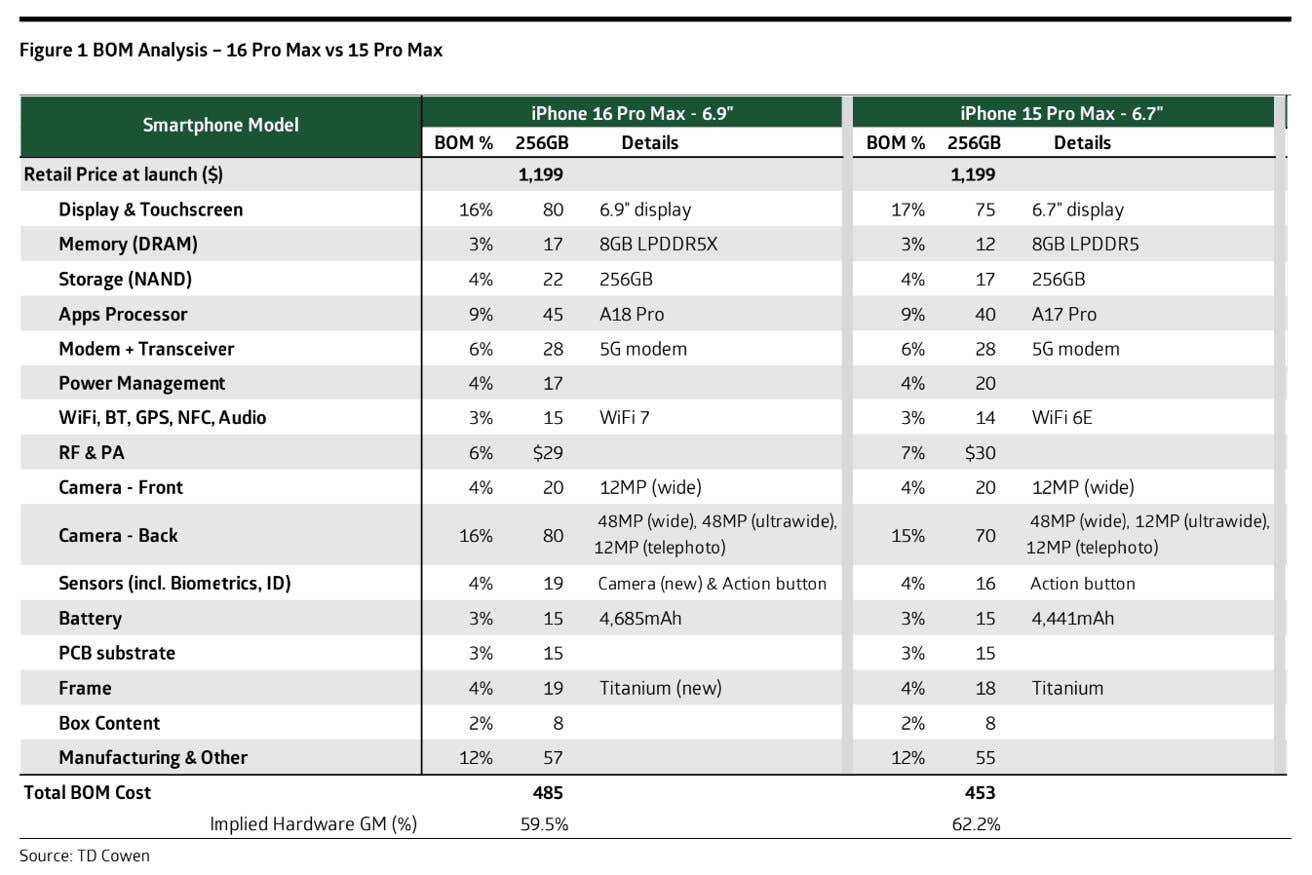
Per the chart above, if Apple can effectively replace Qualcomm’s modems across its entire iPhone line starting in late 2027, it can improve its iPhone gross margin by a few points. Apple is also targeting using its own Wi-Fi and Bluetooth chips, replacing current supplier Broadcom AVGO over the next few years, which would also serve to improve Appel’s iPhone gross margin. While the market seems to be overly focused on the potential business loss at Qualcomm and its efforts to ramp other chip businesses to more than compensate, we haven’t heard much about the potential impact on Broadcom, which counts Apple as a 20% customer. Perhaps we’ll hear more on this when Broadcom reports later this week.
Before we get overly excited by this potential, reports indicate that Apple’s initial modem isn’t “as advanced” as the latest ones from Qualcomm, making them a downgrade from the modem chip currently in the iPhone 16 Pro. This supports the thinking that Apple may hold off replacing Qualcomm in its iPhone Pro and Pro Max products until its second- or perhaps even third-generation modem is ready. That points to late 2026, possibly late 2027.
As we’ve seen with its Apple Silicon efforts, Apple is making great strides, and we don’t want to rule out its potential or how bringing solutions in-house can bolster margins and drive incremental EPS to its bottom line.
More Pro Portfolio
- We're Locking In a Triple-Digit Gain for This Deeply-Overbought Name
- Weekly Roundup: A Lack of Fear Is Concerning as the Market Melts Up
- Half of U.S. Living Paycheck to Paycheck — and More Headlines You Might Have Missed
At the time of publication, TheStreet Pro Portfolio was long AAPL, QCOM and MRVL.