The Post-Earnings ‘Lull’ Continues
End of day rundown of all that you should know for September 8th.
You've reached your free article limit
You've read 0 of 1 free Pro articles.

For readers who are new to my work, this piece, the evening update, is meant to be a look at the major forces which drove markets in the day’s trading and a look ahead to the following day (week on Friday’s). As with the other updates, I also want this piece, to evolve in whatever way is most meaningful for readers.
So please post or email comments, questions, pushback, or suggestions, and especially what you would like to see more or less of. I read all the feedback, and I promise to be responsive.
Also, note that anything that is an X post should have a link, so if you click it you can get to the full post, charts, etc.
Quick Summary
- Oil prices pushing to 3-month highs amid fresh Middle East escalation as discussed in the morning brief drove a second day of losses, lifted Treasury yields and hardened Fed-hike bets pressuring equities.
- The Nasdaq and Russell 2000 tried for green and were turned back, ending -0.3% and -0.5%; the S&P 500 fell -0.6% and the Dow -1.2%, dragged by Amgen’s -10.1% (its worst day since 2000). It was the 10th straight post–Labor Day loss (Bespoke).
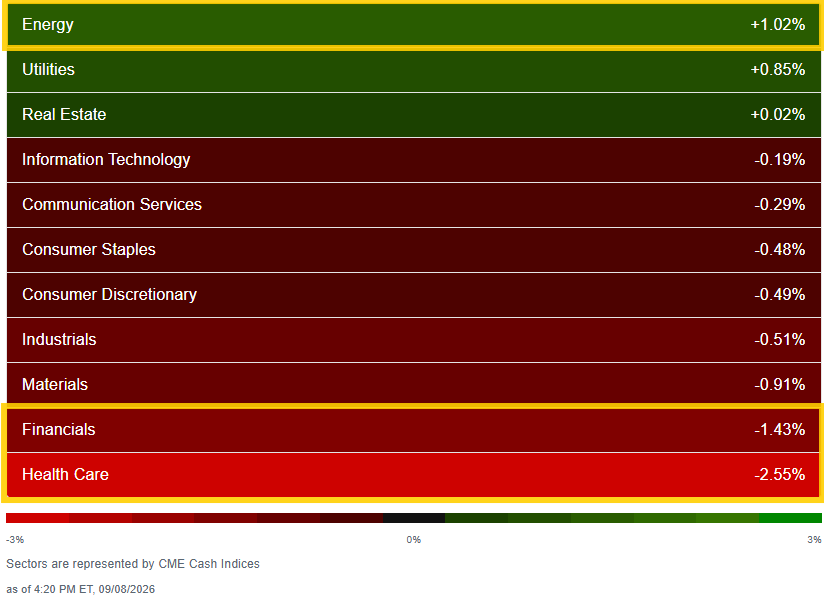
- Just three SPX sectors closed higher — Energy, Utilities, and Real Estate (barely), three of the smallest by market cap — while heavyweight Tech’s modest 0.2% loss contained the damage. Health Care (-2.6%) and Financials (-1.4%) were the only sectors down more than 1%.
- Semis were an important support keeping losses shallow: the PHLX Semiconductor Index rose 1.3% offsetting losses in software (the State Street SPDR Software & Services ETF was -2.5%).
- Brent cash prices briefly pushed over $100 after this morning’s news of Saudi facility outages and were supported during the session on reports of strikes around Iran’s Kharg Island export hub. Fed funds futures continued to price around a 60% chance of a hike at the FOMC’s meeting next week pushing 2-year Treasury Yields to the joint-highest close since July 2024.
- A light day tomorrow before things heat back up Thursday with PPI and Oracle earnings.
Market Commentary:
- “Brace for a turbulent week, with inflation data set to swing market expectations for a Fed hold or hike next week – with knock-on effects on wider asset markets,” said Krishna Guha at Evercore.
- “A run of central bank meetings over the coming weeks will test whether equity composure holds,” said Ed Yardeni, president of Yardeni Research. “Bond yields are also rising worldwide. The question is whether that reflects better-than-expected economic growth, higher-than-expected inflation, and/or looming fiscal debt crises.”
- “We are likely to be in some sort of period of digestion, because we are going through a pretty meaningful adjustment in terms of central bank policy around the world,” Anastasia Amoroso at Partners Group told Bloomberg TV. “So we might give a little bit of those gains back or at least some consolidation here.”
- “The two issues that have dominated the second Trump presidency so far — tariffs and Iran/oil prices — remain top of mind, with equity futures and bonds both dipping from Friday’s closing levels. In a sense, today’s session represents a transition towards the inflation prints later this week, which will help cement the case for or against a Fed rate rise in eight days.” — Cameron Crise, Macro Strategist, Markets Live
- “If you take a step back, the results for some of the big AI players were very strong,” said Mark Preskett, senior portfolio manager at Morningstar Wealth. “The market reaction outside of Nvidia has been pretty muted.”
- “With geopolitical tensions and oil prices on the rise, the markets may find it difficult to focus on much beyond the inflation discussion,” said Chris Larkin at E*Trade from Morgan Stanley. “Unlike the stock market’s reaction to the jobs report, good economic news this week — that is, cooler inflation — should be treated as good.”
- “Energy prices can’t keep rising without impacting the market, and at some point even a tame inflation report later this week may not mean much if crude oil prices remain in the mid-90s, approaching triple digits,” according to Bespoke Investment Group strategists.
- “Brent crude is at a six-week high, with apparent moves toward a deal between Iran and Oman to manage the flow of some shipping through the Strait of Hormuz merely underlining Tehran’s control of the waterway,” Dan Coatsworth, head of markets at AJ Bell, said in a note on Tuesday morning. “Investors will have a laser focus on US inflation data out later this week to see if the impact of rising energy prices is starting to feed into broader inflationary pressures.”
- “If you have a CPI reading that surprises to the upside, that’s going to really make it difficult for [the Federal Reserve] not to hike rates,” said Mark Hackett, chief market strategist at Nationwide. “And that is effectively what investors are focused on right now.”
Stock and Sector Breakdown:
Just three SPX sectors higher Tuesday in Energy, Utilities, and Real Estate (barely), three of the smallest by market cap. Helping keep losses contained though was heavyweight Tech losing just 0.2%. Two sectors were down more than 1% in Health Care and Financials.
Crude’s jump on the Middle East escalation lifted Energy (+1.0%) while Utilities (+0.9%) continued their bounce after testing the lows of the year at the end of August, now up for a 6th straight session. That’s despite yields edging higher which hit some rate-sensitive groups with the iShares US Home Construction ETF falling 3.1%. Oil sensitive names also were weak as shares of travel and lodging companies slid. Expedia Group and Booking Holdings fell 6% and 5%, respectively. Tripadvisor and Airbnb dropped about 3%.
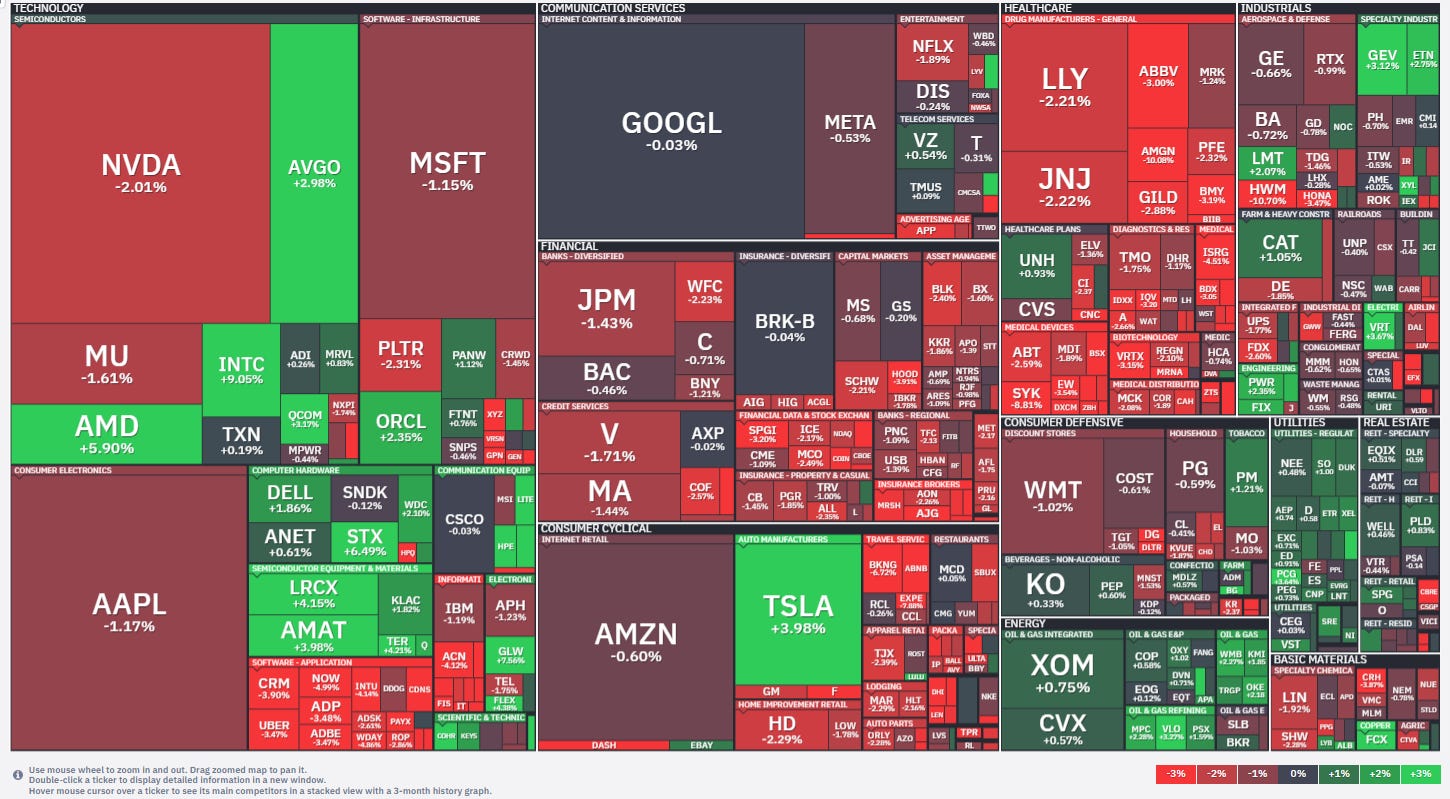
Semis were an important counterweight to selling elsewhere in Tech that kept losses shallow: the PHLX Semiconductor Index rose 1.3% even as Nvidia (-2.0%) lagged and offsetting losses in software (the State Street SPDR Software & Services ETF was -2.5%). Intel jumped ~9% on positive analyst commentary and price-increase reports, AMD gained ~6% on upbeat AI-demand and server-CPU commentary, and Qualcomm added ~3% on a multi-year Amazon deal for custom silicon and optical connectivity. Optical names ran on a separate multibillion-dollar Corning–Verizon fiber agreement (80-plus million miles, 2027–2032): Corning +7.6%, Lumentum +11%, Coherent +7.1%.
Health Care (-2.6%) sat at the bottom after Amgen’s plunge tied to clinical-trial setbacks at Novartis (separately down ~14%) that dragged the rest of biotech lower as well. Financials (-1.4%) were the other notable laggard.
[Note: chart uses futures prices.]
Number of large SPX winners (up over 3%) ~30 Tuesday (a relatively low number which is what we’ve mostly seen the past few weeks), while the number of large losers (down over 3%) came in well above at ~85.
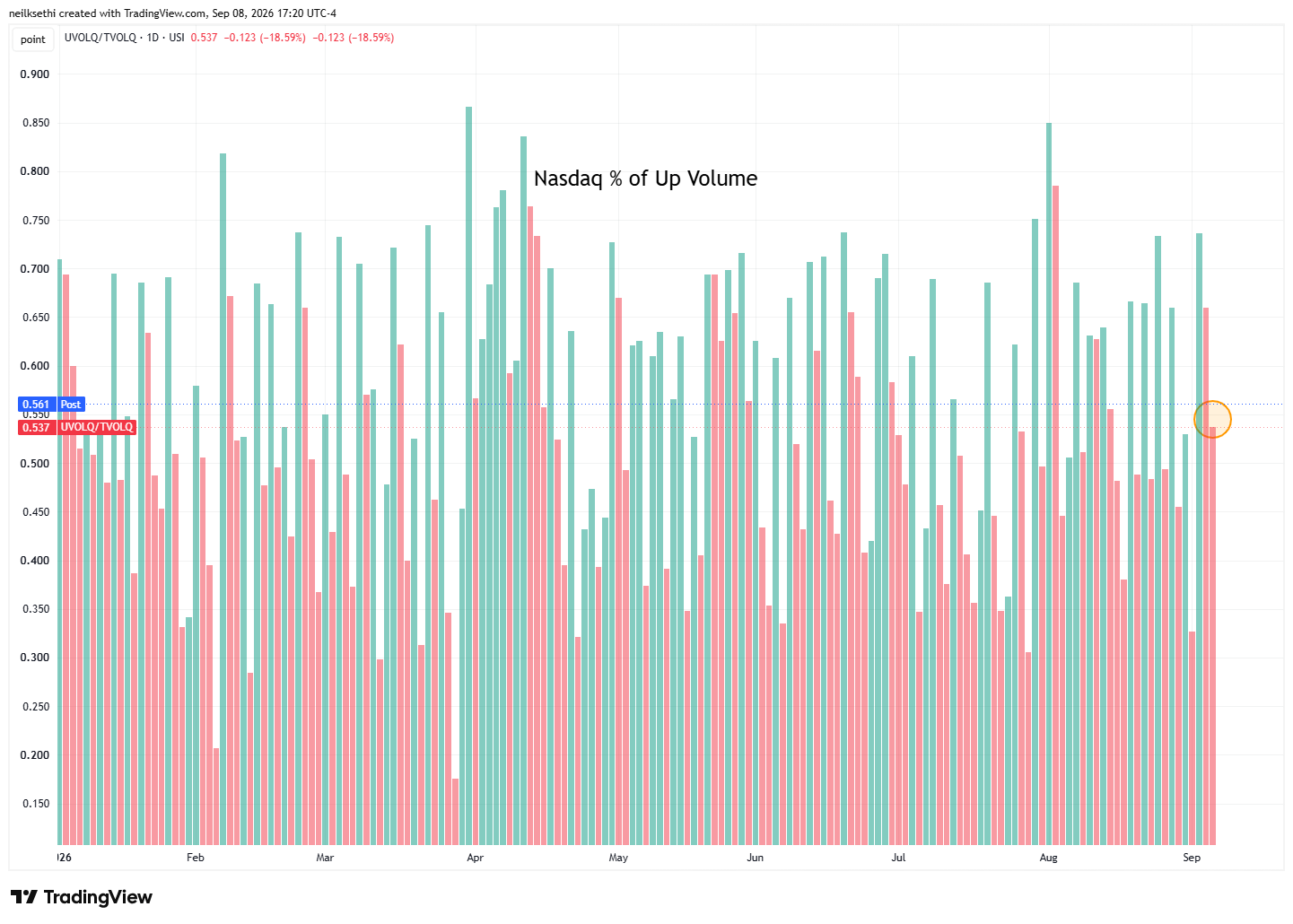
One bright spot was the positive volume on the Nasdaq (intensity of buying in stocks up on the session) at around 55% the best for a down session since August 11th.
Biggest after-hours movers from CNBC:
None today, here were the mid-day movers:
- Stryker (SYK)– The medical equipment maker dropped more than 7% after management said Stryker’s peripheral vascular business is suffering from supply constraints that are expected to act as a headwind through the third quarter and into the fourth quarter of the year.
- Qualcomm (QCOM) – The chipmaker jumped 4%. Qualcomm entered a data center infrastructure partnership with Amazon Web Services. As part of the deal, Qualcomm said it issued Amazon warrants to buy 25 million shares for $4 billion.
- Roivant Sciences (ROIV) — Shares rallied about 20% after the pharmaceutical company said Phase 2 trial results for subsidiary Pulmovant’s mosliciguat demonstrated “a clinically meaningful and statistically significant placebo-adjusted reduction in pulmonary vascular resistance” in patients with pulmonary hypertension with interstitial lung disease.
- Lockheed Martin (LMT) — The defense contractor added about 3% after UBS upgraded Lockheed to buy from neutral, citing underappreciated earnings growth potential.
- Peloton (PTON) — Shares slid more than 5% after Morgan Stanley downgraded its investment recommendation to underweight from equal weight. “PTON is facing structural headwinds in fitness,” the investment bank said.
- Boston Scientific (BSX)— The medical device maker dropped 5% after BSX said a recent cyberattack likely hurt sales and profit targets for 2026.
- Bloom Energy (BE) – The fuel-cell manufacturer jumped 10% in advance of joining the S&P 500 on Sept. 21. Bloom has been a major beneficiary of the AI data center buildout. Its shares are almost a triple this year, soaring about 190%.
- Quantum computing stocks – The quantum computing sector rallied after the U.S. agreed to take minority equity stakes in several companies as part of a $300 million CHIPS Act deal. The investments are in D-Wave, Rigetti, and Quantinuum. D-Wave gained more than 7%, Rigetti rose 4% and Quantinuum added 3%.
Some stock-specific commentary from TheStreet Pro:
- Stephen Guilfoyle – New Intel Price Target After CPU Hike Report
- Chris Versace – Reading Through Comments From Applied Material’s Investor Conference
- Bob Lang – Bloom Is Creating Positive Energy as Big News Arrives
- James “Rev Shark” DePorre – SpaceX Helps Prevent Pullback With New Price Target and My Amazon Trading Strategy
Some other corporate news from BBG (links to BBG):
- Meta Platforms Inc. (META) unveiled a new artificial-intelligence agent designed to carry out tasks on a user’s behalf, advancing Mark Zuckerberg’s vision of a future where people each have a personalized AI assistant.
- Qualcomm Inc. (QCOM) signed up Amazon.com Inc. as a data center chip customer and investor, scoring a major win in its bid to benefit from soaring AI spending.
- Intel Corp. (INTC) climbed after a report from DigiTimes that the company is expected to raise prices. Separately, Northland Securities upgraded the chipmaker to outperform, citing turnaround progress.
- ASML Holding NV (ASML) has won commitments from top chipmakers to use its latest semiconductor production gear, while embarking on a broader agreement to meet surging demand for more powerful AI technology.
- Boston Scientific Corp. (BSX) and Stryker Corp. (SYK) fell after the medical device companies said they are dealing with the repercussions of separate cyber attacks that curtailed their ability to get products to customers and dented sales, with damage that could last for months.
A Look At The Charts
Note on all charts the colored lines are moving averages (the average price over the lookback period (days on the daily charts, weeks on the weekly charts)):
20 = green
50 = purple
100 = blue
200 = brownException is monthly charts where blue is 10-month moving average and brown is 20-month moving average.
MACD = Moving average convergence/divergence line, a measure of momentum that compares longer term and shorter term momentum to gauge if a move is strengthening or weakening. This is probably my favorite individual indicator (it’s also the favorite of Katie Stockton, a very fine technician).
RSI = Relative Strength Index (basically what it sounds like) = measures the strength of the move comparing gains to losses over the given lookback window (I use the standard 14 periods).
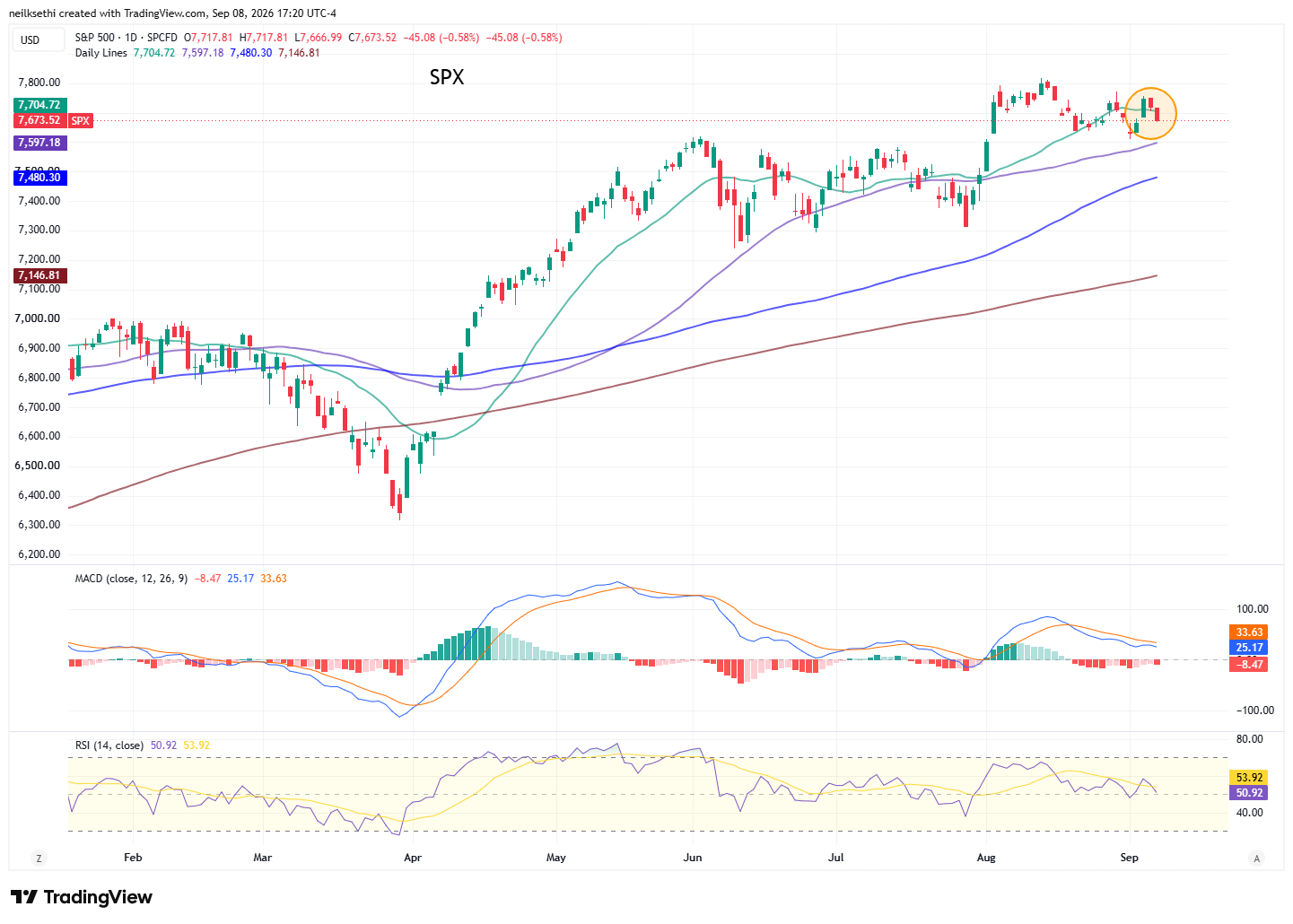
SPX fell back under its now declining 20-DMA, still less than 2% from an all-time high. As mentioned three weeks ago though the SPX along with the other three indices below had seen their daily MACD cross over to a “sell longs” positioning. RSI here remains just above 50. Just caution flags – nothing yet to turn bearish.
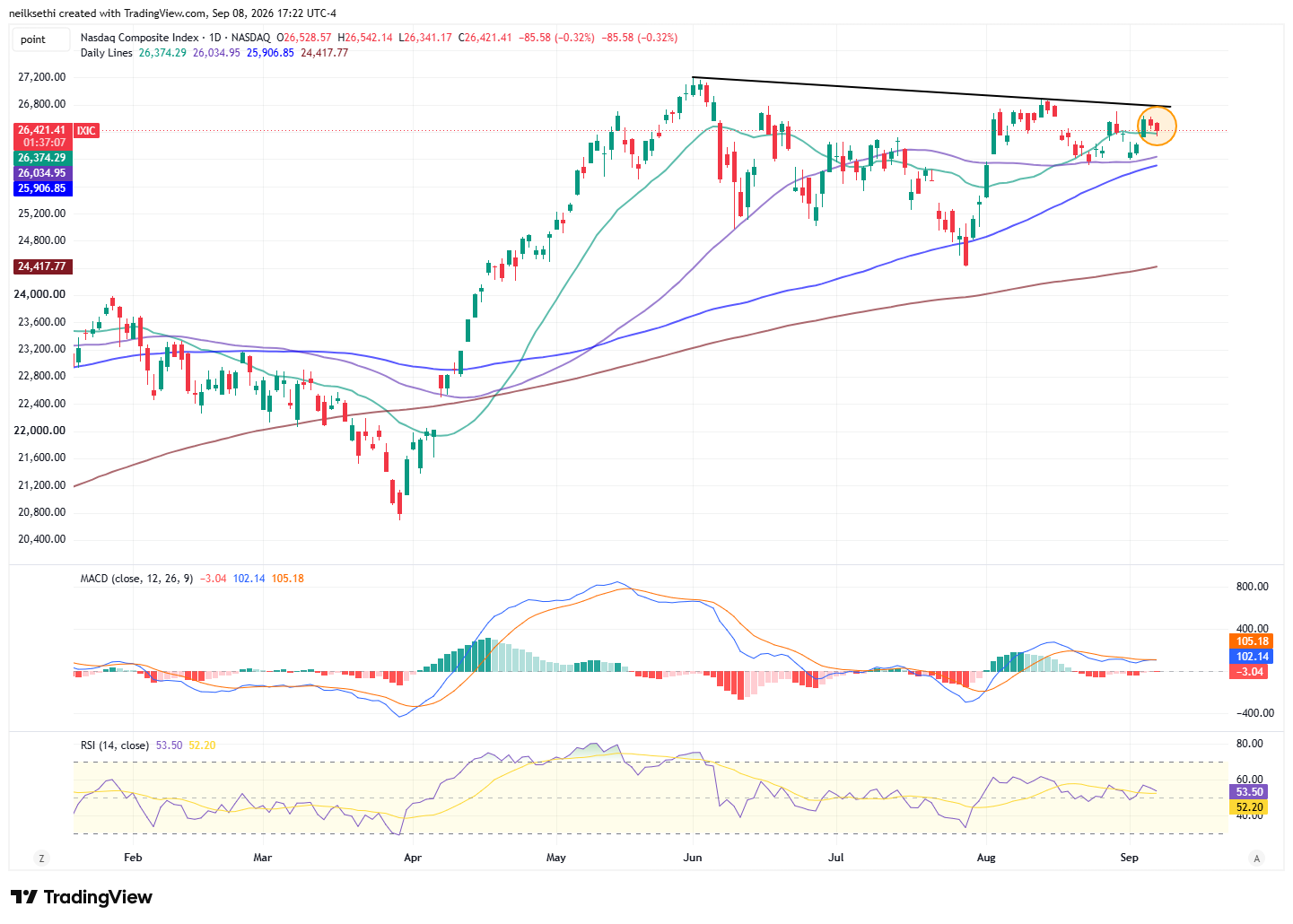
Nasdaq Composite though still above its 20-DMA. It remains a little further from all-time high territory.
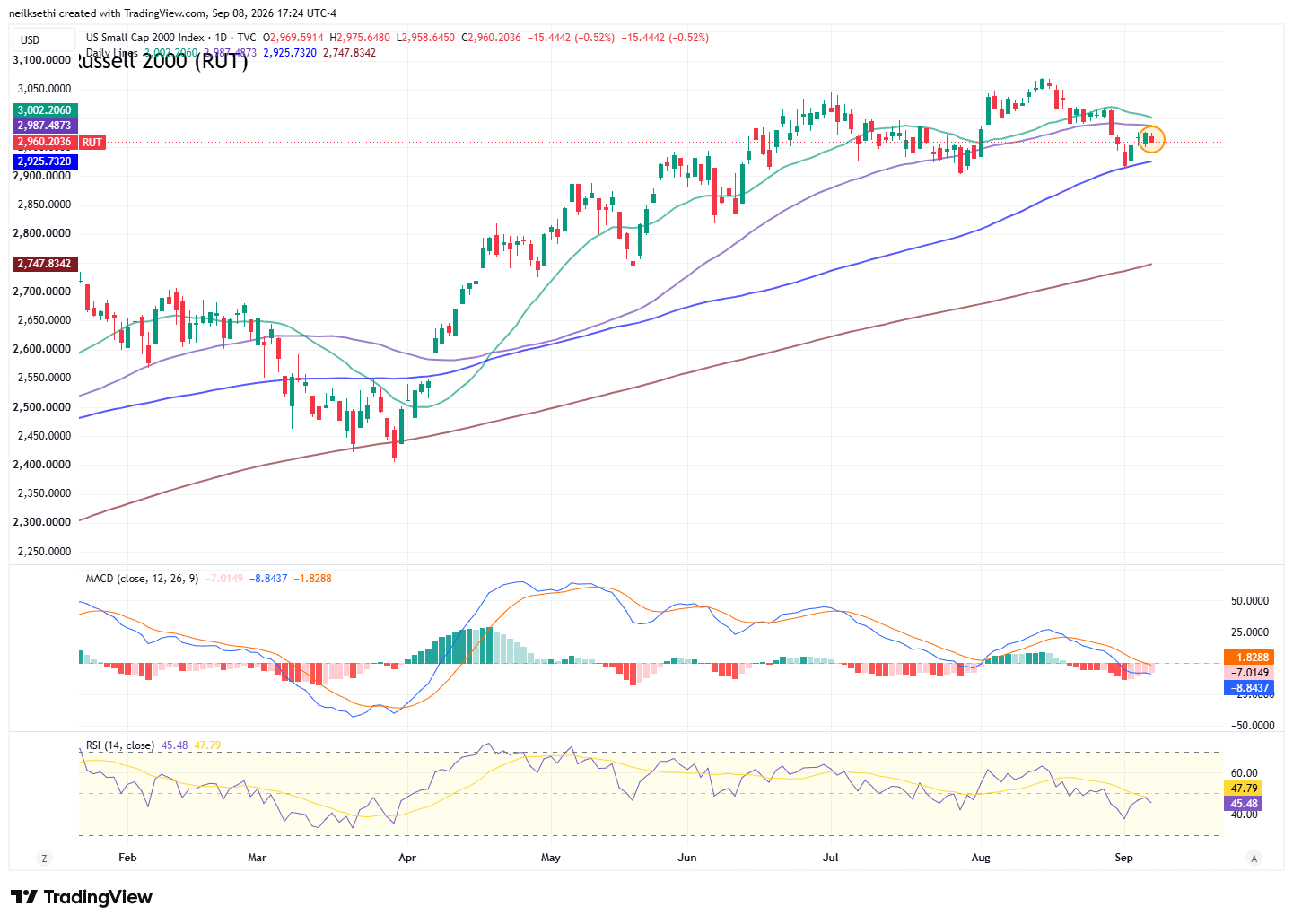
The Russell 2000 (RUT) is caught between its declining 50-DMA and rising 100-DMA. Its daily MACD has tipped to “go short” and its RSI is below 50, but again no reason to sell at this point.
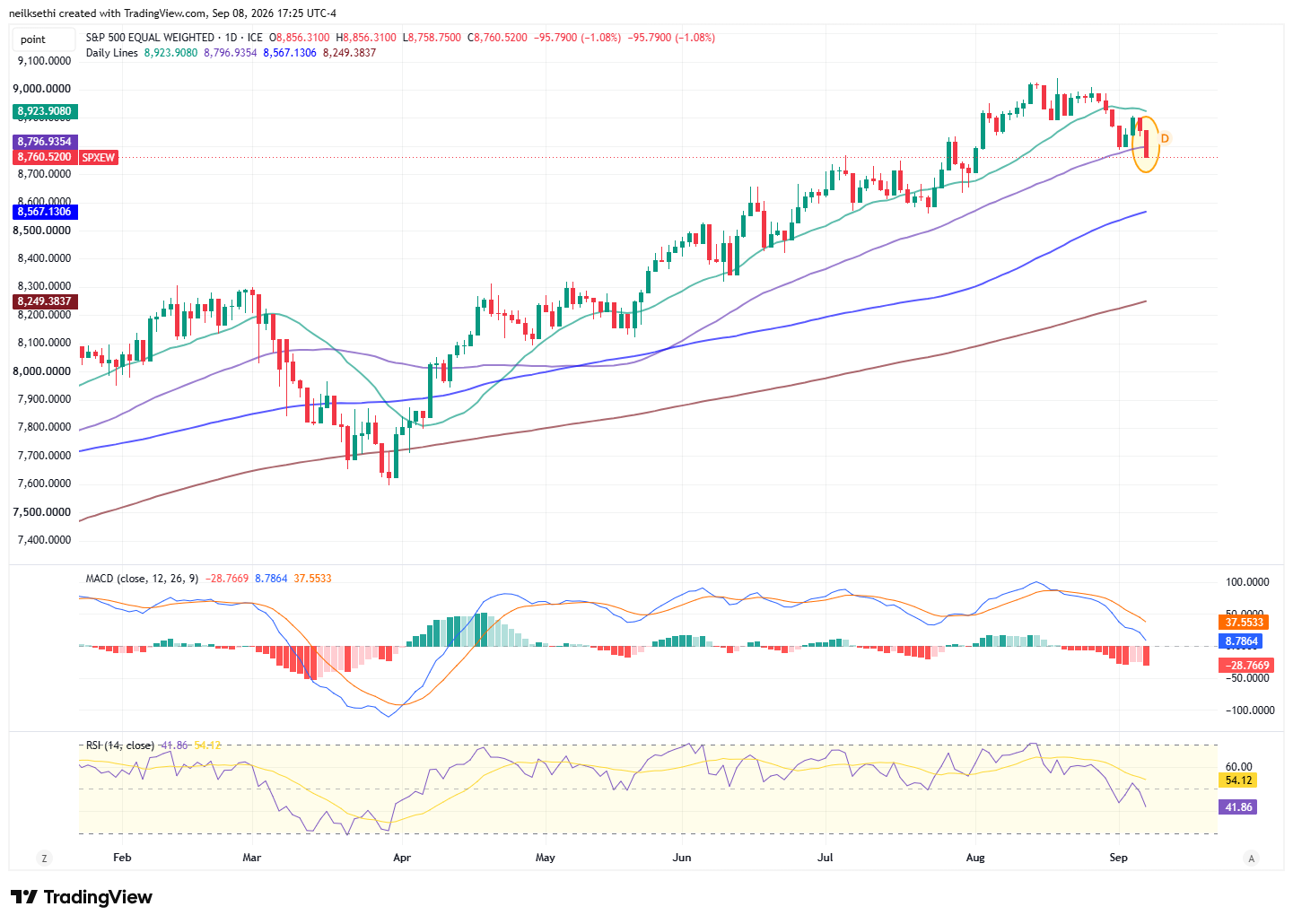
The equal-weighted SPX which had been perhaps the strongest chart since the March bottom now the most concerning. It as fallen under its 50-DMA, has a more severe MACD separation and the RSI is the weakest since late March. I did take off most of my holdings in RSP for now.
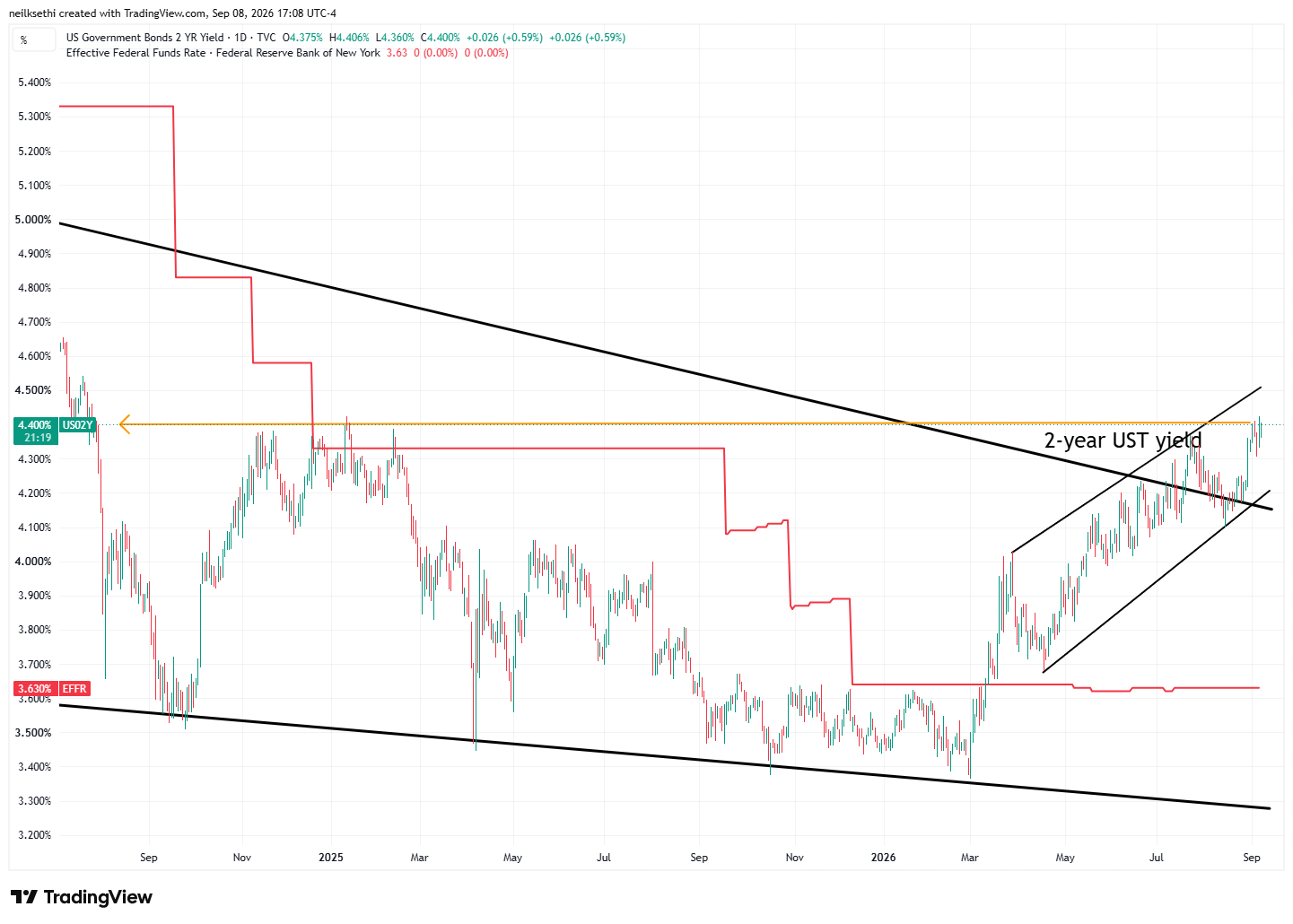
Treasury yields rose across the curve Tuesday in another “bear flattening” (meaning shorter maturity yields rose more than longer maturities (bearish because it’s associated with Fed rate hikes)):
The two-year Treasury yield up three basis points to 4.40%, matching last Tuesday as the highest close since July 2024.
It is ~73 basis points above the Effective Fed Funds rate (red line), now yelling for rate hikes. That’s the furthest above the EFFR since November 2022.
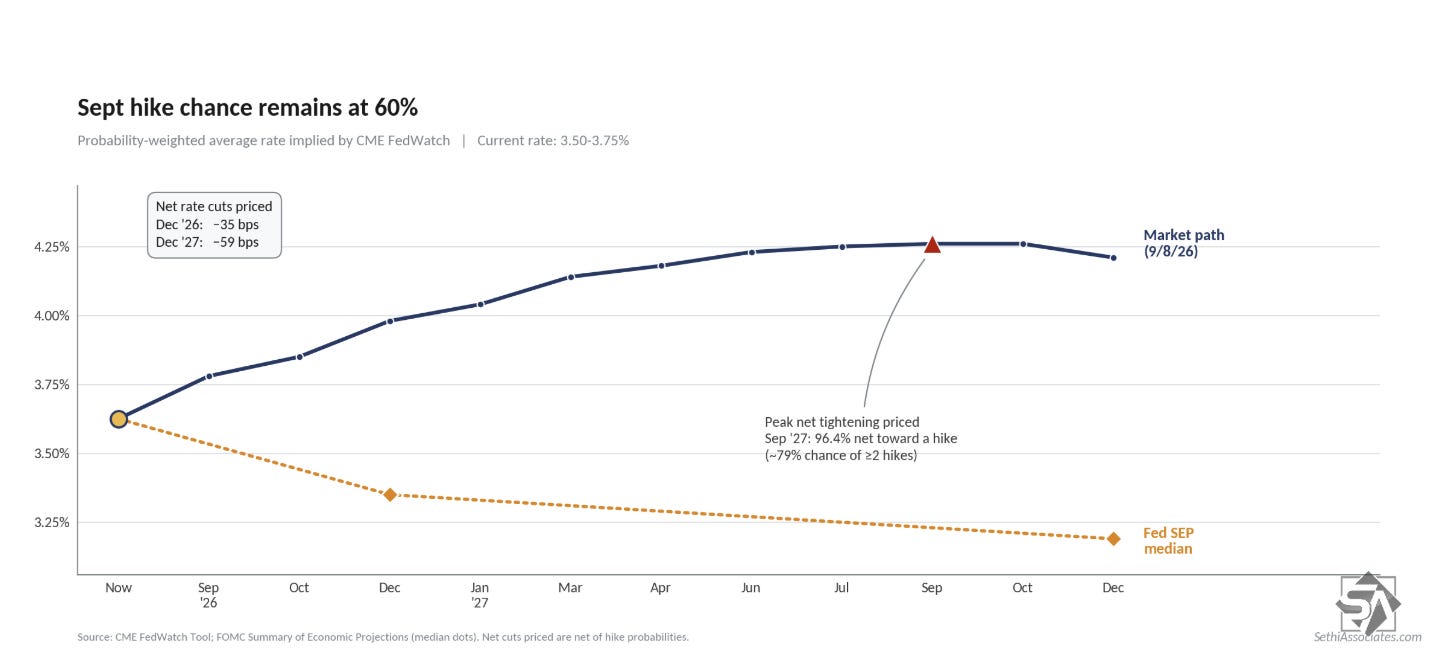
In terms of Fed rate hike expectations according to the CME’s Fedwatch tool those remain with the chance of a September hike at 60% and a hike this year at 87%. Two hikes are a 46% chance this year and 70% by March.
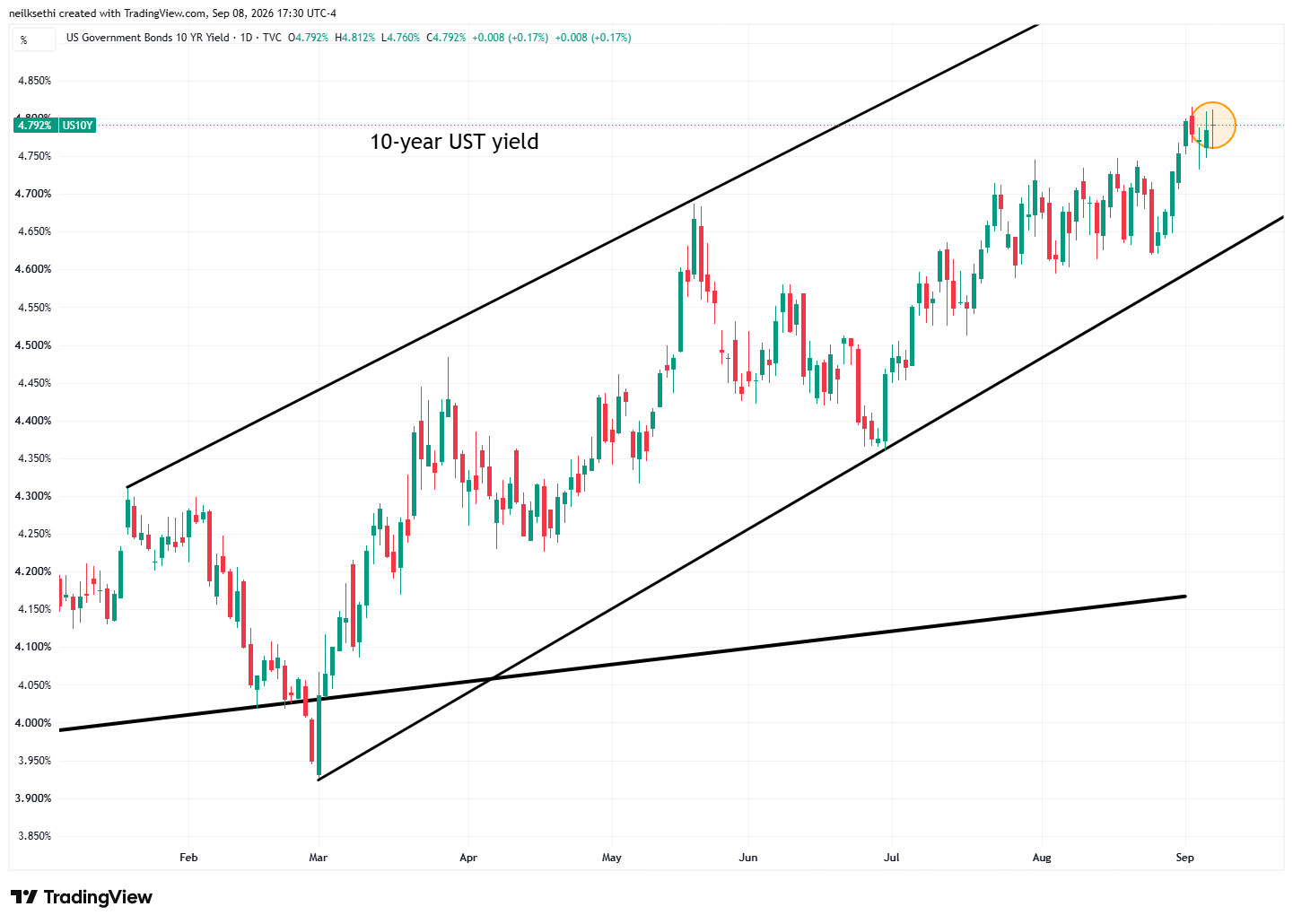
10-year yields up one basis point to 4.79% the second highest close this year (after last Tuesday).
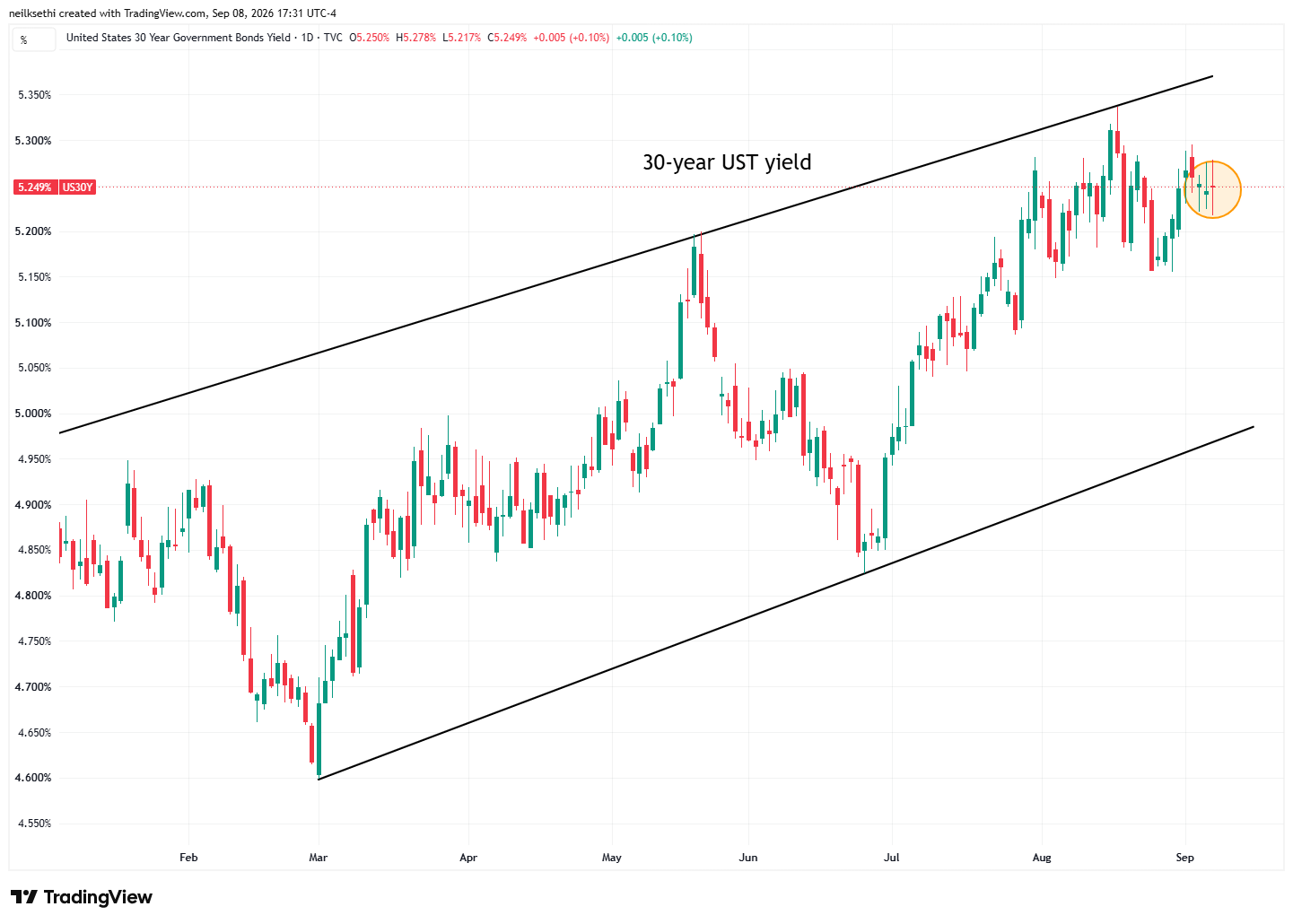
30-year yields also up one basis point to 5.25%, further off the highs of the year.
Some stuff on Treasuries from the weekend:
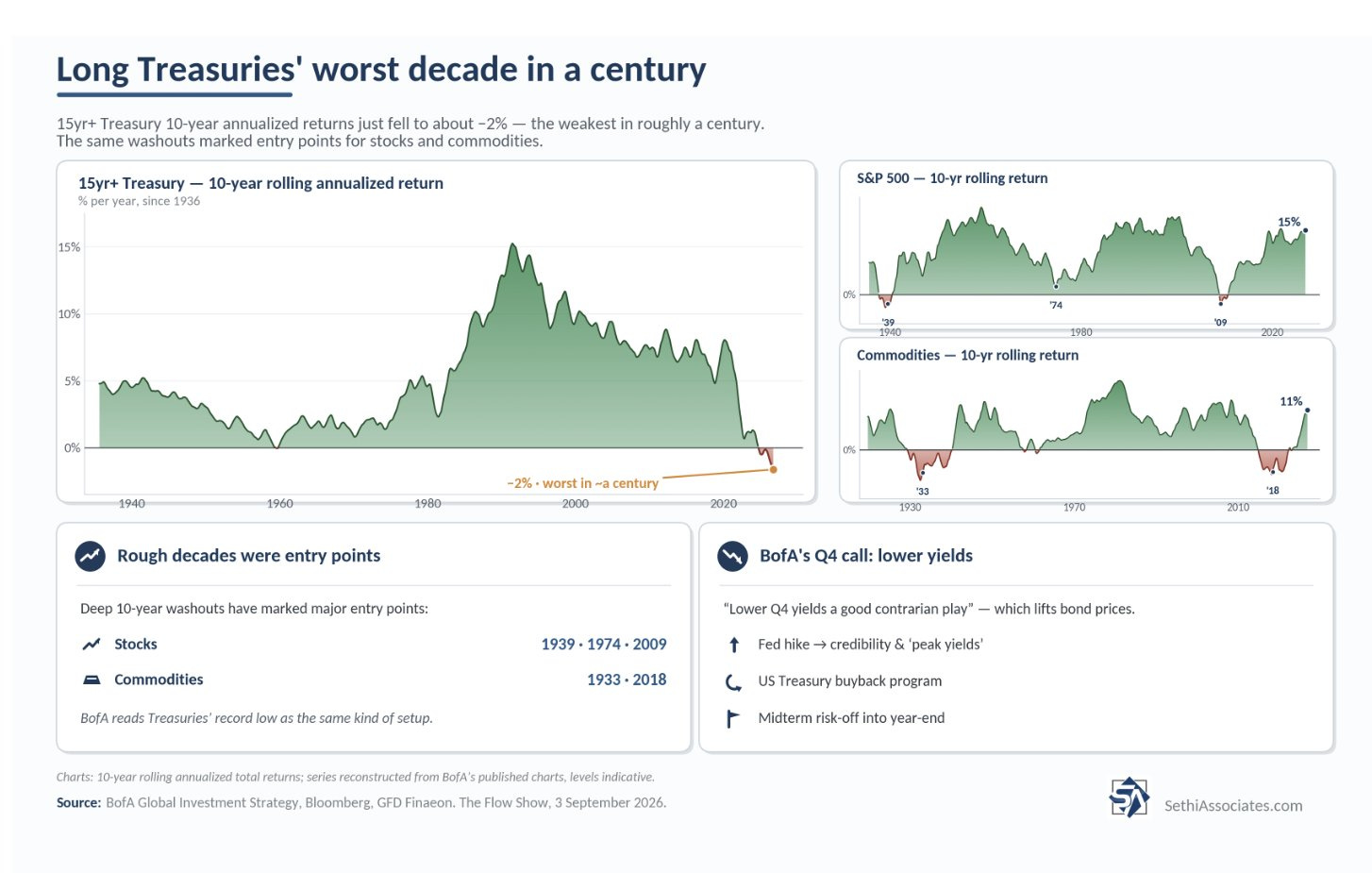
- BofA’s Hartnett notes the 10-year rolling return from 15+ year Treasuries is “-2% (worst of past 100 years),” but that “negative long-run returns” have proven “great entry points for stocks in 1939, 1974, 2009, commodities in 1933, 2018;”
He says while “US midterms [will not be a] ‘regime change’ election like Thatcher/Reagan ’80, BREXIT/Trump ’16, Fed hike, UST buybacks, rising risk midterms show voter priority [is] ‘affordability’ not lower taxes, faster AI data center expansion…”
That makes “Q4 yields [a] good contrarian play.”
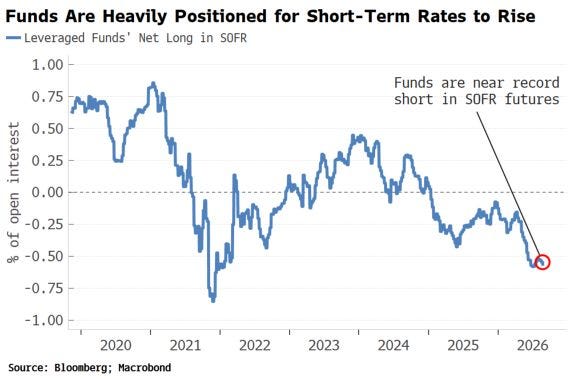
- Simon White (BBG): Hedge funds are strongly positioned for higher rates from the Fed.
Commitment of Traders data show leveraged funds are near record short in SOFR futures, over the history of that contract
…
That’s a pretty big overhang should the bet prove wrong – short covering would rapidly push rates lower
..
I can see good reasons for hiking, but at the same time, it would also make sense if Warsh maximised his hawkish credentials with the market (creating a tightening in financial conditions), but refrain from actually raising rates and therefore irking his boss
If that is the playbook, rates could see quite a nasty move lower after the September FOMC decision on the 16th
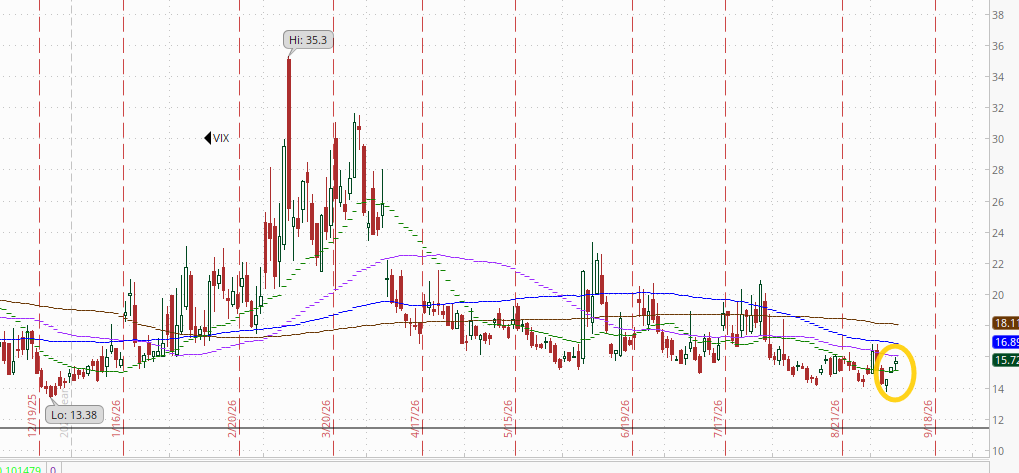
VIX rose for a third session from near the lows of the year to 15.7. The indicator is near the bottom of its “normal” range post-GFC, consistent with ~0.98% average daily moves in the SPX over the next 30 days.
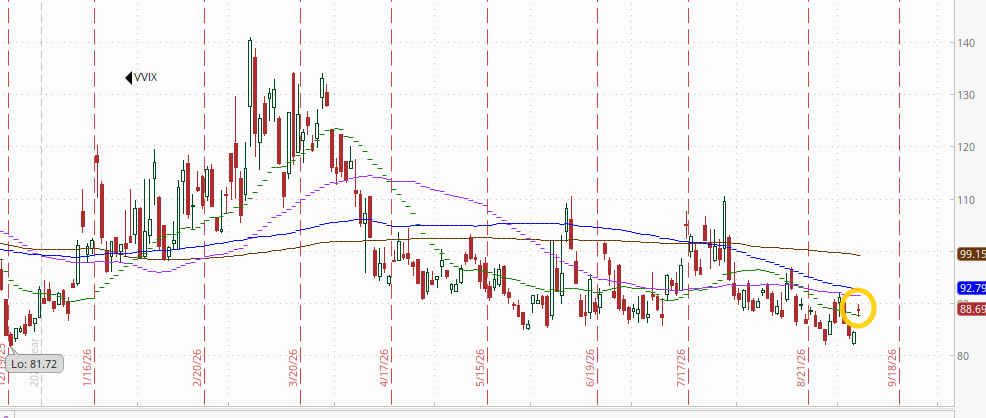
The VVIX (VIX of the VIX) also bounced to 88.7 after touching the lows of the year on Friday.
The current level is consistent with “moderate” daily moves in the VIX over the next 30 days (historically, normal is 80-100, but we’ve been above 90 most of the time since July ‘24). Above 100 is the level flagged by Charlie McElligott as indicating higher stress.
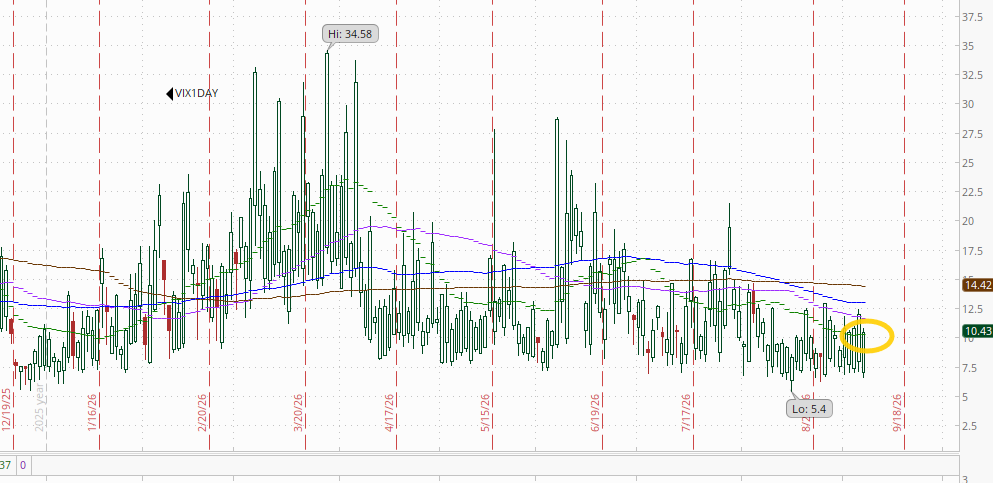
1-day VIX edged back to 10.4, more elevated than we saw at the end of August but less than the beginning. The current reading isconsistent with a move of 0.65% in the SPX next session.
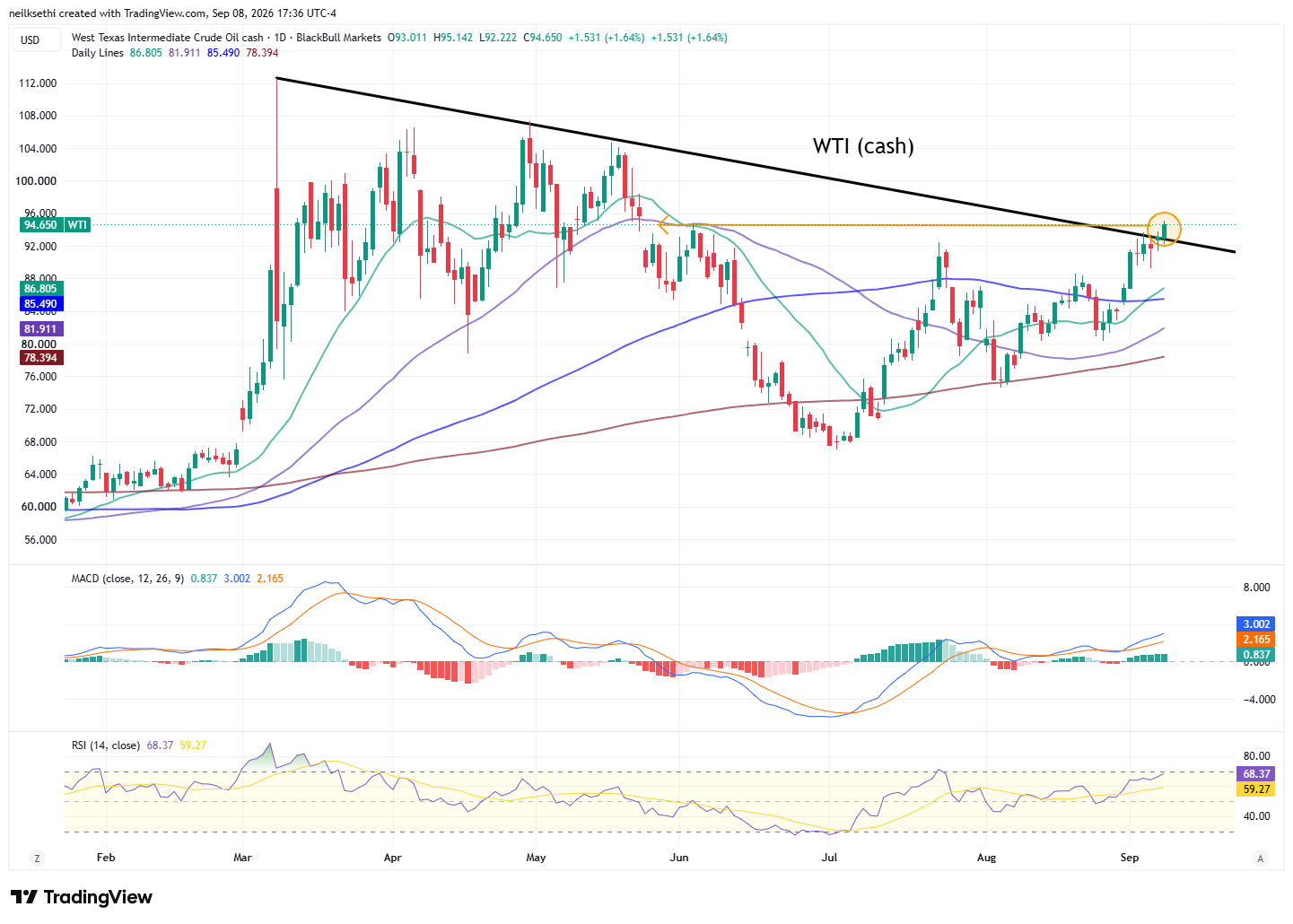
WTI up another 1.6% to the highest close since May 22nd. It also broke over the downtrend line from the March peak.
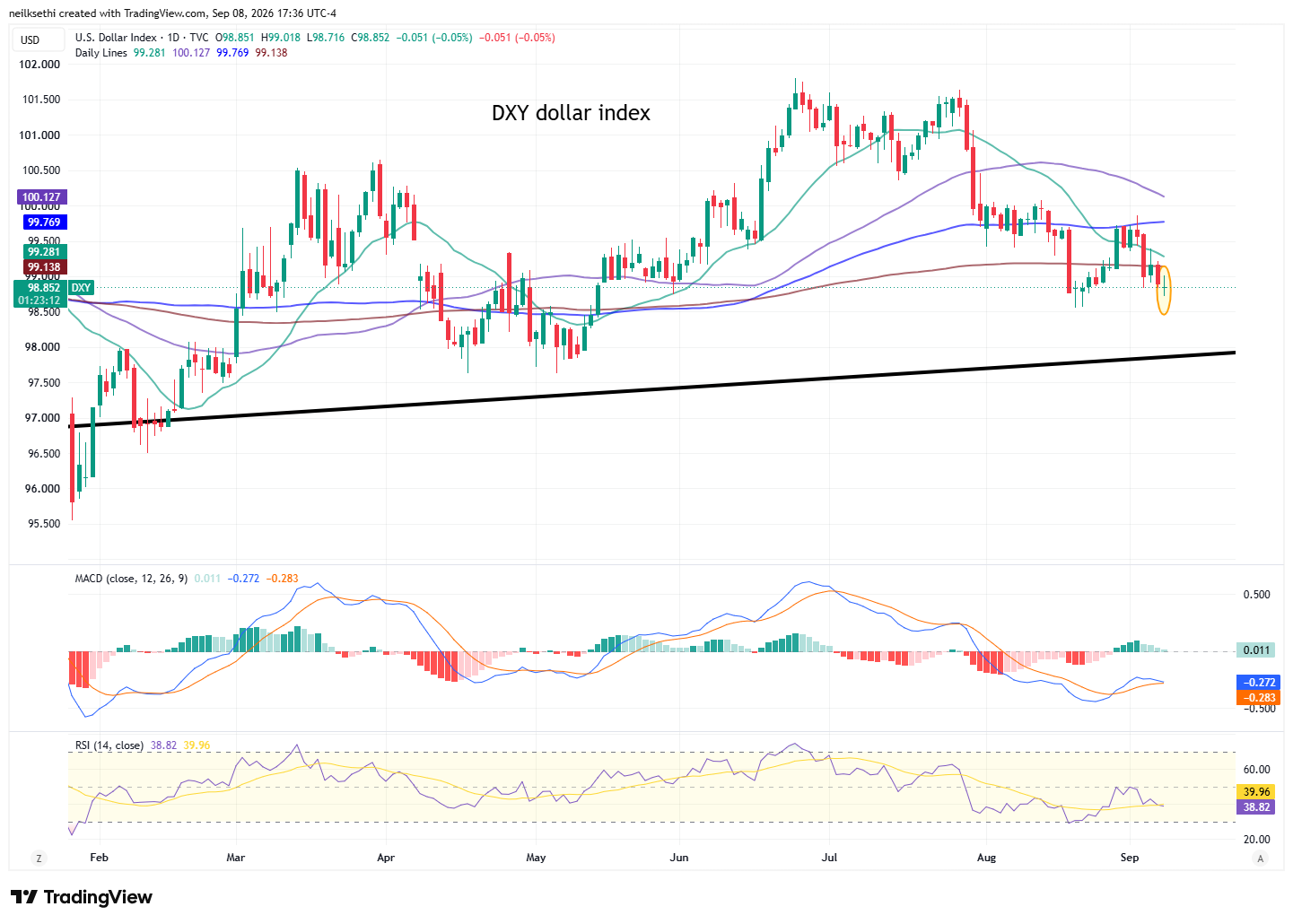
The DXY dollar index (which is fixed weighted with a heavy (57%) weighting vs the euro), little changed at near the lowest close since May.
The daily MACD has softened to neutral while the RSI is under 40, so not a lot of technical strength with heavy resistance above.
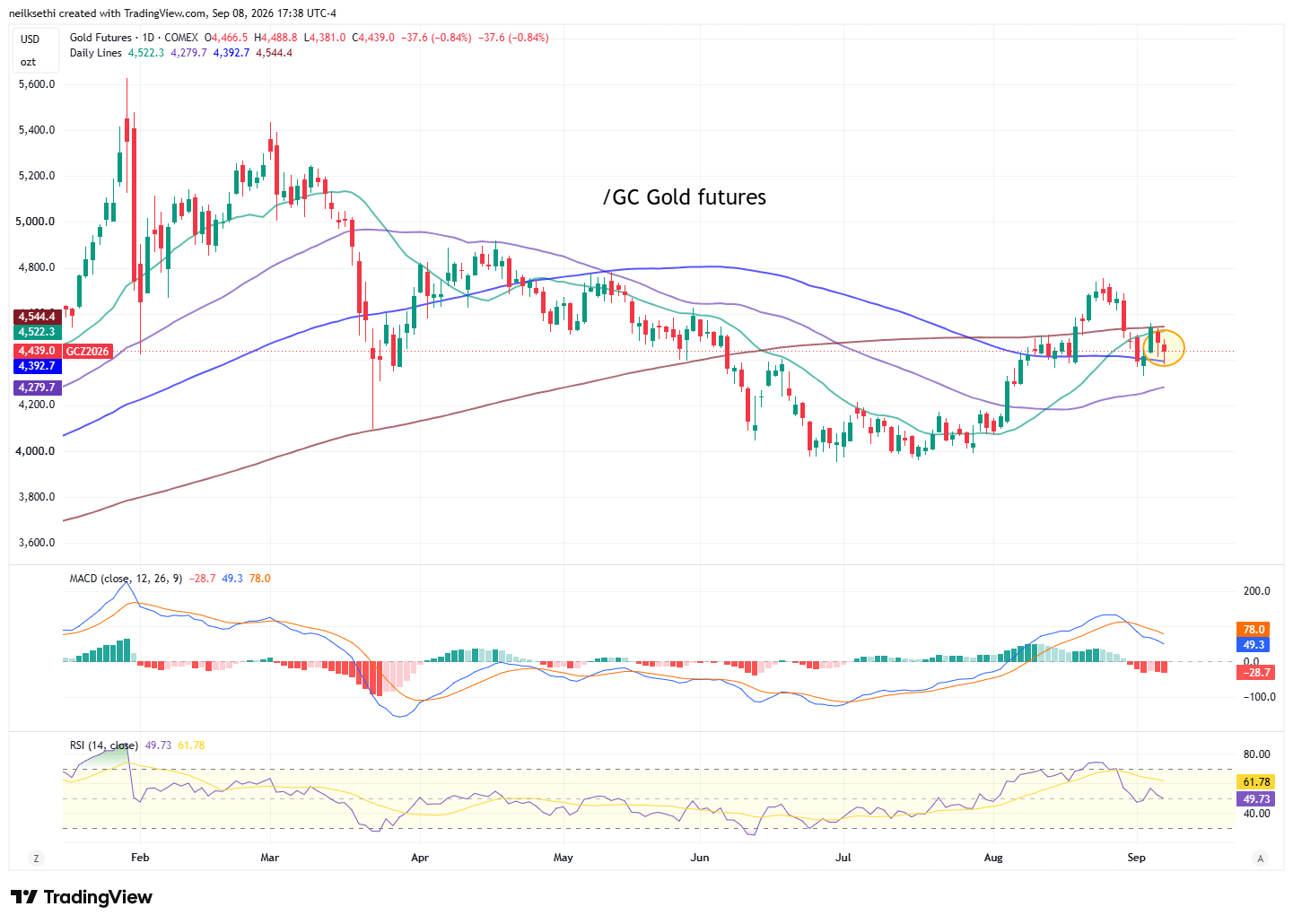
Gold futures (/GC) fell back after failing at the 200-DMA Thursday and Friday. The daily MACD remains negative while the RSI is at 50. I will wait for it to get back over the 200-DMA to add back what I took off when it fell below.
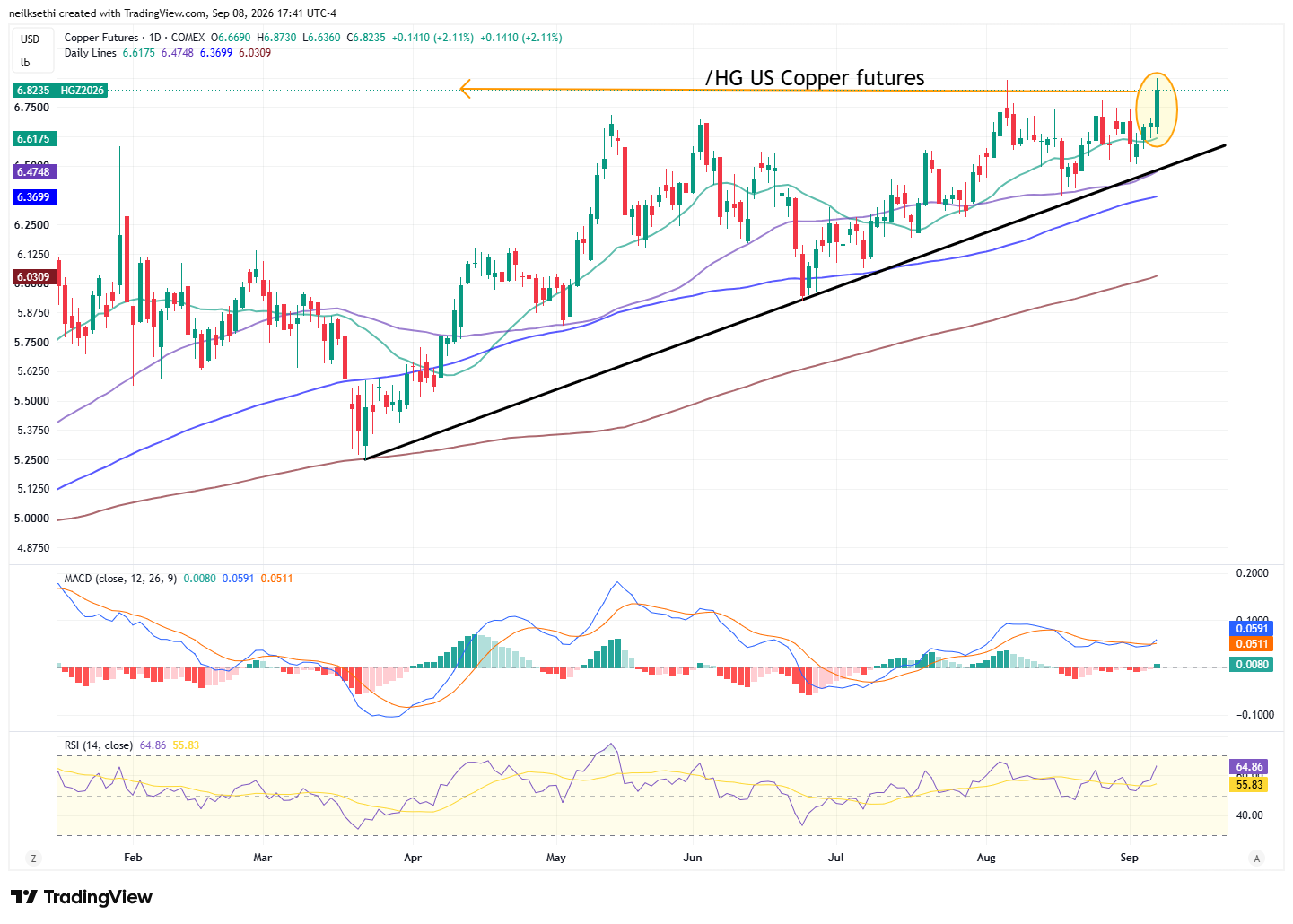
US copper futures (/HG) shot +2.1% to an all-time high, remaining in the uptrend from March (in addition to the longer term uptrend running to February 2020). Technicals also pushed more positively. I remain bullish as I have been since April.
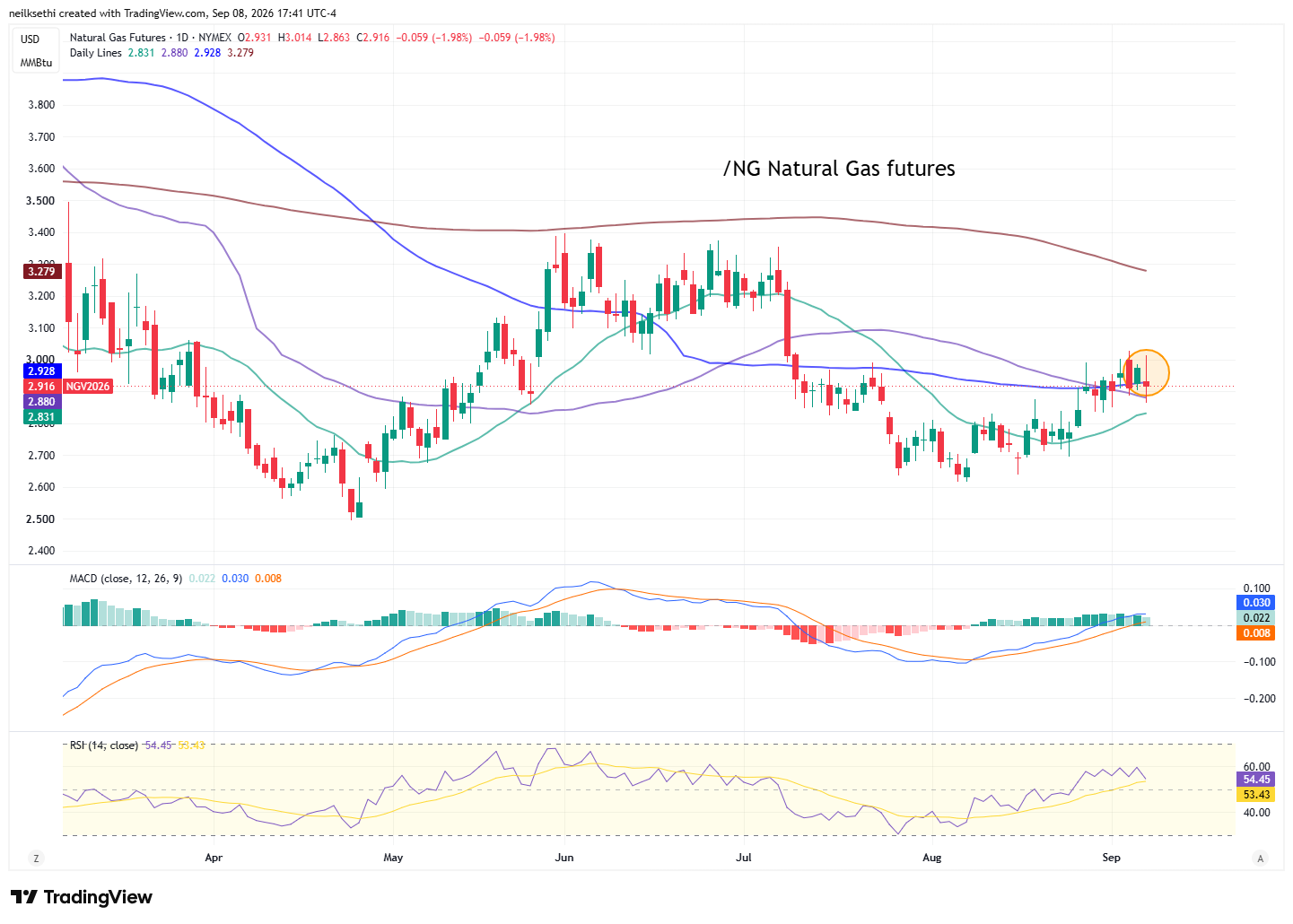
US natural gas futures (/NG) failed at retaking the $3 level for a fourth straight session. As I have said, “if they actually can close above, a run up towards the 200-DMA is not unlikely.” The daily MACD as noted a month ago flipped to more bullish and the RSI remains over 50 for now.
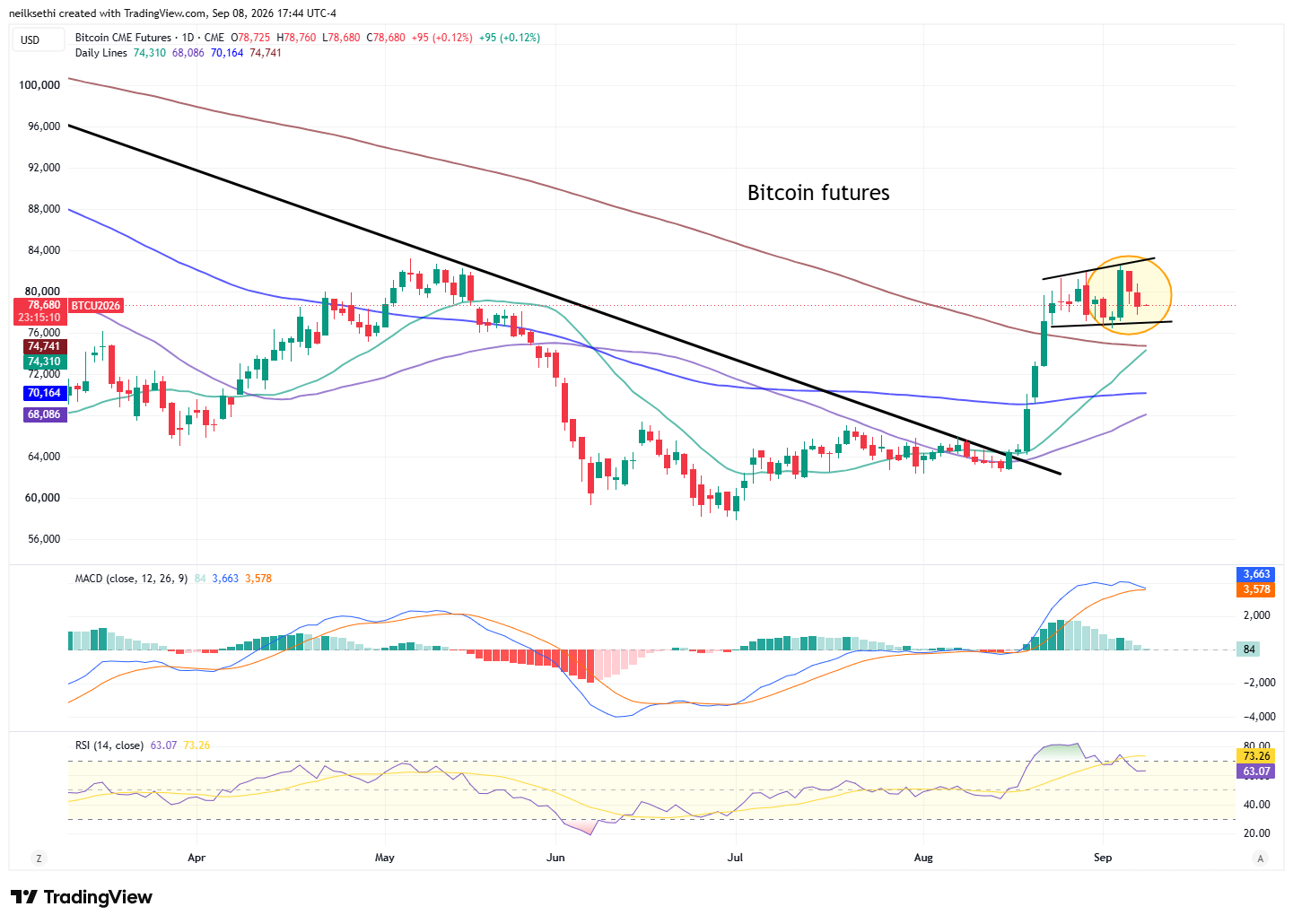
Bitcoin futures continue to trade sideways consolidating their August gains. Seems to be forming a sort of bull flag? Daily technicals are starting to slip though. I’ll stay long as long as it holds above the bottom of the flag (and will add if breaks above).
A Look Around TheStreet Pro:
- Helene Meisler – The Market’s Biggest Problem Isn’t What You Think
- Peter Tchir – Why This One Thing Has the Biggest Impact on the Long End of Yields
- Bret Jensen – Credit Markets Send Financial Warning Despite Index All-Time Highs
- Alex Frew McMillan – Bank of Japan Sees ‘Opportunity’ as Fed Leans Toward Interest Rate Decision
- Stephen Guilfoyle – A Chill Blows Through Wall Street
- Chris Versace – Canada Fires Back, Oil Nears $100: 8 Key Items Shaping the Stock Market Tuesday
- James “Rev Shark” DePorre – The Market Is in Transition as Summer Comes to an End
- Bob Lang – Charting the S&P 500: Uphill Battle Remains for the Index
Miscellaneous:
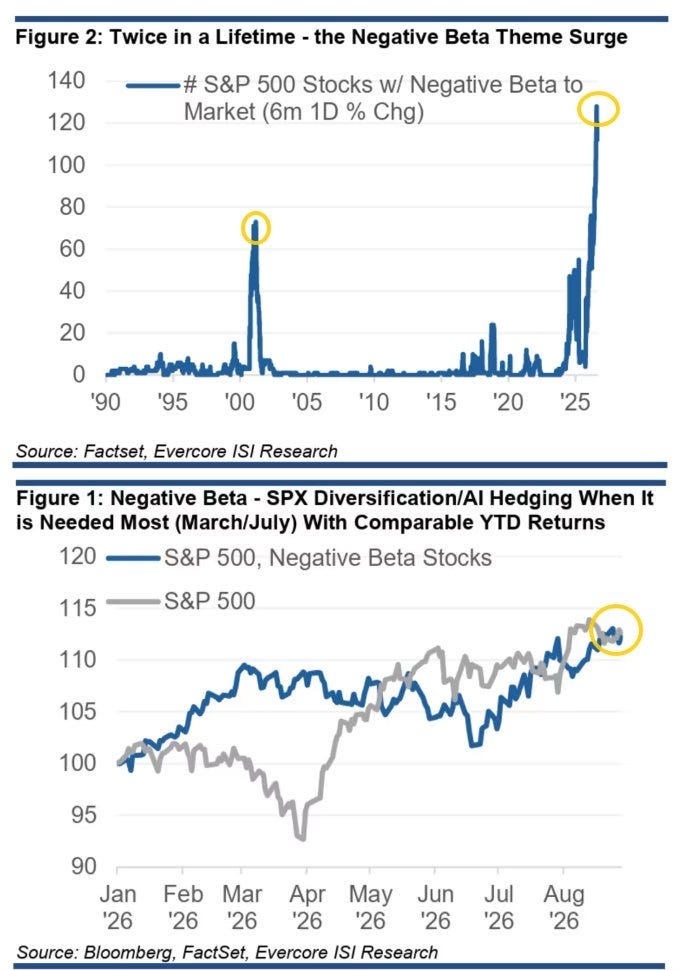
- Evercore strategists led by Julian Emanuel note that S&P 500 stocks with negative beta (i.e., that move in the opposite direction to the index) over the prior six months surged to 115 as of the start of the month, crushing the previous high of under 80 following the bursting of the internet bubble.
That’s even as the AI trade continues apace though as Emanuel says this time “investors have proactively sought diversification [with] index correlations (a mean reverting relationship) [sitting] at generationally attractive lows.”
And while that proactive strategy would have trailed badly during the internet bubble, in another display of how this time is different, a basket of negative beta stocks has kept pace with with the SPX this year.
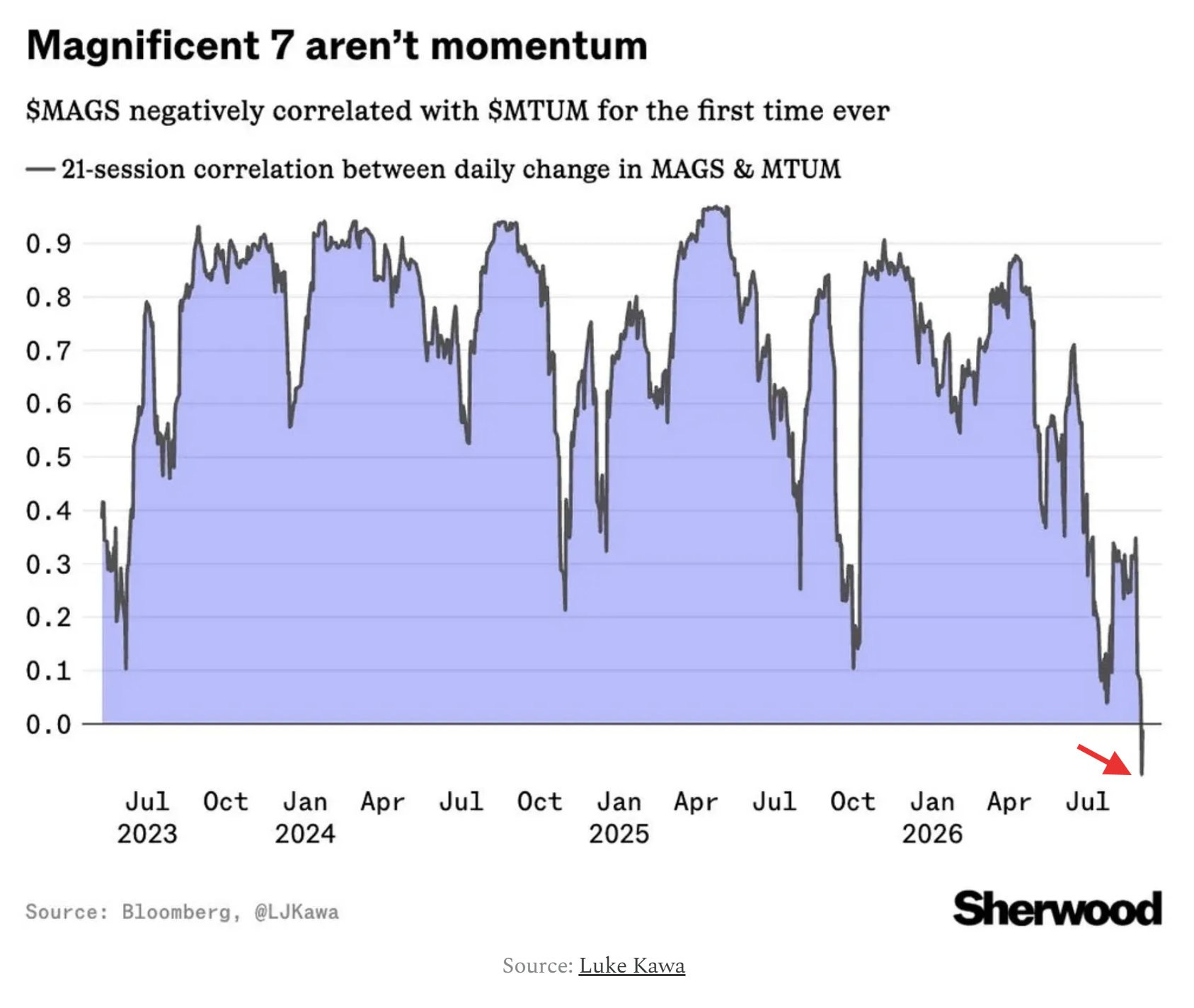
- As always a nice commentary from Eric Soda. I’ve noted before he has for years maintained a bullish outlook on the Mag-7 (and that remains), and he notes a potential bullish catalyst for the group in his note.
Per terrific follow Luke Kawathe MAGS Mag-7 ETF is now negatively correlated with the momentum factor (represented by the MTUM Momentum Factor ETF) for the first time since MAGS was launched in 2023, despite an over 10% run for MAGS since the late July low.
That suggests rules-based momentum strategies have yet to re-enter, leaving that as potential fuel if MAGS can continue to rally. As a side note, the next scheduled major reconstitution for MTUM is in November.
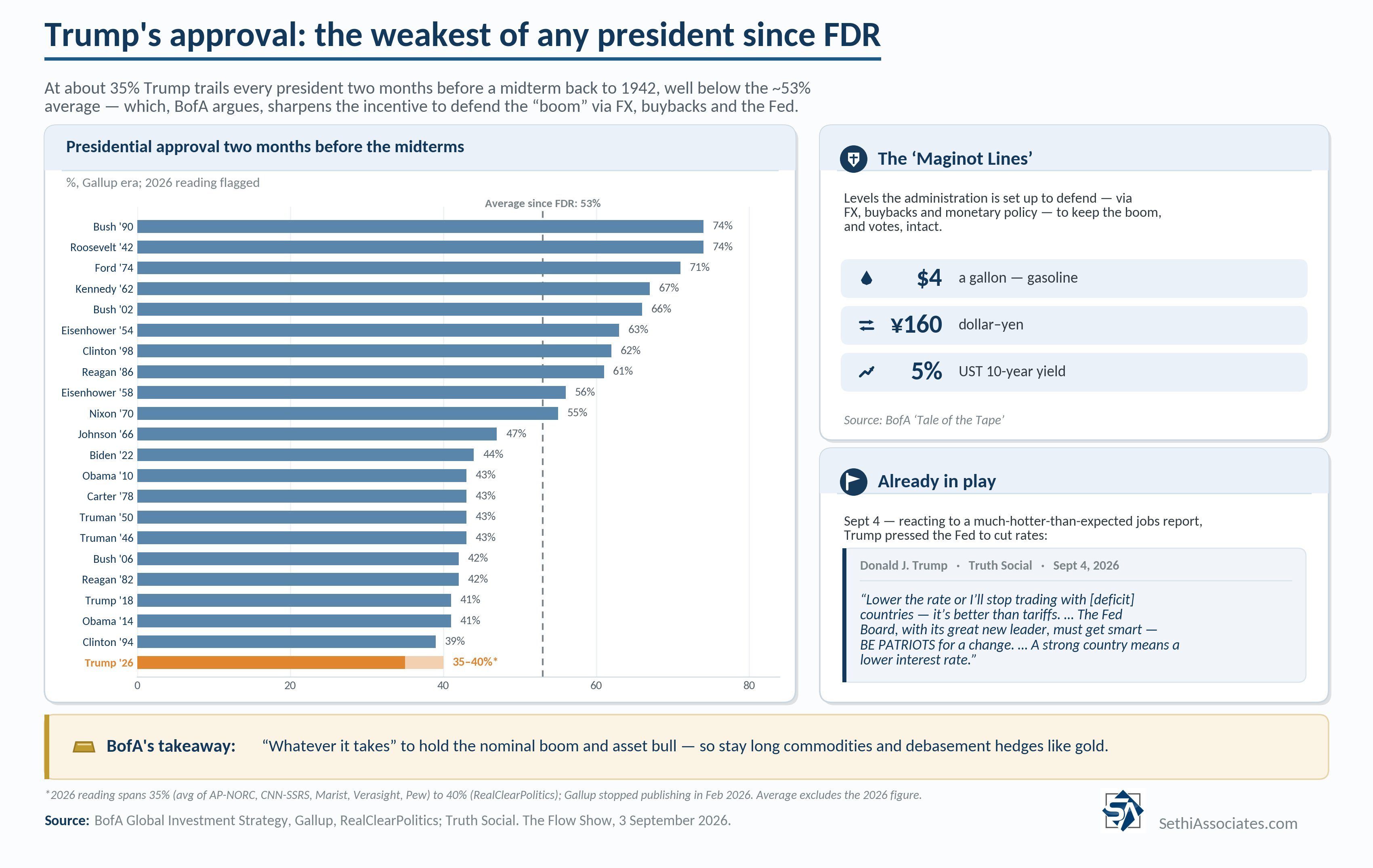
- BofA’s Hartnett (Flow Show) notes that “DEM sweep likelihood rising; Trump Presidential approval number ranges from 35 to 40%, significantly below historical average 2 months ahead of midterms (53%) since FDR; Polymarket probability now shows DEM sweep 50%.”
To avert DEM sweep Harnett says the administration must defend “Maginot Lines” of “$4/gallon gas, 160 dollar-yen, 5% UST bond yield”.
Hartnett also says administration will undertake “‘whatever it takes’ policies to maintain nominal macro boom and asset price bull… stay long commodities & debasement hedges, e.g. gold.”
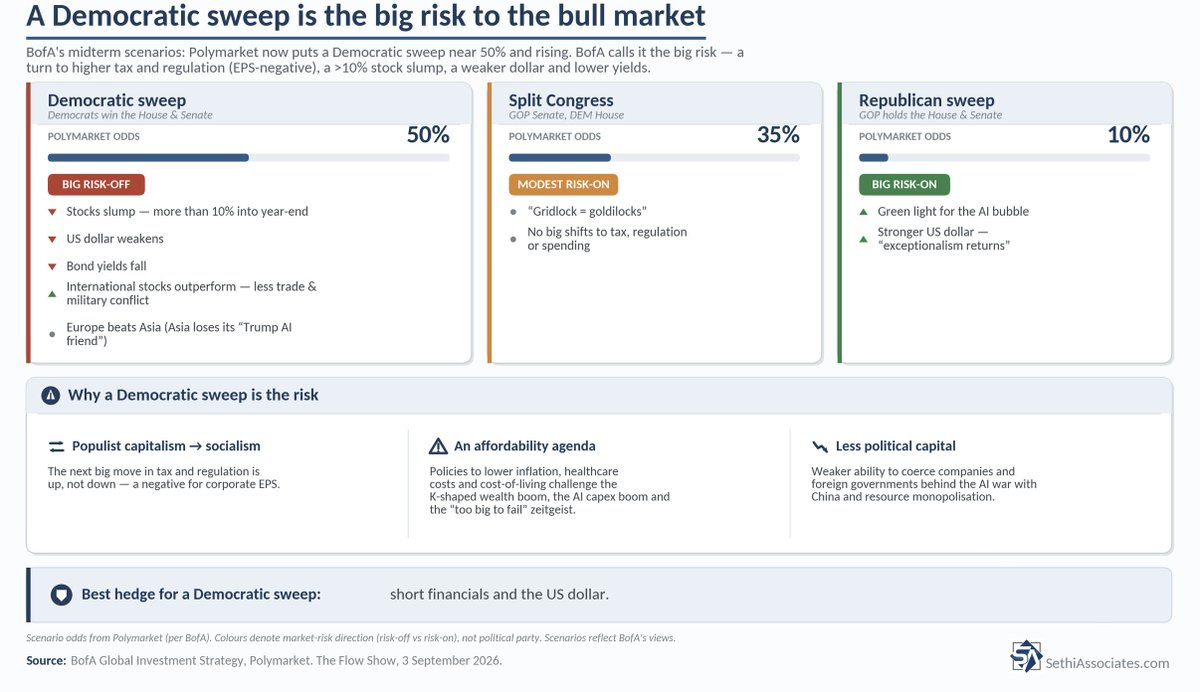
- Hartnett says if the Democrats do manage a sweep, it’s a “threat to asset prices… electoral shift from populist capitalism to populist socialism says next big direction in tax & regulation up not down (EPS negative)... policies to lower inflation, healthcare, improve affordability challenge K-shape wealth boom, AI capex boom, stocks ‘too big to fail’ Wall St zeitgeist;
In addition, the “loss of political capital = less ability for Trump to coerce resources, corporations, foreign governments into support for policy priorities of AI war with China, resource monopolization.
“We say DEM sweep = big risk-off… slump in stocks (>10%), US dollar, bond yields into year-end; international stocks outperform on less trade & military wars; but Europe outperforms Asia (loses Trump AI friend); we say best hedge for DEM sweep is short financials & US dollar;
“in contrast, a surprise GOP sweep (maintain House/Senate) control = big risk-on… green light for AI bubble and positive US dollar (‘exceptionalism’ returns); scenario of ‘GOP Senate, DEM House’ = modest risk-on... ‘gridlock = goldilocks.'”
Wrap-up – The Lull Continues
I mentioned in the Week Ahead the “lull phase” at the end of each earnings season this year noted by Deutsche Bank, as well as the many reasons to be watching for a September pullback, so today’s weakness is not a big surprise.
It was nice to see the AI trade reengage, but less nice to see the broad weakness outside of Energy and Utilities. That has me concerned about the broader market, particularly with the technical deterioration in the equal-weighted SPX.
At this point, though, I need to remind myself of what I wrote:
The economy continues to look resilient, if uneven, with GDP trackers still pointing to solid growth. Earnings have been extraordinary, and while expectations are for growth to slow, it holds at double-digit levels through 2027. Valuations have continued to ease. Positioning is not uniformly stretched — on the discretionary side in particular there is plenty of room to move higher. And outside of BofA’s Bull & Bear Index (which hasn’t been much use since it was reformulated in December), sentiment sits just moderately bullish to neutral (a good place for equity gains historically).
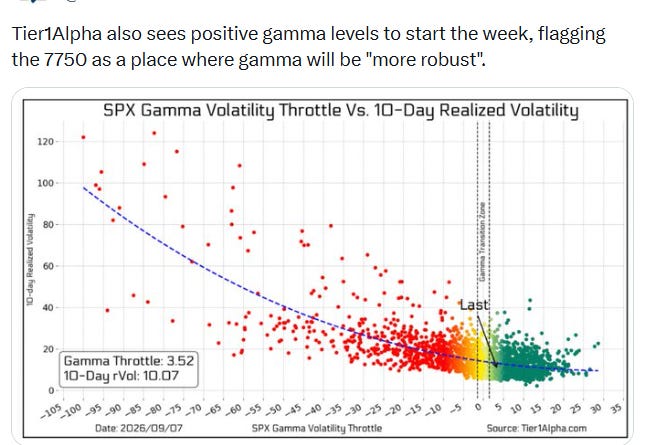
The technical and flow picture reinforces it: dealer gamma is positive again, suppressing volatility and encouraging larger systematic holdings; buybacks are back in full force; and retail continues to keep allocations high. None of this eliminates downside risk, but together it makes it hard to turn too negative unless the data, rates, or flows deteriorate more meaningfully.
So my view continues to be that the setup is constructive — but with positioning this extended and markets on edge, this is not a time to be complacent. Pullbacks and chop come with the territory, and a material pullback would not surprise me. But as of now there’s no reason to make that our base case.
A Light Day Ahead
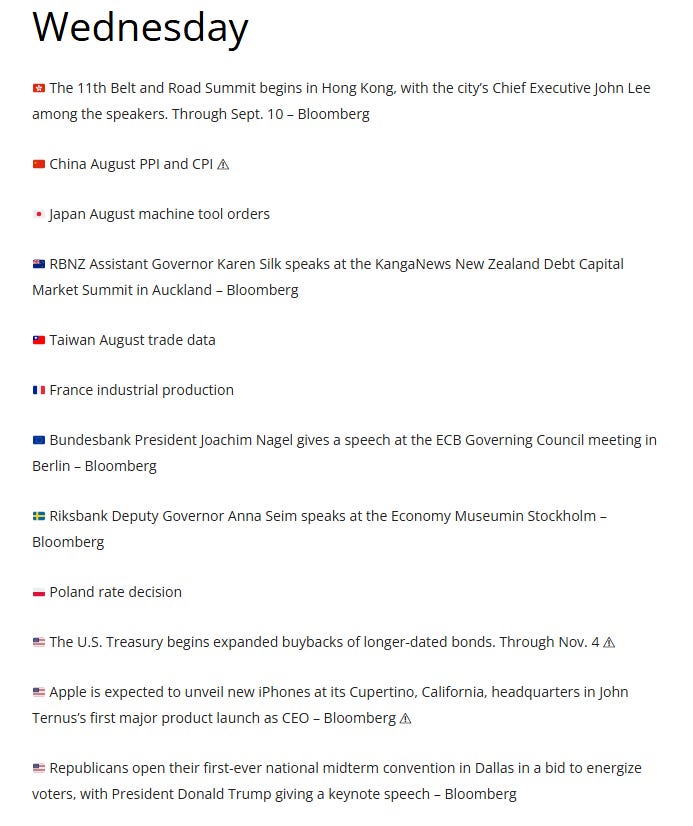
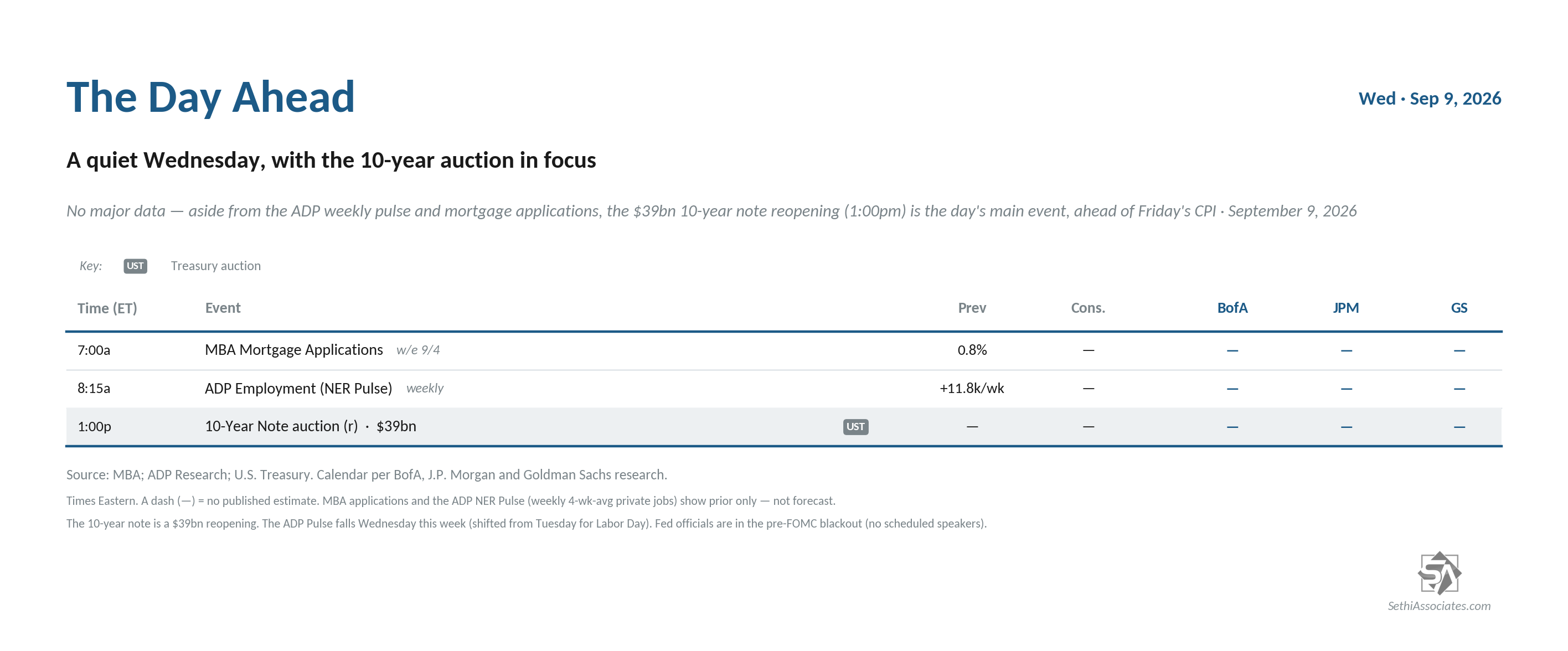
Wednesday is a very light day for US economic data with just weekly mortgage applications.
No Fed speakers with the blackout in effect.
Non-Bill (>1yr in maturity) US Treasury auctions though heat up with the benchmark 10-year. As mentioned in the Week Ahead, this will be the first under the US Treasury’s expanded buybacks.
In terms of corporate events, we continue to wrap up Q2 earnings season with just one SPX component reporting in The Cooper Companies (COO). Also, Apple (AAPL) releases its new suite of products Wednesday.
Ex-US highlights include China CPI & PPI, France industrial production, and a policy decision in Poland.
Finally, the US Republican Party will hold its first midterm national convention in Dallas on Wednesday and Thursday. President Trump and Vice President Vance are expected to deliver speeches.
From Christophe Barraud’s Week Ahead: