The Outlook for Residential Real Estate in 2025
A look at how one pro integrates economist insights into his own research to develop an actionable strategy.
You've reached your free article limit
You've read 0 of 1 free Pro articles.
One of the most impactful strategies for advisors is to maintain detailed notes on what clients share about their personal situations and then use that information to assess broader economic trends. This bottom-up approach often provides a clearer and more accurate picture of the economy than mainstream news.
I like to seek out the best analysts in specific areas and contrast their insights with real-world client experiences.
To illustrate this, I’ll share an example of how I integrate insights from one of my favorite economists in the real estate market—Redfin's Chief Economist—into my analysis. By comparing these expert perspectives with my observations, I develop actionable conclusions to guide clients in making informed decisions about the real estate market for the coming year.
An Internal Discourse About the Real Estate Market
As we move toward 2025, the U.S. housing market stands at a critical juncture. Insights from Redfin economists Daryl Fairweather and Chen Zhao, combined with my client observations, point to a complex landscape influenced by economic policy, demographic changes, and supply dynamics.
There may be overhead supply in the residential real estate market
Redfin predicts a 4% rise in home prices due to insufficient inventory. However, I foresee a more balanced scenario. Many of my clients are considering selling their homes but have yet to list them, suggesting a latent overhead supply. If sellers, particularly investors, adjust their expectations downward in response to market saturation, price growth may be more moderated than Redfin anticipates.
Interest rates will be stubbornly high
Interest rates remain a pivotal factor. Redfin forecasts rates hovering near 7%, driven by Federal Reserve policies and inflation pressures from tariffs and tax cuts. I agree that rates could stay elevated.
The technical downtrend in interest rates that persisted for decades has likely bottomed out. This structural shift implies that rates could remain stubbornly high, especially given the challenges of excessive federal spending and poor debt management. Even with plans like using DOGE to mitigate spending, without meaningful fiscal discipline, the continued printing of money to finance deficits will likely devalue the dollar further. This scenario could sustain higher-than-normal inflation and interest rates, even during an economic slowdown.
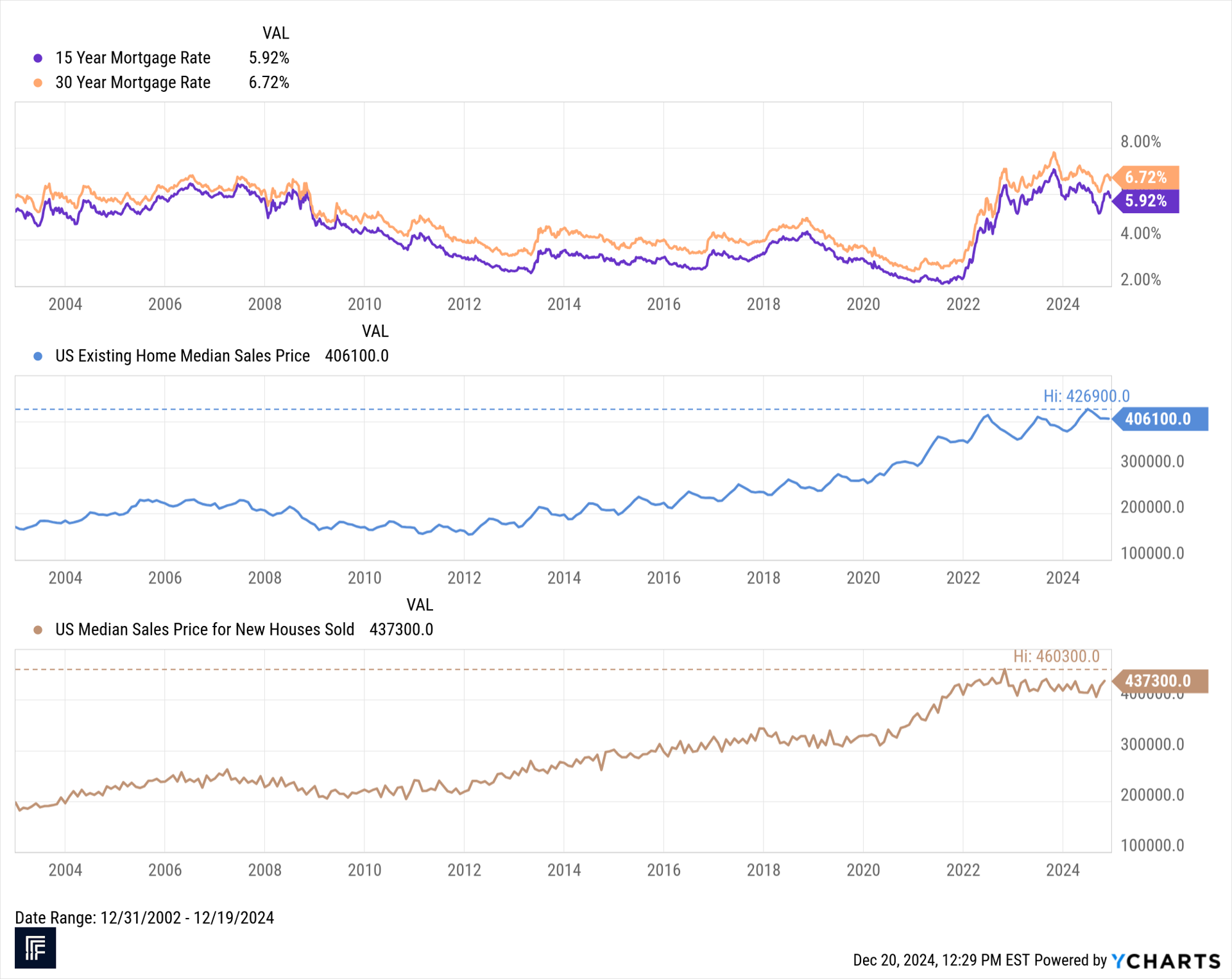
But rates will not have a disastrous effect on real estate prices
While an extreme case of falling rates coupled with declining home prices—like the 23.7% drop in median home prices from $262,600 in March 2007 to $204,600—is possible, it is not my prediction. The factors outlined above suggest a more persistent environment of elevated rates unless significant policy changes occur.
Home sales will be up but they will likely be met with hidden supply
Both Redfin and what clients are telling me indicate a rise in home sales, driven by pent-up demand. Redfin projects a 2%–9% increase in transactions as buyers adapt to higher rates. I concur and note that while significant supply waits to enter the market, life changes may compel many to buy or sell at adjusted price points, even if not at peak values.
Rental demand will be good but rental rates will be good in some places and bad in others
The rental market is expected to favor tenants but investors want to move properties to less regulated states. Redfin predicts flat rents coupled with rising wages, improving affordability. This aligns with my observations of clients who are investors and homeowners moving out of highly regulated states, which could increase rental inventory. This dynamic particularly benefits those priced out of buying, offering stability in the rental sector. High net worth real estate investors will continue to sell properties and go into other more attractive states, regardless of the view that things are getting better in highly regulated cities
Regulations will probably make it easier to build so supply will increase
Policy changes are likely to play a significant role. While Redfin anticipates regulatory easing to spur construction, I emphasize that investor hesitance in states with restrictive landlord policies could lead to geographic shifts in investment. Regions with favorable tax environments and strong job markets are poised for increased construction and investment activity.
People were reminded again that hurricanes aren't fun
I've seen this cycle before. Clients want to move to Florida or other areas where hurricanes are abundant. And then they change their mind and that influences new migration. Redfin highlights the impact of disasters on prices in high-risk areas, driving demand in more stable regions like the Midwest and Northeast. My clients also want to benefit from economic and tax incentives will further influence these movements, shaping both residential and multifamily real estate markets.
Generational Trends
Many of my clients’ children, particularly those in Gen Z, are delaying homeownership, opting to rent or live with family. Redfin identifies this trend as a key driver impacting demand for entry-level homes while supporting growth in the rental market.
More people with be buying and selling houses and supply and demand will be more balanced so I'm cautiously optimistic on residential real estate in 2025
After harmonizing my observations with Redfin’s analysis, I arrive at a cautiously optimistic outlook. While price increases may be tempered by supply and market dynamics, high interest rates are likely to persist unless economic conditions shift dramatically. Regulatory and demographic trends will continue to shape the market, requiring adaptability from all participants. The housing landscape of 2025 will be defined by these interconnected factors, creating opportunities for informed decision-making.
Final Thoughts
I hope this thought process helps you reconcile what you are observing with what the best specialized analysts are predicting. By combining these methods, you can provide stronger and better advice while making more informed decisions for yourself and your clients.