The Goldilocks Traders
Will jobs be not too hot nor too cold? Is a palatable Iran deal on the table? And is the market charting out a rally? Let’s dig in.
You've reached your free article limit
You've read 0 of 1 free Pro articles.

Goldilocks and the Three Bears
“First she tasted the porridge of the Great Big Bear, and that was too hot for her. Next she tasted the porridge of the Middle-sized Bear, but that was too cold for her. And then she went to the porridge of the Little Wee Bear, and tasted it, and that was neither too hot nor too cold, but just right, and she liked it so well that she ate it all up, every bit!”
– Originally by Robert Southey (1837), retold by Flora Annie Steel in 1922
Jobs Day
Friday, the first Friday of the month. You’ve made it. Just a couple of miles to go. Jobs day. Always a tricky day for traders and investors to navigate. The Department of Labor’s Bureau of Labor Statistics will release the July results of the agency’s two monthly employment-focused surveys at 8:30 ET this morning. Consensus view for job creation in the form of non-farm payrolls seems to be up in the mid-90,000s, which while not “gangbusters” type growth, would be up modestly from June’s addition of 57,000 positions. Readers can see below that I am at 89,000 new jobs. Then again, these numbers are revised, quite often significantly, over the two months after release and down the road as well.
Don’t let the fact that these numbers are salted, peppered and then revised multiple times later on stop anyone from reacting. Markets do move on this data. Why? Simple. Trends in demand for labor as interpreted by financial markets reflect mass expectations for the trajectory of monetary policy, cross-referenced across data for consumer level inflation, on the national level. Sounds like a mouthful. Not really complex though.
A strong labor market is a positive for the economy. On this, we have no doubt. Yet, central bankers will fear that increased demand for labor could force upward wage spirals and in turn support accelerating consumer-level inflation. So, are markets rooting for a weak labor report? No, not really. Something that comes off as jarringly soft will force traders, investors and economists to consider the potential for economic recession, which would be far worse than a burst of inflation supported by increased demand for labor.
So, we are Goldilocks? Exactly. We want our porridge this morning. We’re hungry. That said, we don’t want something too hot. We don’t want something too cold. We want something just right. By the way, the consensus for the unemployment rate is for a 4.2% print for July, same as June. That is my expectation as well. Be cognizant though, that the Chicago Fed’s model is showing unemployment of 4.1% for July. A market positive? Only if it’s not caused by too many potential workers leaving the labor force. Nobody wants to see reduced participation.
Such a Deal?
So, Iran reportedly has come to an agreement with Oman on reopening the Strait of Hormuz to commercial maritime traffic. Regional media reports have stated that Iran will seek to bar vessels from both the U.S. and Israel from using the Strait. Iran, reportedly, will also require compensation from hostile countries before they’re allowed to sail through the narrow passage. The government in Tehran apparently adds that a full reopening of the Strait would require the lifting of the U.S. naval blockade.
Is this true? Do we really know? Markets have cooled over the past two days after apparently prematurely pricing in a peace deal. Crude oil prices have started to move higher again. So have yields (prices down) paid by U.S. Treasury debt securities. Former U.S. State Department official Thomas Warrick was quoted by Bloomberg News concerning the Iran-Oman news. He stated, “That’s clearly not going to go down well in Washington. Instead of both sides making concessions, both sides are increasing demands.”
The Trump administration has been pushing for free civilian commercial transit through the passage, while more or less calling for a return to the pre-war status quo. The U.S. stance is that temporary routes through the Strait won’t be subject to approvals, exclusions or tolls of any kind. When asked at the White House on Thursday evening about these negotiations, Pres. Donald Trump simply said, “Moving along good.”
Meta Penalty!
Holding. Ten yards. Still third down. News broke late Thursday that a New Mexico judge had ordered Meta Platforms (META) to pay $942 million and in addition, to limit the amount of time that minors can spend on its social media platforms. Those platforms include Facebook, Instagram, WhatsApp and Threads. According to the ruling, Meta must create a new $567 million abatement fund to remediate harm done by the firm’s platforms to children. This would be in addition to paying the $375 million in civil penalties that a jury ordered back in March.
What does this mean for the stock? So far, very little. Meta Platforms has stated that the firm disagrees with the ruling and plans to appeal. A company spokesperson commented for the media, “We remain confident in our record of protecting teens online and will continue to defend ourselves against claims that misrepresent the facts.”
From the state of New Mexico’s perspective, this award falls short of what was asked for. That’s not the key issue for Meta Platforms, though.
Meta has to appeal and has to take some kind of win away from the process in that state. Why? Because there are a lot of arrows aimed at the firm. Meta is facing thousands of these lawsuits. These suits are being launched by state attorneys general, school districts and even individual plaintiffs that allege the company prioritized growth over safety concerning underage users. The New Mexico case is just the first to openly question whether social-media companies are to be held responsible for the content posted on their platforms by users.
Marketplace
Thursday was a generally negative day, but not significantly so. This was the second day like this consecutively coming after a “peace deal-stoked” four-day rally that took the major indexes back toward or even creating new all-time highs. On Thursday, the S&P 500 gave back just 0.18%. That came after a 0.17% loss on Wednesday. The Nasdaq Composite surrendered 0.83% on Wednesday but gave back just 0.06% on Thursday.
Moving out into the foliage to keep from being spotted by aircraft, small caps, the transports and the banks all underperformed the broader marketplace while the semiconductors outperformed. Only three of the S&P sector SPDR ETFs managed to finish the regular session on Thursday in the green, led by Energy (XLE). Despite the fact that there were eight losers, not a single sector SPDR even gave up 0.9% for the day. There was no clear winner for the session in the eternal tug of war between the cyclicals and the defensives. Both growth sectors finished in the top five for the day, so we do have that.
Losers beat winners by a rough five-to-three margin for the day at the NYSE and by about seven-to-five at the Nasdaq. Advancing volume took a rather paltry 37.9% share of composite NYSE-listed trade. Advancing volume, however, took a “near-majority” 49.2% share of composite Nasdaq-listed activity, turning the day into something of a “nothing burger.” Reinforcing that concept or at least in acknowledgment that July jobs were on deck, aggregate trade decreased on a day over day basis across NYSE-listings, across Nasdaq-listings and across the membership of the S&P 500.
Chart Setting Up for Rally?
Note that trading volumes have been lower over the past two sessions vs. the four-day rally, which came on much heavier traffic. This implies that professional managers are participating in greater numbers or with greater enthusiasm during rallies than they are during selloffs.
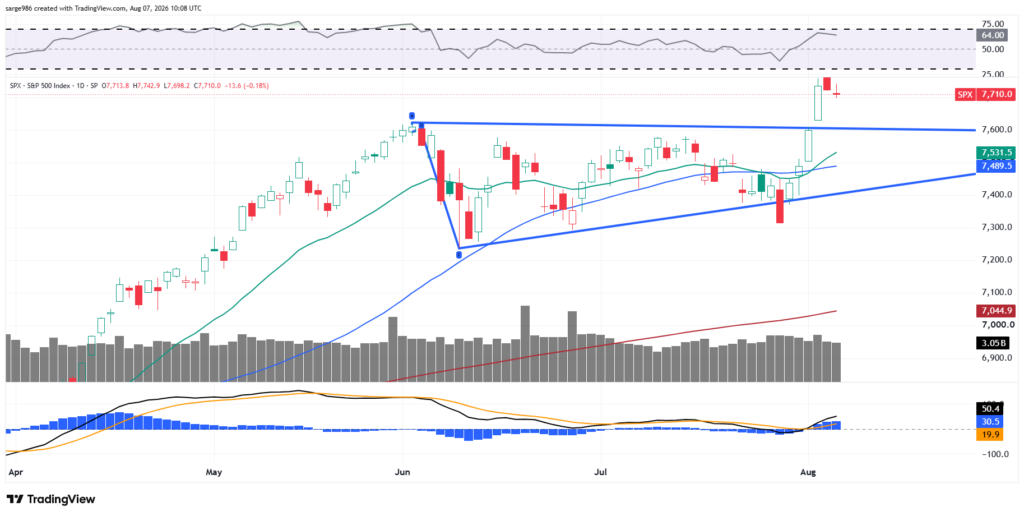
While the July jobs release may circumvent any of our carefully laid out analysis, I did tell readers that the S&P 500 could test the pivot created by the often-mentioned “ascending triangle” set-up before taking off. That is still a possibility. That said, both Relative Strength and the daily moving average convergence divergence are set up for a rally.
The Yen Game
The Japanese yen has already given back almost half of the intervention-driven gains made earlier in the week. At last glance, the yen was trading at 158.34 to the U.S. dollar. This is well off of a 155.23 peak on Monday. The yen traded at close to 161 per dollar last Friday and at almost 164 per dollar in late July.
July Employment Situation (08:30 ET)
Non-Farm Payrolls: Expecting 89K, Last 57K.
Unemployment Rate: Expecting 4.2%, Last 4.2%.
Underemployment Rate: Expecting 7.9%, Last 7.9%.
Participation Rate: Expecting 61.6%, Last 61.5%.
Average Hourly Earnings: Expecting 3.5% y/y, Last 3.5% y/y.
Average Weekly Hours: Expecting 34.3, last 34.3 hours.
Other Economics (All Times Eastern)
1:00 p.m. – Baker Hughes Total Rig Count (Weekly): Last 588.
1:00 – Baker Hughes Oil Rig Count (Weekly): Last 451.
3:00 p.m. – Consumer Credit (June): Last $-180M.
The Fed (All Times Eastern)
10:00 – Speaker: Richmond Fed Pres. Tom Barkin.
Today’s Earnings Highlights (Consensus EPS Expectations)
Before the Open: ESNT (1.76), OKLO (-.18), WEN (.16), TTWO (.36)
At the time of publication, Guilfoyle had no position in any security mentioned.