My Palantir Plan, Google's Quantum Leap and Taiwan Semis' Sales
Let's take a deep dive into PLTR's outside day, digest TSM's numbers, look at Alphabet's 'Willow' chip and more.
You've reached your free article limit
You've read 0 of 1 free Pro articles.
Very early on Tuesday morning, if one lives in North America, Taiwan Semiconductor TSM, which updates sales on a monthly basis, reported its November numbers. The world's largest foundry, manufacturing chips for the likes of Apple AAPL, Nvidia NVDA and Advanced Micro Devices AMD among many others, posted November sales of roughly $8.5 billion when translated into U.S. currency. While that print reflects year-over-year growth of 34%, it also shows a sequential 12.2% contraction from sales in October.
For the year to date (11 months), sales are up 31.8% vs. 2023. What might be more important is that sales for the two-month period of October and November combined were up 31.4% over the 2023 comparison. That's vs. the consensus 36.3% fourth-quarter sales that Wall Street has largely set its sights on, meaning that there is significant pressure here to put together a very strong December. Taiwan Semi's monthly sales reports are seen as a bellwether for demand for the high-end chips required to put together large language models (gen AI), data centers (the cloud) and all other purposes from gaming to mobile devices to autonomous vehicles. TSM is down about 1.6% as I work my way through the zero-dark hours on Tuesday morning.
Not As Ugly as It Looked
It felt like Rome was burning. Maybe that's because so many of my lower priced stocks, that have become something of a specialty of mine, were punched in the nose on Monday. Overall, though, the beating taken across financial markets was not really as severe as it felt, nor as severe as the financial media appeared to report. Bitcoin sold off rather sharply on Monday but is clawing its way back on Tuesday morning. Gold had a strong Monday session.
But Treasury debt securities were a little weak ahead of this week's auctions and ahead of this week's inflation-focused macroeconomic releases. The yield for the U.S. Ten Year Note moved 3 basis points higher for the session to 4.2%. That yield is up to 4.22% this morning in the early going.
Turning to equities, the S&P 500 gave up 0.61% on Monday as the Nasdaq Composite surrendered 0.62%. Both were coming off of record high closes on Friday evening. U.S. stocks, to include many higher profile names, were hit as the above-mentioned chip stocks were taken out to the woodshed. Nvidia shares dropped 2.55% in response to news it was under investigation in China, as Advanced Micro Devices dropped 5.57% in response to a downgrade to a "neutral rating from "buy" at Bank of America. Five-star analyst Vivek Arya lowered his target price for AMD from $180 to $155. Arya sees hyper-scalers developing and designing their own custom AI-chips rather than leaning on firms like AMD more and more going forward.
While it is true that nine of the 11 S&P sector SPDR exchange-traded funds closed in the red on Monday, breadth was far from being truly awful. Two defensive sector funds, Health Care XLV and the REITs XLRE closed in the green, while three of these funds gave up more than 1%, to include Communication Services XLC. That fund gave back 2.13%.
Losers beat winners at the NYSE by a 5-to-4 margin and at the Nasdaq by just 11 to 10. Surprisingly on a day that most would consider to be a "down" day, advancing volume took a majority share of composite trade for names listed at both the NYSE (52.7%) and the Nasdaq (59.2%). Trading volume was higher across listings at both exchanges, but I really don't think that means much as the race between winners and losers was little more than a photo-finish and more than half of all trade throughout the session was of the "take 'em" variety.
Quantum This!
The quantum computing world was shaken a bit on Monday as Alphabet GOOGL unveiled its own quantum computing chip known as "Willow." The new chip is capable of handling highly complex calculations in five minutes that would take the most powerful supercomputers on the planet 10 septillion years. At least that's what Alphabet said about its chip in a study that has now been published at "Nature." The intimation is that if scaled, this chip "could realize the operational requirements of large-scale fault-tolerant quantum algorithms."
Sundar Pichai, who is CEO of both Alphabet and its Google subsidiary, posted to social media, "We see Willow as an important step in our journey to build a useful quantum computer with practical applications in areas like drug discovery, fusion energy, battery design and more." This development put the "whammy" on quantum computing stocks on Monday. IonQ IONQ, Quantum Computing Inc (QUBT) and D-Wave Quantum (QBTS) were down 9.8%, 5.8% and 8.1% respectively. All three are attempting to stabilize overnight.
Palantir's Outside Day
On Monday, our beloved Palantir Technologies PLTR closed down 5.08% after having been up on the day early on. There had been good news. The stock had traded more than 7% higher than where it went out on Friday evening as news broke that the U.S. Special Operations Command or SOCOM for short, had expanded its contract with Palantir to deliver advanced artificial intelligence and mission manager capabilities.
The news sounds awesome but is really only worth $36.8 million on a one-year delivery basis. Though the dollar amount is not what might make investors really take note, this was is first deployment for Palantir's Mission Manager platform to special operations units. This platform employs the firm's secure, Kubernetes-based infrastructure to streamline the onboarding of emergent technologies from commercial software vendors, while maintaining that secure environment.
What this is, is really more about the opportunity to be the lead software integrator for the military's SOCOM units, which one could see as being potentially lucrative, and not about an immediate increase in the top-line performance. Keyword reading algorithms caught on to this and sold the stock, which forced some portfolio managers and traders to take what I view as premature profits.
Yes, I understand that there are huge profits to take that must be protected. The announcement that Palantir could be added to the Nasdaq 100 will come this Friday, assuming it happens. Could there be a "sell the news" response to that event? Of course. We may have even started to see a little bit of that as some investors probably feel PLTR's addition is already fully priced in.
Readers will see the "outside day" that PLTR experienced on Monday. That's a day where the high and low are above and below the high and low of the day prior and the open and close are above and below the open and close of the day prior. What does that signal? More than direction, this signals a coming period of volatility. Given the macroeconomic data-points that we expect to be released over the next two days and the potential for firm-specific news on Friday, it might seem obvious that the firm will go through a period of increased volatility.
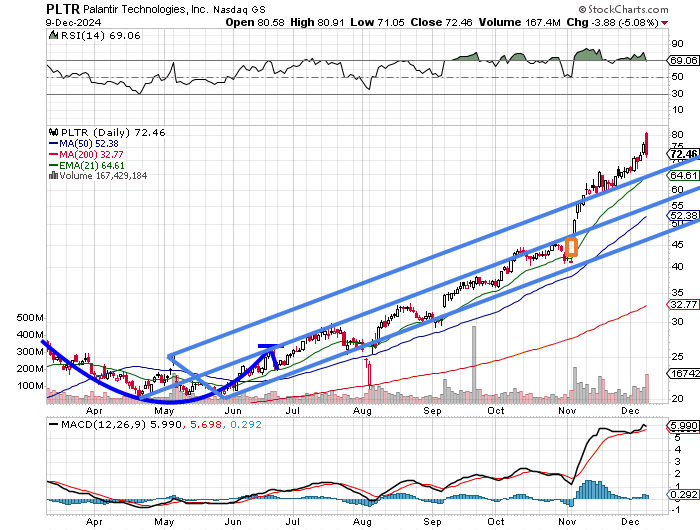
My ideas that I wrote up for you last week have not changed. Relative Strength is still very strong. The daily Moving Average Convergence Divergence is still positive, but one can see that the 12-day exponential moving average seems poised for a cross-under of the 26-day EMA. That would be short-term bearish. I still add to my long position between the 21-day EMA and the 50-day SMA. I maintain my target price of $90, which as far as I know, is still the high TP across Wall Street.
Economics (All Times Eastern)
06:00 - NFIB Small Biz Optimism Index (Nov): Expecting 94.4, Last 93.7.
08:30 - Non-Farm Productivity (Q3-rev): Flashed 2.2% q/q, SAAR.
08:30 - Unit Labor Costs (FQ3-rev): Flashed 1.9% q/q, SAAR.
08:55 - Redbook (Weekly): Last 7.4% y/y.
16:30 - API Oil Inventories (Weekly): Last +1.232M.
The Fed (All Times Eastern)
Fed Blackout Period.
Today's Earnings Highlights (Consensus EPS Expectations)
Before the Open: AZO (33.72), OLLI (.57)
After the Close: GME (-.03)
At the time of publication, Guilfoyle was long NVDA, AMD, QUBT, QBTS, PLTR equity.