Here’s Why the U.S. Dollar Index Just Reached a One-Year High
Warsh’s battle for price stability and against the Fed’s balance sheet are creating a reaction in currency markets.
You've reached your free article limit
You've read 0 of 1 free Pro articles.
One week ago, Fed Chair Kevin Warsh laid out his vision. Warsh made it clear that price stability, in the form of low inflation, was his top priority.
Less attention has been paid to Warsh’s comments about the Fed’s $6.7 trillion balance sheet.
“The Fed’s bloated balance sheet, designed to support the biggest firms in a bygone crisis era, can be reduced significantly.”
The one-two punch of higher interest rates, which could be necessary for price stability, and an adjustment in fiscal policy, which will be needed to reduce the Fed’s balance sheet, has caught the market’s attention.
The U.S. dollar has been the strongest G7 currency over the past week. The rally began on June 17, the day Warsh gave his first press conference as Fed Chair.
Charting the Greenback
According to the charts, it’s about to get even stronger.
Technically, the U.S. Dollar Index, which measures the buck against a basket of foreign currencies, has broken out of a cup-and-handle pattern (shaded yellow).
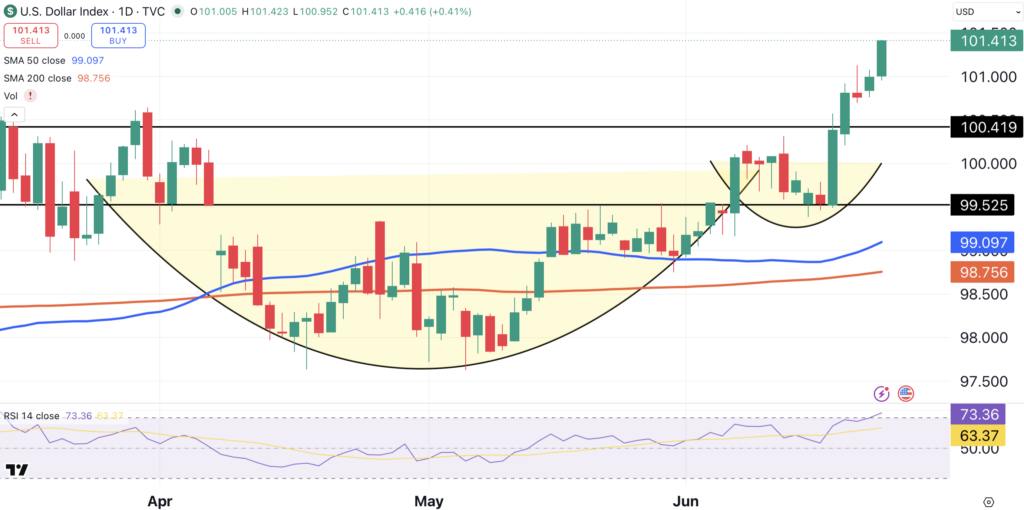
The dollar index is now at its highest level since May of last year, trading well above its 50-day (blue) and 200-day (red) moving averages. The index has finally broken through a tough area of resistance in the 100 area, and appears headed to 103.
Why Is The Dollar Getting Stronger?
There are three main reasons why the greenback could continue to rally.
1) The U.S. currency is globally perceived as a safe-haven.
If institutional investors are concerned about a potential downturn, or if geopolitical tensions boil over, they tend to get out of stocks. They often put the proceeds of stock sales into U.S. Treasuries. This in turn creates demand for dollars, which are then used to purchase Treasuries.
Assume a hedge fund sells stocks on Japan’s Nikkei. They are now holding Japanese yen. In order to buy Treasuries, they must first exchange yen for dollars. Repeated across dozens of hedge funds, this creates demand for the dollar, and weakens the yen.
2) Higher U.S. rates are on the way.
The perception that rates could move higher also causes a currency to strengthen. Just as a bank with a higher interest rate attracts capital from banks with lower rates, a G7 country with a higher interest rate will attract capital from countries with lower rates.
Right now, there is a growing perception that U.S. rates are about to move higher. According to the CME’s FedWatch tool, there is a better than one-in-three chance that Warsh’s Fed will raise interest rates at its next meeting, in late July.
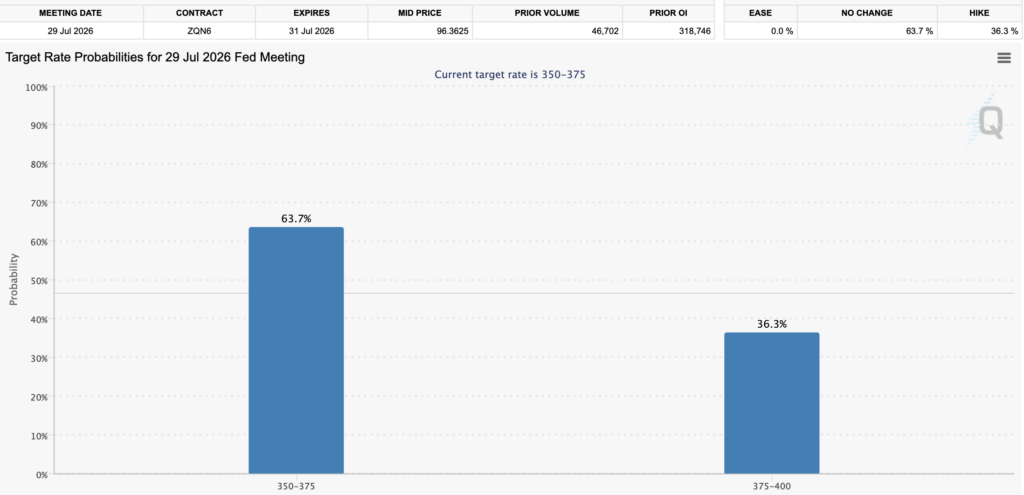
It’s not a coincidence that the dollar’s breakout coincided with an increased probability of a near-term rate hike.
3) The U.S. has compelling investments right now.
Many of the major companies that are building the infrastructure for artificial intelligence are based here. So are iconic brands like Apple (AAPL), Amazon (AMZN), and Walmart (WMT).
In the past three years, the S&P 500 has gained 17.88%, 25.02%, and 26.29%. For the tech-heavy Nasdaq Composite, those figures are 20.36%, 28.64%, and 43.42%.
Compelling investments, whether in stocks, bonds, real estate, or elsewhere, pull capital in from overseas. This strengthens the underlying currency, which in this case is the dollar.
What About Stocks?
A strong dollar isn’t usually associated with a strong stock market. In 2022, when the dollar soared to nearly 115, the Nasdaq Composite lost 33%.
However, that doesn’t necessarily mean the dollar will pull stocks lower. The dollar can rise on positive news (compelling investments, fiscal responsibility) as well as on negative news (higher interest rates or safe-have money flows).
If the dollar is climbing for the right reasons, and I believe it is, stocks can rise as well.
Bottom Line
The dollar’s breakout is a reaction to Fed Chair Warsh’s policies. The strong greenback aids his quest for price stability by lowering the cost of imports. It also leads to lower commodity prices, which helps the Fed’s fight against inflation.
At the time of publication, Ponsi was long AAPL and WMT.