China's $840 Billion Stimulus Scheme, Charting Palantir, Fed Sensationalism
A look at Palantir getting on target, the Trump trade, the Nasdaq's chart, and more.
You've reached your free article limit
You've read 0 of 1 free Pro articles.
Stocks in Hong Kong and Shanghai had already closed lower for the regular session. Not sharply lower, but lower. The Hang Seng Index had been down 1.07%, while the Shanghai Composite had surrendered 0.53%. Then, after the close, Beijing announced the approval of a bill that would raise the local government debt ceiling by the equivalent of $840 billion, revealing a debt swap program that would allow these municipalities to issue 6 trillion yuan in additional special debt over three years. According to Xinhua, which I read about at Bloomberg, local governments will be able to tap an additional 4 trillion yuan on top of that swap in a new local bond quota over five years.
This announcement appears to be toward the upper range of what economists who watch the Chinese economy had been looking for, but did not exceed those expectations. Not only did Chinese equity index futures not "pop" on this announcement, but European equities are opening in the red.
Here In The U.S. ...
The "Trump Trade" kept on rolling, or was this portion of the current rally oar of the "Fed Trade?" Regardless of what was behind the action on Thursday, it was not quite as convincing as had been the first two days of said rally. There was decent demand for US Treasury debt securities for a nice change, which did shake a few trees on the equity side.
The yield of the U.S. Ten Year Note dropped ten basis points for the regular session, going out at 4.33%, while the U.S. Two Year Note paid 4.20% (down 7 bps) by day's end. As the zero-dark hours roll by, those two yields are down to 4.30% and 4.18% respectively. The spread between the yields of the U.S. Ten Year Note and U.S. Three Year Note backed away from normalizing on Thursday, dropping from -11 bps to -19 bps. Early Friday morning, I now see that spread at -23 bps as on Thursday we learned that Q3 non-farm productivity had underperformed expectations and Q3 Unit Labor Costs had significantly exceeded what had been projected.
Equity Marketplace
For the day on Friday, the rally that we investors had enjoyed this week narrowed sharply. The S&P 500 gained 0.7% as the Nasdaq Composite popped for another 1.51%. That's all well and good, but around the mid-majors, the rally faded. While the Philly Semiconductors still gained 2.27% led by Intel INTC and Marvell Technology MRVL, the Dow Industrials closed very close to unchanged as the banks were hit with a bout of profit taking. The KBW Bank Index gave back 2.68% for the session. Additionally, the Dow Transports closed down 1.44% as the rails, truckers and airlines all tumbled. All of your favorite small to mid-cap indices closed in the red as well.
Getting into breadth, eight of the 11 S&P sector SPDR exchange-traded funds closed in the green on Thursday, with four of those funds gaining at least 1%. Tech XLK led the way supported by those semiconductor stocks, followed by Communication Services XLC. The Financials XLF were the only one of these funds to give up more than 1% as support for the banks withered.
Winners beat losers by about 3 to 2 at the NYSE, with advancing volume taking a 59.2% share of composite NYSE-listed volume. But aggregate trade across all NYSE-listings decreased by a whopping 22.2% on a day over day basis. That could signal to investors that this week's rally needs to pause and catch its breath.
On the other hand, winners beat losers at the Nasdaq by a 5-to-4 margin, as advancing volume took a still commanding 73.2% share of composite Nasdaq-listed activity. Additionally, from already gigantic levels, aggregate Nasdaq-listed trading volume popped for another 13.4% day over day gain. Does that mean that the S&P 500 is tried, but the Nasdaq Composite and Nasdaq 100 are still ready to roll? Possibly.
Take a look at this chart of the Nasdaq Composite. Though we have just seen a three run for the stars on trading volume that continues to grow, the reading for Relative Strength is yet to hit the 70 level. That's above the chart. Below the chart, the daily Moving Average Convergence Divergence indicator finally postured more bullishly than it has been. The histogram for the 9-day exponential moving average has at last moved back above zero, while the 12-day EMA (black line) has crossed over the 26-day EMA (red line).
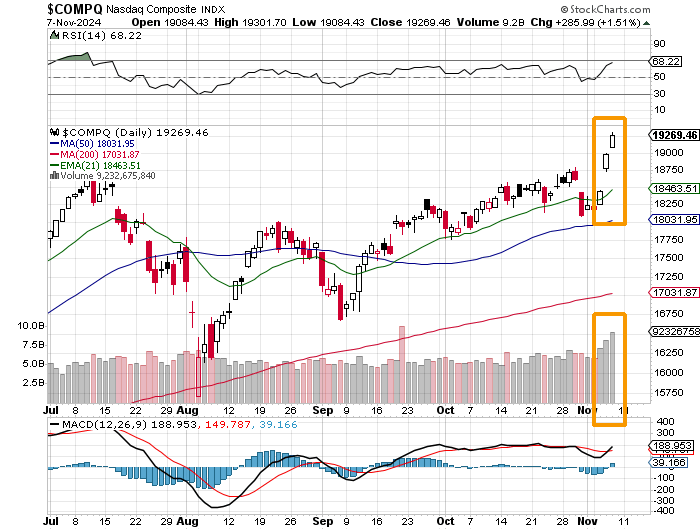
Pausing to rest would probably be healthy for this equity market as markets do need to consolidate recent gains. That said, these indicators do not tell the tale of a market that's going to want to rest for a very long time. We still need a break between a day one reversal and technical confirmation.
Anyone Else Notice...
That the words "The Committee has gained greater confidence that inflation is moving sustainably toward 2 percent" was removed from the official policy statement between Sept. 18 and Nov. 7? Does that mean that the Fed knows, what I have been telling readers and what Hedgeye Risk Management has been spouting for quite some time now, that inflation likely bottomed in September. Clearly, the focus of late has been on labor and economic growth and not on fighting inflation, but that's fairly blatant. Consumer level inflation close to 3% by early 2025? Probable.
Fed Up With This Line of Questioning...
Also, how stupid are questions from the financial media asking Fed Chair Jerome Powell if he thinks President Elect Donald Trump will try to fire him when he assumes his new role in January? Additionally, how stupid is Jerome Powell to answer those questions seriously, in an attempt to sound defiant? Certain members of the financial media, we can always expect an attempt at sensationalism from, but Powell has to play it cool. If you think you have an edge, keep it in your pocket until you need it. Additionally, why would one pick a fight before there is one. That's just poor judgement.
Notable
The Fed's "quantitative tightening" program continues despite the recent reductions made to the Fed Funds Rate. For now, liquidity does not seem to be an issue. That said, I don't think the Fed can allow its balance sheet to return to pre-pandemic levels and neither do a lot of pros. Many thought the announcement would come in November. Perhaps that announcement was saved for December so the Federal Open Market Committee can take some kind of "dovish" action should they not cut short-term rates further this year.
Bird Flu Strategy
According to the Department of Agriculture, of the 446 dairy farm hands confirmed to be infected with the "bird flu" or H5N1 this year, 151 have been confirmed within the past 30 days. The CDC is now recommending testing dairy workers exposed to the virus even if they are not showing symptoms and that antivirals be given to any of these workers that know that have had exposure to sick animals without wearing safety gear.
The aim here, by the CDC, is to prevent this flu bug from gaining the ability to spread easily from one human to another. This virus has started to spread more easily between birds and cattle. At the end of October, the first pig tested positive. This past Wednesday, a second pig tested positive. Oddly enough, the strain found in the pigs is not the same strain found in cattle so far. Unfortunately, pigs are seen as a virus mutation breeding ground once the bug is active inside the pig population.
Palantir at Target Already?
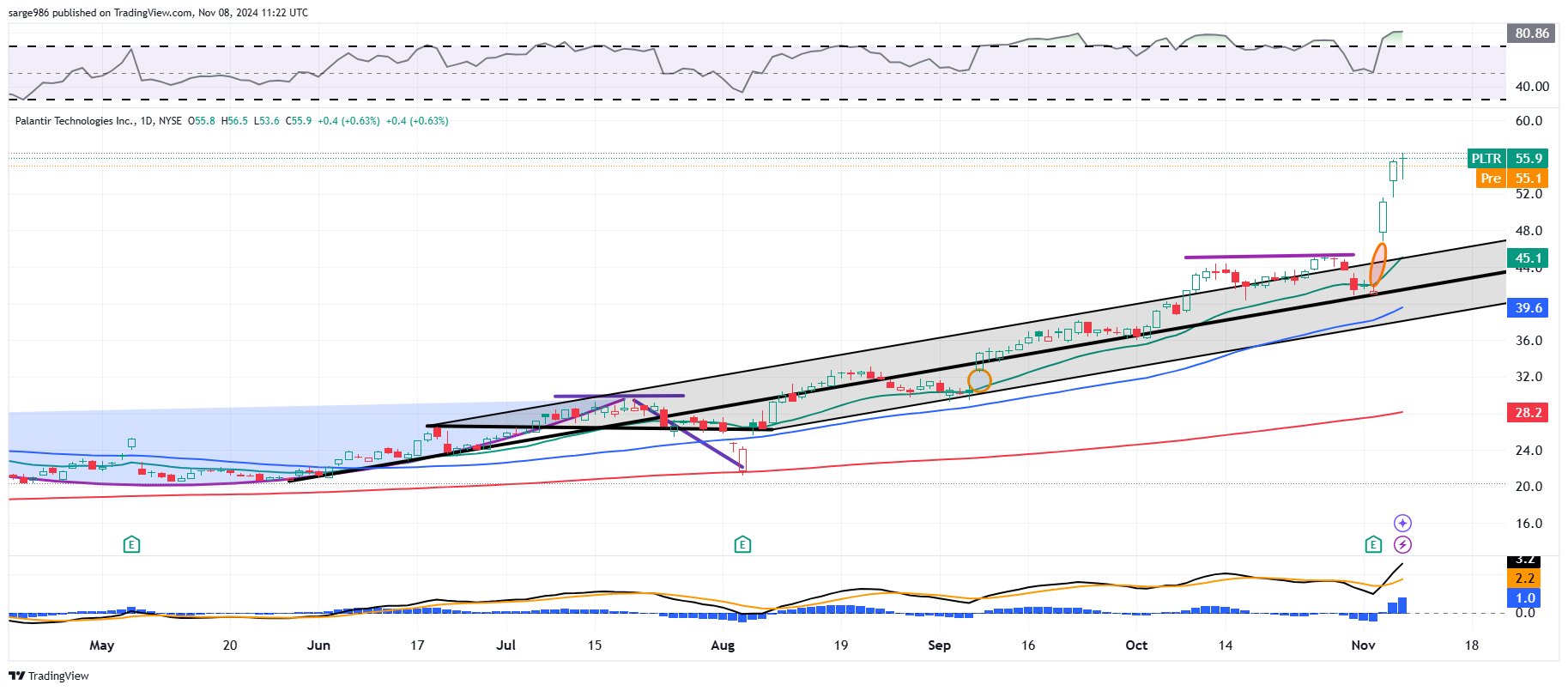
I wrote to you on Tuesday in response to Palantir Technology's PLTR glorious quarterly earnings report and marvelous guidance provided. In that piece, I increased our target price from $48 to $56. Well, it only took from Tuesday until Thursday for PLTR to trade at $56. Take off another token? It's okay and actually an act of discipline if you did. Yes, PLYT needs, just like the market itself, to consolidate, but we're going to need a bigger boat (higher target price).
I am going to put a $70 target price on PLTR this morning, up from $56, just so we don't end up selling shares more quickly than we can add them back on. That does become a problem when a core holding refuses to consolidate.
This chart really is a masterpiece. Note that the 200-day simple moving average stands at just $28.20. That's still our panic point. I have never seen a last sale and a panic point so far apart, but I am certainly not complaining.
A couple of readers reached out to me this week as analyst Brent Thill of Jefferies downgraded PLTR to a sell with a $28 target price and analyst Brian White of Monness reiterated a "sell" rating on PLTR with an $18 target. You can worry about PLTR and you can manage your position. We all should manage every position.
That said, don't let the guys rattle you. They both are long-time PLTR bears and have been wrong every step of the way. Thill, who is only rated at three stars at TipRanks, had a "sell" on PLTR in January when it was trading with a $16 handle. White, who is a highly rated analyst thanks to his other picks, had a sell rating on PLTR in May when the stock was trading with a $23 handle.
Neither of these analysts has had anything better than a "hold" rating on PLTR at any point this year. In short, when it comes to this name, you and I have absolutely schooled these two, who just can't seem to get out of their own way. Watch it trade down a few bucks and we hear the peanut gallery start claiming victory.
Never forget, we are the hunters and gatherers who must create every day in order to eat. These are salaried employees who can never have that kind of hunger inside.
Economics (All Times Eastern)
10:00 - U of M Consumer Sentiment (Nov-adv): Expecting 70.3, Last 70.5.
10:00 - U of M One Year Inflation Expectations (Nov-adv): Expecting 2.7%, Last 2.7%.
10:00 - U of M Five Year Inflation Expectations (Nov-adv): Expecting 3.0%, Last 3.0%.
1:00 a.m.- Baker Hughes Total Rig Count (Weekly): Last 585.
1:00 - Baker Hughes Oil Rig Count (Weekly): Last 479.
The Fed (All Times Eastern)
11:00 - Speaker: Reserve Board Gov. Michelle Bowman.
Today's Earnings Highlights (Consensus EPS Expectations)
Before the Open: FLR (.76), BAX (.78)
After the Close: PARA (.24)
At the time of publication, Guilfoyle was long INTC, PLTR equity.