‘Big Short’ Michael Burry Shorts the AI Trade
Was Wednesday’s poor market performance a warning of things to come?
You've reached your free article limit
You've read 0 of 1 free Pro articles.
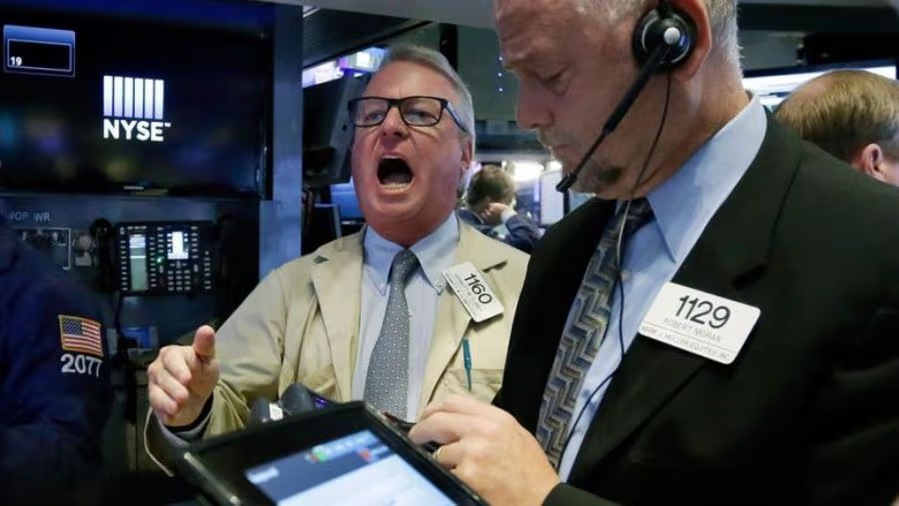
The action turned surprisingly ugly on Wednesday. July 1 is historically one of the most positive days of the year and the seasonal tailwinds were lined up in favor of the bulls. The pattern failed miserably.
The Dow gave back a 423-point rally to record highs and closed just below the flatline. The S&P 500 slipped 0.2%. The Nasdaq Composite dropped 0.7% and the QQQ was down more than 1% intraday before recovering some of the loss.
When strong seasonality fails, the underlying selling pressure is greater than the mechanical calendar factors and that demands attention.
Rotation Into META and Out of Chips
The most interesting piece of Wednesday’s action was where the money went. The Roundhill Magnificent Seven ETF (MAGS) held up better than the broader tech complex because Meta Platforms (META) surged 8.81% to $612.91 on reports that the company plans to launch a cloud business selling excess compute capacity. Volume on META ran 159% above its three-month average. That was the largest single-name move on the S&P Wednesday and it explains why the Mag 7 held up while the pure AI infrastructure names were being sold.
The cloud business is important because it addresses the key pressure on META stock. Meta’s 2026 capital expenditure guidance is $125 billion to $145 billion. Selling excess capacity turns that capex from pure cost into a partial revenue offset. Investors are willing to pay for the AI buildout when they can see a path to revenue from the infrastructure. That is why META was celebrated and the pure infrastructure names get sold.
The other side of the trade was ugly. The VanEck Semiconductor ETF (SMH) dropped 5.4%. Micron Technology (MU) and SanDisk (SNDK) each fell more than 10%. The chip names that produced record Q2 rallies started Q3 with a dud. This is positioning movement into earnings and it fits the character shift I have been writing about for two weeks.
Michael Burry Is Aggressively Betting on the Reversal
One of the most well-known names in bearish positioning made his views public on Wednesday. Michael Burry, the investor from “The Big Short” who called the 2008 housing crash, disclosed five new short positions on his Substack newsletter. He deregistered his hedge fund Scion Asset Management in November 2025 and now discloses his moves through a newsletter rather than through 13F filings.
The five shorts are: Nvidia (NVDA) at $198.09, Applied Materials (AMAT) at $729.40, Tesla (TSLA) at $416.22, the iShares Semiconductor ETF (SOXX) at $642.80, and Caterpillar (CAT) at $1,060.98. He also holds a short on Micron.
The Caterpillar and Tesla shorts are his first ever in those names. He has historically been long CAT and has never previously bet against TSLA. When a value investor with Burry’s record shorts names he has loved on the long side, the shift in his view is significant.
He views the Korea chip capex spending announcement from Samsung and SK Hynix last week as “the beginning of the end” for the semiconductor cycle. He sees semis due for a 30% correction. He views AI infrastructure valuations as overextended. He shorted TSLA into a 10% rally rather than chasing weakness, which is the typical bearish move. His own words: “Happy it jumped back to this level.”
His Palantir (PLTR) trade earlier this year is an illustration of how Burry’s process works. He disclosed his put position on PLTR back when the stock was running to new highs. He was early and the stock kept going. He held the position and it eventually worked as the market caught up to his view. He then partially covered the position when the stock broke down.
Burry does not need to be right on timing. He needs to be right on direction over the horizon of his position, and he manages the position based on how price responds to his thesis.
Given Burry’s success with the PLTR trade there will be some extra focus on this new basket of shorts.
Thursday’s Jobs Report Is the Immediate Catalyst
The June nonfarm payrolls report will be released at 8:30 AM ET Thursday. Consensus is for 115,000 jobs added. Goldman Sachs estimates the World Cup could boost the June number by 40,000. June unemployment, June hourly earnings, and June factory orders will also be released.
The setup is binary. A hot number confirms the hawkish Fed setup that Kevin Warsh established at his first meeting and pressures the rate-sensitive groups. A soft number gives the bulls cover to argue the Fed is behind the curve on economic softening. Either outcome creates significant intraday volatility because positioning is thin ahead of the long weekend.
Asia action overnight is another indication of growing negative sentiment. The Kospi dropped 7.89% overnight to 7,648, the second major single-day drop for the Korean chip names in the past two weeks. Samsung Electronics and SK Hynix were both down more than 7%. The Korea capex commitment that Burry cited as “the beginning of the end” is now producing consecutive selloffs in the names that led the first-half rally.
Strategy
I raised more cash Wednesday by reducing some of my biotechnology positions that had produced significant gains. I trimmed Definium Therapeutics (DFTX) and Xeris Biopharma (XERS) after their extended runs and plan to buy them back aggressively on any meaningful pullbacks. I still hold significant core positions in the biotech names and the rotation winners.
My cash levels are now above 50%. That is the highest I have run so far in this cycle. The character of the market has shifted and the seasonal failure yesterday confirmed it.
Wednesday’s action did not need Burry’s disclosures to validate the setup, but his willingness to make five aggressive new shorts public on the same day the chip complex started Q3 with a dud is not coincidence. He waited for the seasonal setup to fail and then made his call.
I am not shorting anything. I am not chasing the META bounce. I am positioned to be a buyer when the pullbacks that this setup produces create the entries I want. The biotech names still work. The rotation into cloud-revenue names may extend the META move but I have no interest.
The AI infrastructure trade is under significant pressure and Thursday’s jobs report is the immediate catalyst that will determine whether the pressure intensifies or eases before the long weekend.
At the time of publication, Rev Shark was long DFTX and XERS.