A Fed Under Pressure
Let’s look at the position our central bankers are in regarding inflation, while keeping watch of the global central banks … and on all the E.U.-Canada sweet talkin’.
You've reached your free article limit
You've read 0 of 1 free Pro articles.

The Federal Reserve’s Federal Open Market Committee will release its latest official policy statement at 2 p.m. ET. A quarter point rate hike has been pretty much baked into the cake over the past month or so, at 93% probability. That “pricing in” has become acute over the past couple of trading days as the yield paid by the U.S. Ten-Year Note has settled around 5% and prices for front-month crude oil have absolutely soared. The West Texas sweet stuff is now up a rough 29% just since the late August lows. This has made it difficult to generate alpha trading across multiple asset classes over the past few weeks.
The FOMC will release its quarterly economy projections alongside that statement. The semi-economically illiterate will reveal their median (and ranged) outlooks for gross domestic product, unemployment, and inflation going out over the next three years in this release. The group will also cast its “dot plot” projections for the future of the overnight Fed Funds Rate. Current Fed Chair Kevin Warsh is no fan of these projections or for that dot plot and will not likely participate, as these forecasts often appear less accurate in hindsight than would have a chimpanzee throwing darts at a dartboard.
Finally, a half hour after those releases, the still newish Fed chair himself, Kevin Warsh, who really is in a tough spot, will hold a press conference that will be heavily attended by members of the financial media. I have been an opponent of increasing short-term rates and have been vocal about that. I do not believe that adjusting aggregate demand through changes made to short-term interest rates can slow upward inflationary pressures created by shocks to supply. Those increased rates can, however, put downward pressure on demand for labor, especially at smaller employers where there is a heavier reliance upon borrowed capital to maintain operations.
There are more than 36 million smaller businesses in this country that employ more than 62 million people. A total of 18% of all U.S. workers are employed at businesses with 20 employees or fewer. That’s a heck of a gamble to make to try to slow an inflationary pressure not likely to abate until the export of energy commodities out of the Middle East is once again normalized. Then again, I do understand the political pressure currently being placed upon our central bankers. This FOMC, despite that this condition is not one of their making, is expected to adjust to and adapt to anything. It’s literally the Fed’s job to balance labor market health against price stability. So, act it must and act, it will. Should be a heck of a press conference.
One Eye On Central Banks
Global central banks are key to watch now. A week ago, the European Central Bank increased all its key rates by a quarter percentage point. That was already the ECB’s second rate hike of this year. Last week, the ECB pointed to inflationary pressures created by the conflict in the Middle East as a continuing problem. That first rate hike, in June, was the first such hike since 2023. Should the Fed hike this afternoon, it will also be the U.S. central bank’s first such move since 2023.
Both the Bank of England and Bank of Japan will make policy decisions later this week. While the BOE is not expected to raise rates on Thursday, the BOJ is overwhelmingly expected to raise rates on Friday. This is likely at least one of the actions that U.S. Treasury Sec. Scott Bessent was referring to when he made those statements concerning Japanese yen valuations over the past few weeks.
Too Daze Gone
Walkin’ through the streets just the other day (movin’)
Caught up in the traffic, I can never get away (movin’)
Runnin’ here, runnin’ there
No satisfaction anywhere
I do my work, ain’t enough anymore
It takes the mornin’ after to forget the night beforeToo daze gone, too daze gone
I’m broke down, insufferable, my mind is on the blink
It’s later than you think and I’m too daze gone
-Billy Squire (1981)
Tuesday’s Child…
The rhyme “Monday’s Child” was first published in 1836. We have no idea who actually wrote the little poem. Readers will likely recall that in this little ditty, that Tuesday’s Child was full of grace. Well, I found that idea to be somewhat unfounded. Tuesday’s child was, at least this week, messy and unkempt. As Treasury yield held at higher levels, crude oil prices soared to unwelcome levels. Equities followed suit. At the headline level, equities retreated in orderly fashion. Breadth, however, was decisively more negative in nature than it had been on Monday, which was officially, our “Day One” bearish reversal of trend.
As the poem goes, Wednesday’s Child was full of woe. Is it too much to ask as the Fed’s FOMC comes out of its two-day “meeting of the minds” for the poem to get yet another day incorrect? For the net long (and wrong) crowd, of which I am still one, we can only hope. As for Tuesday, the S&P 500 gave up 0.45% as the Nasdaq Composite surrendered 0.78%. The small caps were hit harder as (mentioned above) higher interest rates will negatively impact smaller firms disproportionately.
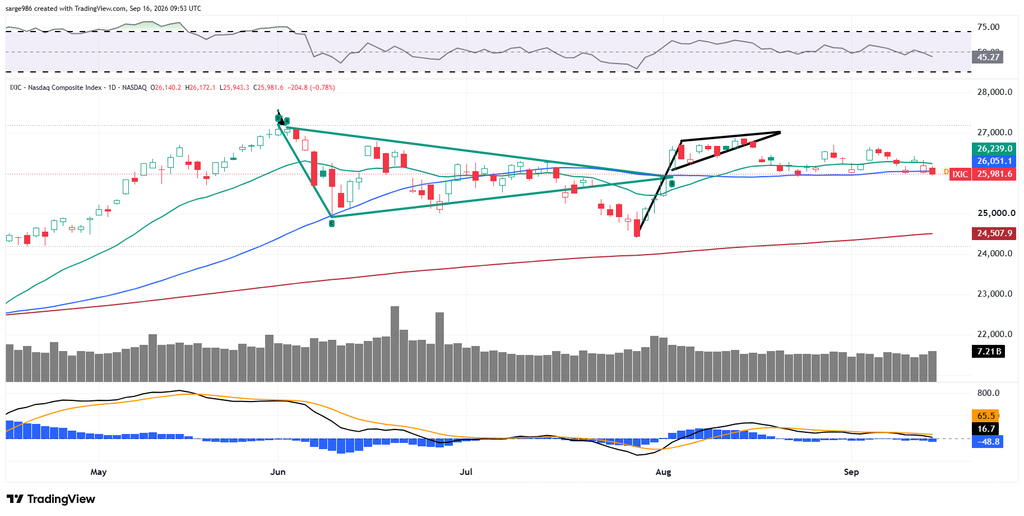
Readers will see in this daily chart of the Nasdaq Composite that the Triangle pattern that we had talked about over the summer did indeed create the volatility that we expected. But, and this may be important, coming out of that selloff, the index developed what could have been (should have been?) a bullish pennant pattern that failed. Now, on Tuesday, this index (and the S&P 500) closed below its 50-day simple moving average as well as its 21-day exponential moving average. While the swing crowd has probably already been lost for now, the pros won’t cut bait en masse unless contact with that thin blue line is lost. That has not happened as of yet.
Both Relative Strength and the daily moving average convergence divergence are signaling at this time, further bearishness. That said, Kevin Warsh’s words this afternoon, how he frames this rate cut, will impact equity prices for the short to medium-term future more than anything else. Traders will see that the increased volume on Tuesday created a two-day “day one.” What this means is that the move lower that forced the recognition of a “day one” reversal took two days (at least) to complete. We have not yet seen the pause that we need in order to confirm that bearish change of trend. What that means, in addition to the obvious, is that market participants will not be able to trust an algorithmic knee-jerk reaction to the Fed’s monetary policy setting party later on.
Canada-U.E. Partnership?
Ursula von der Leyen has now openly endorsed Canadian Prime Minister Mark Carney’s pitch to hitch Canada’s wagon to that of the European Union’s. On Wednesday morning, speaking to the European Parliament, the president of the European Commission said, “We must urgently reimagine our partnerships. So, I would like to work with you on opening the door for Canada to being the first associate member of the European Union,” Mark Carney was in the audience.
Von der Leyen added, “In short, we want to bring the relationship with Canada to the highest level possible.”
In what was obviously an attempt not to raise the ire (or maybe it was) of U.S. Pres. Donald Trump, von der Leyen poked, “This is not a partnership against anyone else, but for our common strength. We see the world with the same eyes.”
It should be noted that an E.U.-Canada free trade deal, known as CETA, was signed nine years ago and never ratified by 10 E.U. member states, including key players such as France, Italy and Poland. Several E.U. member states have suggested ratification should first be completed before embarking on new steps.
So, no slam dunk? Probably not. That said, in the eyes of the president of the European Commission, the E.U. and Canada would move “from CETA to an Alliance for the Future, to create a common prosperity and economic security space.”
Sarge says, “Good luck with that, being neither the E.U. nor Canda appear to be hitting the ball out of the park (unless carried on the back of the U.S.) on a regular basis.”
Economics (All Times Eastern)
07:00 – MBA 30 Year Mortgage Rate (Weekly): Last 6.85%.
07:00 – MBA Mortgage Applications (Weekly): Last -2.7% w/w.
08:30 – Retail Sales (Aug): Expecting 0.8% m/m, Last -0.6% m/m.
08:30 – Core Retail Sales (Aug): Expecting 0.5% m/m, Last -0.3% m/m.
08:30 – Export Prices (Aug): Expecting -0.5% m/m, Last -1.3% m/m.
08:30 – Import Prices (Aug): Expecting 0.1% m/m, Last -0.4% m/m.
10:00 – Business Inventories (July):
Expecting 0.2% m/m
, Last 0.0% m/m.
10:00 – NAHB Housing Market Index (Sept): Expecting 34, Last 35.
10:30 – Oil Inventories (Weekly): Last -391K.
10:30 – Gasoline Stocks (Weekly): Last +1.269M.
4:00 p.m. – Net Long-Term TIC Flows (July): Last $172.7B.
The Fed (All Times Eastern)
2:00 p.m. – FOMC Policy Decision.
2:00 – FOMC Economic Projections.
2:30 – FOMC Press Conference.
Today’s Earnings Highlights (Consensus EPS Expectations)
After the Close: LEN (1.30)
At the time of publication, Guilfoyle had no position in any security mentioned.