The Hysteria Over Bitcoin ETFs Is an Accident Waiting to Happen
ETFs are convenient, but not ideal, for all assets – including Bitcoin.
You've reached your free article limit
You've read 0 of 1 free Pro articles.
Bitcoin has always been a market that everyone discussed, but few participated in. However, Bitcoin ETFs make allocating money to the asset easier for the average retail trader.
Almost everyone has access to stocks and ETFs via existing brokerage accounts; it is easy to gain it if they don't. A lower barrier to entry seems to have created a second wave of speculation in Bitcoin. Those who don't trust crypto brokerages or know how to create cryptocurrency wallets to hold assets are now free to exercise their FOMO via ETF purchases.
The tech and crypto mania feels eerily like late 2021, except instead of euphoric speculation in Tesla TSLA, meme stocks, NFTs, and crypto, it is Nvidia NVDA and Bitcoin ETFs.
The finance industry is a sales machine designed to rack up as much fee revenue as possible -- and ETFs representing relatively shallow markets are just that. They generate profits for exchanges and managers, but the unintended consequences are dysfunctional markets and lives ruined.
In deep markets with mass participation, such as an SPY ETF that tracks the most widely held stocks on the planet, ETFs are efficient and effective, but ETFs created to provide convenient exposure to markets that the masses shouldn't necessarily be participating in, or worse, assets that are not liquid enough to accept investment dollars from all who are interested, are highly concerning.
As a commodity broker who has seen the dysfunction commodity ETFs can cause to otherwise normally functioning futures markets, I view the hysteria over Bitcoin ETFs as an accident waiting to happen. Two notable examples of ETFs suddenly finding mass appeal despite being associated with minimally liquid markets are the popular crude oil ETF identified by the ticker USO, and the wheat ETF known by WEAT.
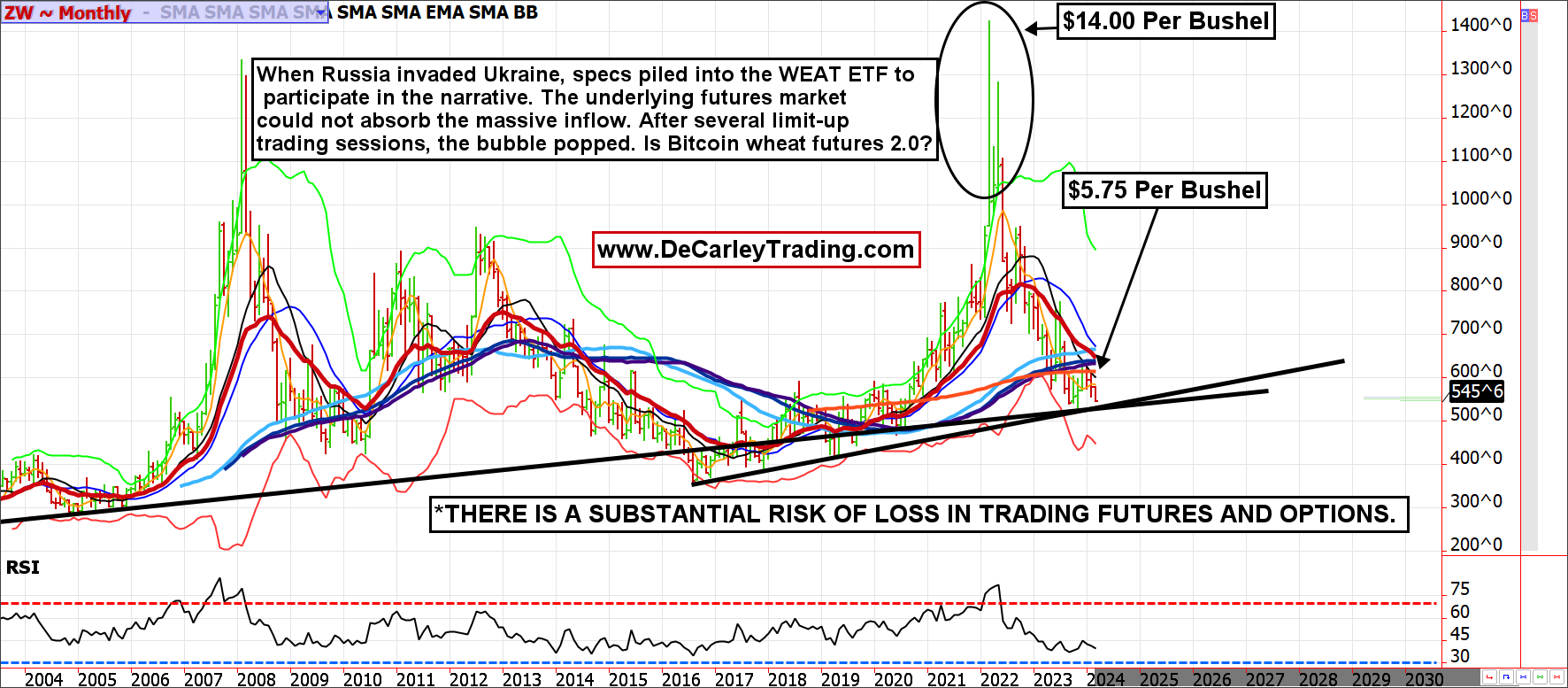
A fund blow-up at USO was a significant driving force pushing oil futures below zero in 2020. Similarly, when Russia invaded Ukraine, the popular narrative was that the "world's breadbasket" had been compromised and wheat prices would get a hefty price bump due to short supplies.
Every young person with a mobile phone and an online brokerage account seemed to receive notification of the WEAT ETF making a move, and many hit the buy button. The WEAT ETF pools investors' money to buy futures contracts. Trading in this ticker jumped from one million to two million shares per week to about 55 million per week, undoubtedly mainly on the buy side.
With so much money flowing into the ETF, the WEAT fund had to buy futures contracts in a market that was not intended for mass speculation and could not absorb the liquidity. It was like pouring a gallon of liquid into a tablespoon, but according to the prospectus it had to be done.
The necessity to buy contracts distorted natural price discovery and left financial devastation for most market participants in its wake. As the WEAT ETF aggressively bought futures contracts to comply with obligations to investors, wheat futures spent six or seven trading sessions locked limit up with very few opportunities for traders who were short to exit and those who wanted to be long to enter.
In the chaos, prices jumped from about $7.00 per bushel to $14.00 per bushel. Once the last of the forced buys were executed, prices collapsed in a whirlwind of dysfunction. Since then, wheat has continued its downward spiral to a valuation of just over $5.00 per bushel. It is naïve to assume the Bitcoin ETF frenzy will end any differently.
There are four primary reasons investors are flocking to Bitcoin ETFs; I've listed them with some additional context.
· Fear of missing out (FOMO) – Usually occurs at the end of a mania, not the beginning.
· Ease of access – Anyone with a stock account can participate in ETFs; it is no longer limited to those with crypto wallets, crypto brokerage accounts, or futures accounts. This is attracting fresh investment dollars, but convenience has unintended consequences.
· Regulatory oversight of ETFs – As we have learned in WEAT and other commodity ETFs, regulatory oversight can't prevent market composition or logistic issues. Further regulations are meaningless for a product that can go to zero in seconds due to a lack of intrinsic or transactional value.
· Mainstream acceptance – New asset classes sometimes gain legitimacy via regulator acceptance, but the track record for such assets isn't always positive. Cannabis stocks went through a phase of mainstream acceptance and euphoric rallies, but most of them quickly imploded.
Bitcoin and Nvidia, and therefore the Nasdaq 100 and even the S&P 500, have become highly correlated. Despite the appeal of crypto being an off-the-grid portfolio diversifier, it is now neither of those things.
There are undoubtedly a lot of people making a lot of money, but all I see when I look at a Bitcoin chart is the impending misery that will eventually come when the music stops. Not everyone will keep the money they have made thus far. Truthfully, most will give it back, plus more. That is how these things have panned out historically.
Technology is a blessing and a curse. Technology, combined with government manipulation of natural market and business cycles, has allowed the markets to become gamified. Warren Buffett's recent shareholder letter stated, "The markets have become a lot more casino-like." The Bitcoin and Nvidia rallies are what he was talking about. He suggested the goal isn't to thrive in this environment, it is simply not to lose your shirt, and we tend to agree.
Sometimes it feels like market participants think they are playing World of Warcraft or Call of Duty, but there is a lot more at stake. I love that young people are getting involved in the markets, but I hate that instead of building lasting wealth, they could dig themselves a big hole if they aren't careful.