A Checkdown Trade on a Small-Cap Biotech Stock
This options strategy is prudent while the company navigates through an inflection point.
You've reached your free article limit
You've read 0 of 1 free Pro articles.
We have our eyes on a small-cap biopharma name that currently sets up well as a covered call trade on a number fronts.
The shares have taken a recent dive on a litigation setback late in 2023. However, the company is appealing that judgment, which will push back into late 2024 or early in 2025 the time before its core drug franchise potentially faces generic competition.
Better yet, the company should submit a marketing application for an improved compound that will replace this drug by the end of the first half of this year -- and that should make this issue moot. The stock also appears to be trading at longer-term technical support levels.
I am talking about Corcept Therapeutics CORT . The company's current primary asset is a drug called Korlym (mifepristone) tablets. This compound is approved for the treatment of hyperglycemia secondary to hypercortisolism in adult patients with endogenous Cushing's syndrome, who also have type 2 diabetes mellitus or glucose intolerance.
This once-daily oral medication racked up sales of more than $475 million in 2023, which was a 20% increase from the prior year. Management has put out initial sales guidance of between $600 million and $640 million of revenue in 2024.
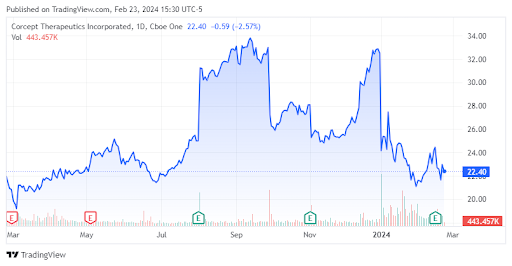
Corcept's current market cap is approximately $2.5 billion and it also has more than $400 million of net cash on its balance sheet. The stock trades at around $22.45 a share. Corcept should remain solidly profitable and revenues should rise at least 25% in 2024.
Here is the fly in the ointment and why the stock is down 30% from its recent highs in late December. The trigger for that decline was a litigation judgment in late 2023 favoring Teva Pharmaceutical TEVA in their effort to be able to market a generic version of Korlym. Corcept has appealed the decision, which should delay potential generic competition for several quarters.
More importantly, the company is working on a replacement for Korlym called Relacorilant that, when approved, will have patent protection until 2038 for Cushing's syndrome. The compound is also being evaluated as part of combination therapies to treat various forms of pancreatic, prostate, ovarian, triple-negative breast, and lung cancers.
In studies, Relacoritant has been shown to be superior to Korlym for glucose control and improving hypertension. Two late-stage study results should be out soon and Corcept should submit a marketing application to the FDA for Relacoritant by the end of the second quarter. If all goes well, Teva's litigation challenges around Korlym should be largely for naught.
Options against CORT stock have decent liquidity and lucrative premiums, making a covered call strategy prudent while Corcept navigates through this inflection point.
Option Strategy
Here is how one can establish a position in CORT using a covered call strategy. Remember, covered call orders involve buying an equity and simultaneously selling just out of the money call strikes against the new position.
Selecting the August $20 call strikes, fashion a covered call order with a net debit in the $15.50 to $16.00 a share range (net stock price - option premium). This strategy provides downside protection of approximately 30% over the option duration with potential upside of over 25% even if the stock trades down 10% from current trading levels.
At the time of publication, Jensen was long CORT.