Nike Rallies as Execution Improves but There’s a Problem
The once-prestigious apparel firm has turned some heads on Wall Street.
You've reached your free article limit
You've read 0 of 1 free Pro articles.
On Tuesday evening, athletic equipment and apparel seller Nike (NKE) went to the tape with the firm’s fiscal fourth quarter financial results. Wall Street is less than excited about it.
Even after the shares have fallen more than 77% from their late 2021 high, there just seems to be no way for the once-prestigious brand name to get out of its own way. The shares are down 36.5% just in 2026 alone.
For the period ended May 31, Nike posted an adjusted EPS of $0.20 (GAAP EPS: $0.72) on revenue of $10.972 billion. The $0.52 per share adjustment was due to the benefit related to the expected recovery of the IEEPA tariffs. These numbers did manage to beat the consensus view. That said, nobody is impressed. Sales were still down 1.1% year over year.
President and CEO Elliott Hill commented in the press release:
“In fiscal 2026, we took decisive actions to strengthen the foundation of NIKE, Inc. and reposition our business for long-term growth. We made meaningful structural improvements to lay the groundwork for our Sport Offense across our team culture, innovative product, brand strength, and how we serve consumers in our countries and cities.”
Hmm. Hill went on:
“While we continue to face top-line headwinds, we’re encouraged by progress in performance product and are focused on consistent execution, improved profitability and scaling our wins to realize our full potential.”
Sounds like a CEO having a rough day. Or quarter. Or year.
Operations
While sales were contracting 1.1% to $10.972B, the cost of sales contracted 16%. This left a gross profit of $5.393B (+2%) on a gross margin of 49.2%, up from 40.3%. Sounds awesome. Hang on. Adjusting for that tariff refund, gross profit contracted 1.4% to $4.407 billion and gross margin fell from 40.3% to 40.2%.
Total operating expenses contracted 1.6% to $4.082 billion. After accounting for interest, other income and expenses and taxes, net income printed at $1.069 billion (+407%). Oh wait, that tariff refund. Included, GAAP EPS landed at $0.72 versus the year-ago comp of $0.24. Once properly adjusted, that EPS number lands at $0.20.
Product Sales Performance
Footwear generated revenue of $7.103 billion (-1.1%)
Apparel generated revenue of $3.046 billion (+1.5%)
Equipment generated revenue of $551 million (-2.8%)
Converse generated revenue of $244 million (-31.7%)
Geographic Sales Performance
North America generated revenue of $4.832 billion (+2.7%)
Europe, Middle East & Africa generated revenue of $2.975 billion (-0.8%)
Greater China generated revenue of $1.297 billion (-12.1%)
Asia Pacific & Latin America generated revenue of $1.596 billion (+1.3%)
Guidance
Nike provided some guidance during the earnings call. It was during that call that CFO Matt Friend said, “We expect reported revenues to be down low to mid-single digits” and “we expect gross margin in Q1 to be slightly positive.”
The firm had previously guided towards gross margin improvement in fiscal Q2, so this was something of an improvement. Friend also said, “We reiterate our expectation for earnings to be flattish… excluding the benefit from tariff recovery.”
Not exactly a home run ball, but I guess Nike investors will take what they can get these days.
Fundamentals
Nike does not release a statement of cash flows with earnings, so we don’t have those numbers yet. The firm typically releases its Form 10-Q a day or two after earnings. So, with incomplete information, we approach the balance sheet.
Nike ended the quarter with a cash position of $9.027 billion. and inventories of $7.501 billion. That puts current assets at $24.603 billion. Current liabilities add up to $12.547 billion, including $2 billion worth of short-term debt. This leaves the firm’s current ratio at 1.96, which is strong enough.
We don’t really focus on quick ratios for retail and retail-dependent business given the inventory-centric nature of running that kind of operation. It should be noted though that, over a year, current assets grew 5% while current liabilities grew 19%. Food for thought.
Total assets amount to $38.41 billion that includes close to no intangibles. Total liabilities less equity comes to $23.545 billion, including long-term debt of $5.942 billion. The firm could take care of its entire debt load out of pocket. The balance sheet is probably the best thing I have found in Nike’s numbers. Just watch that current ratio.
Opinion
OK. The execution of the business is improving, but the business itself is still in decline. China remains a serious problem that Nike has no answers for. The balance sheet is pretty decent. The firm is using it to re-gear and will have to continue to do so. I am not excited about Nike, but I do see that the overnight sell-off has turned into a Wednesday morning rally.
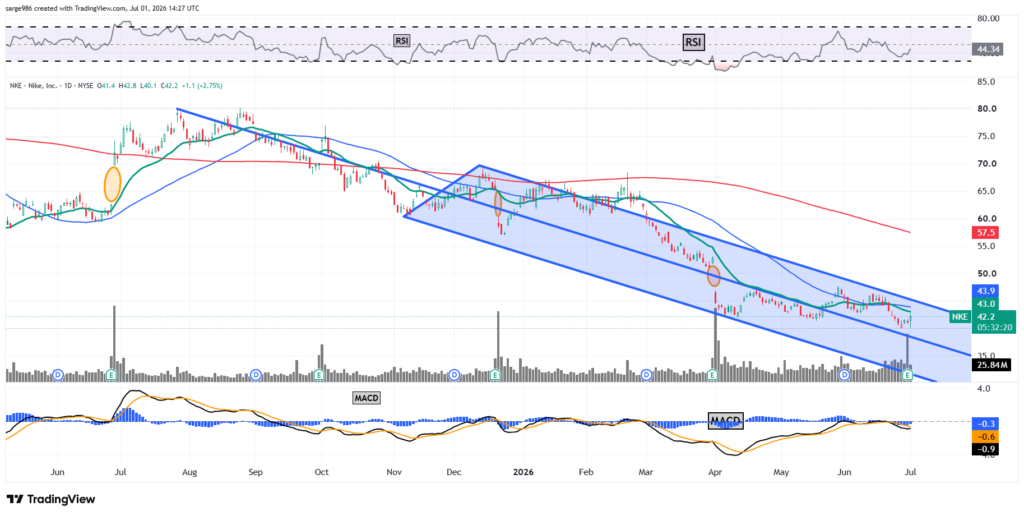
Readers will see that this leg of Nike’s five-year slide has been fairly steady for about a year. The nearly full-year trend fits pretty neatly, with the exception of an attempted breakout this past winter, inside an Andrews’ pitchfork model. In order to break out for real, the stock will need to take back both its 21-day EMA and 50-day SMA as well as crack the upper trendline of the model. That’s a lot of wood to cut for the algorithms that will have to do it.
Relative strength is soft but improving. The daily MACD is still postured rather bearishly for now, but not dramatically so. The risk/reward proposition for this stock may finally be reaching a spot on the charts where investors no longer see a good reason to exit the name.
The problem is that I just don’t see a catalyst to the upside. Maybe next quarter? I’d rather be long a January 2027 $40/$50 bull call spread for a net debit of $3.80 or so than directly lay out any capital for the equity.
At the time of publication, Guilfoyle had no positions in any securities mentioned.