New AMD Price Target After Nvidia ‘Superchip’ Threatens Key Business
Advanced Micro Devices appears ripe for some bloodletting after a major Nvidia and Microsoft update.
You've reached your free article limit
You've read 0 of 1 free Pro articles.

Early on Monday morning, Nvidia (NVDA) unveiled the new Nvidia RTX Spark.
This is a new superchip, part CPU, part GPU. The chip was designed for its AI-capabilities, content creation and gaming. This chip is also said to reinvent the abilities of personal computers reliant upon Microsoft’s (MSFT) Windows operating system. According to reports, this new chip will position Nvidia and Microsoft quite well to compete directly against those already entrenched in the PC business. That would be Apple (AAPL), Qualcomm (QCOM), Intel (INTC) and Advanced Micro Devices (AMD).
This “superchip” will debut in laptops and desktops starting as soon as this autumn. The product was built with some help from Taiwan’s MediaTek, and both Dell Technologies (DELL) and Lenovo Group (LNVGY) have signed on to offer consumers computers built with these new superchips inside. I have some mixed feelings concerning this development.
I am long NVDA and MSFT. They are both up nicely on this news. However, I am also long AMD. AMD has long been a stalwart position in the Sarge-folio, and I have long been a fan of AMD CEO Lisa Su. What now for this position? None of these three names are currently among my top-10 exposures in terms of weighting, but all three are in my top 15.
I’m Not Panicking
Last I checked, Su has never been that far behind Nvidia CEO Jensen Huang in developing anything.
For the firm’s most recent quarter, the Data Center segment drove more than 56% of AMD’s total sales. Sales driven by that segment grew 71% year over year. The firm’s other segments were growing a rough 16% (Client & Gaming) and 3% (Embedded), respectively. This development does threaten a key legacy business for AMD but does not threaten the firm, where the growth is and where the majority of sales have come from. To panic, one would also have to assume that Su chooses not to compete. I find that hard to believe.
Remember, For the current quarter, AMD projected revenue of $10.9 billion to $11.5 billion. That was a serious beat of what Wall Street had been looking for, which was around $10.5 billion. At the midpoint of that guidance, AMD would generate year-over-year sales growth of 46%. No, I don’t think I’ll be panicking.
On Monday Morning
Analyst Thomas O’Malley of Barclays was assigned AMD by his firm. O’Malley rated AMD as a “buy” while increasing his firm’s target price from $500 to $665. O’Malley is rated at five stars out of five at TipRanks. Over the past two years, he has a 74% success rate, with an average return of 105.6%.
Analyst Joshua Buchalter of TD Cowan was assigned AMD by his firm. Buchalter rated AMD as a “buy” while increasing his firm’s target price from $500 to $600. Buchalter is rated at five stars out of five at TipRanks. Over the past two years, he has a 78% success rate, with an average return of 76.4%.
The Chart
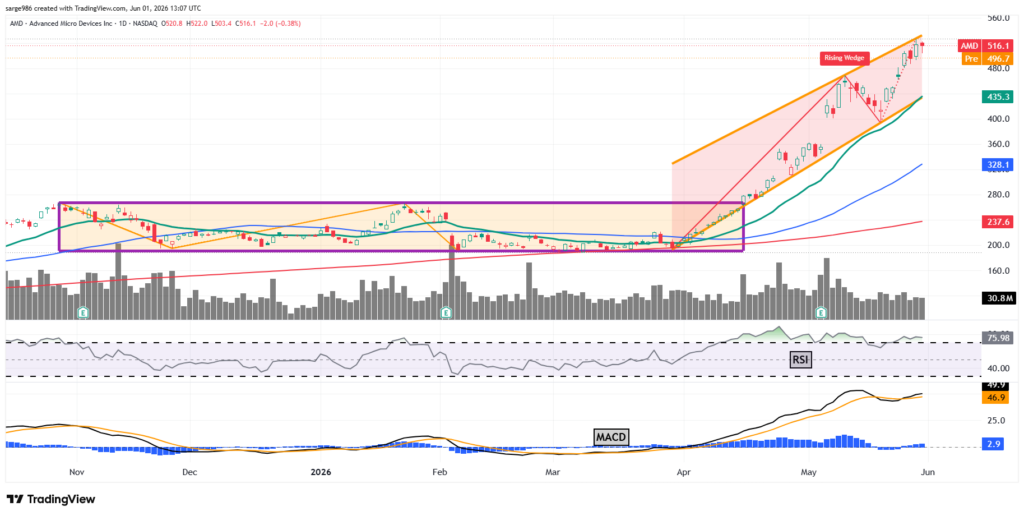
Readers will see that AMD broke out sharply in April from the basing pattern (rectangle) of consolidation that ran from late October 2025 into late April 2026. The shares obliterated my temporary target price of $456 as May wore on. We sold a small amount.
What now? The shares look to have created a rising-wedge pattern of bearish reversal as relative strength had reached technically overbought levels. The daily MACD is also ripe for some bloodletting.
How severe will it be? I’ll tell you what I’m doing. I am likely to add should the stock approach the mid-May high of $470, but not before. I would add more at the 21-day EMA. Where do I sell more? Not until my next target is breached. Where is that? $588. Where do I panic? I already told you. I don’t. Not where Su is concerned.
At the time of publication, Guilfoyle was long NVDA, MSFT and AMD equity.