Macy's Report Puts Abrupt End to Any Optimism
The retailer reported its latest results and it wasn't pretty.
You've reached your free article limit
You've read 0 of 1 free Pro articles.
Former "Stocks Under $10" portfolio holding (very former, as in years ago), retailer Macy's M, reported the firm's second quarter financial results on Wednesday morning.
For the three-month period ended August 3, 2024, the iconic New York City based retail chain posted a GAAP EPS of $0.52 on revenue of $5.096 billion, of which $4.937 billion were generated by sales. Net sales were down 3.8% from the year-ago period. Company-wide comparable sales were down 4% year over year on an owned basis and down 3.3% year over year on an owned-plus-licensed-plus-marketplace basis.
Brand Name Sales Performance
- Macy's Net Sales: -4.4%, comp sales -4.5% owned, -3.6% owned+lic+marketplace
- Macy's Go Forward: -4.3% comp sales, -2.4% owned, -2.3% owned+lic+ marketplace
- First 50 Go Forward: +0.8% owned, +1% owned+lic+marketplace
- Non-First 50 Go Forward: -3.8% owned, -3.7% owned+lic+marketplace
- Macy's Non-Go Forward: -6.5% both owned, and owned
- Bloomingdales Net Sales: -0.2%, comp sales -1.1% owned, -1.4%owned+lic+marketplace
- Bluemercury Net Sales: +1.7%, comp sales +2% on an owned basis.
Operations
As net sales were down 3.8%, total revenue was down 3.5% to $5.096 billion. Cost of sales decreased 7.5% to $2.938 billion, while operating expenses decreased 0.3% to $1.973 billion. After gains on the sale of some real estate, that left an operating income of $222 million, up 79% from $124 million for the year-ago period. This took the firm's operating margin as a percentage of total revenue up to a still meager 4.4% from 2.3%.
After accounting for interest, other income and taxes, net income printed at $150 million, up from $-22 million a year ago. This works out to a GAAP fully diluted EPS of $0.53 versus $-0.08 for the year-ago comparison.
Guidance
For the full fiscal year, Macy's reduced its expectations for net sales from $22.3 billion to $22.9 billion down to $22.1 billion to $22.4 billion. Full-year comparable owned+licences+marketplace sales are now expected to print between -2.0% and -0.5%, down from prior guidance of -1.0% to +1.5%.
Projections for full-year adjusted EPS was left at $2.55 to $2.90, unchanged from guidance issued in May.
Fundamentals
For the first six months of the year, Macy's generated operating cash flow of $137 million (roughly half of last year's half-way total). Out of that number came capex spending of $271 million and spending on capitalized software of $161 million. That left free cash flow of $-295 million. Incredibly, the firm still paid out $96 million in cash dividends to shareholders over that time frame.
Looking at the balance sheet. Macy's ended the period with a cash position of $646 million and merchandise inventories of $4.378 billion. This puts the firm's current assets at $5.707 billion. Current liabilities add up to $3.867 billion, which includes almost no short-term debt. That leaves Macy's with a current ratio of 1.48, which is not bad at all if we can trust the value of those inventories.
We're not usually too strict on quick ratios for retailers because the nature of the business is so inventory centric. That said, Macy's inventories make up 77% of its current assets. If we did do a quick ratio for this firm it would print at 0.34, which is a little tough to look at.
Total assets amount to $15.833 billion, including a small amount of goodwill and other intangibles. Nothing to be concerned about there. Total liabilities less equity comes to $11.53 billion including long-term debt of $2.993 billion. That might not seem like a lot, but with a cash position this small and negative free cash flow, it could be seen as a mountain.
My Thoughts
A lot of this is not very pretty. Just think, back in mid-July, Macy's board of directors voted unanimously to end talks with Arkhouse Management and Brigade Capital Management that saw the firms revise their joint bid for Macy's to $24.80 per share (about $6.9 billion). Macy's stock had traded as high as $20.47 in early July. I now see the stock trading with a $15 handle, down 11% for the day.
The firm has done a good job of reducing costs and expenses. That's where the good news stops. Sales are in decline almost across the board. The firm was GAAP profitable but could not produce positive free cash flow for the first six months of the year. If that keeps up, one would have to wonder just how safe the annual payments totaling $0.69 to yield 3.92% really are.
Having to cut guidance automatically made the firm, trading at six times forward-looking earnings, worth less (in my opinion). Let's go to the chart.
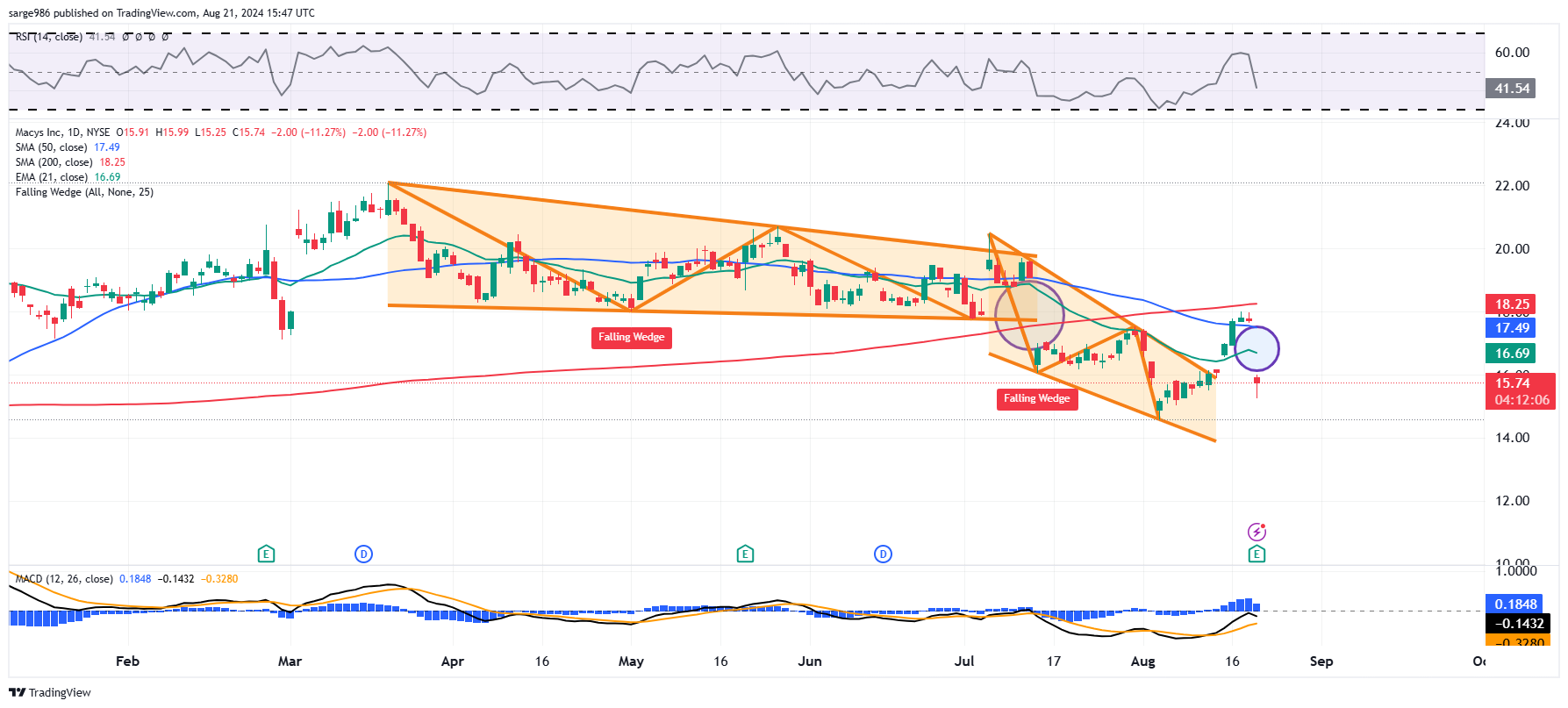
Readers will see one falling wedge on top of another, separated by an unfilled gap in mid-July. As we know, falling wedges are patterns of bullish reversal, so it's safe to say that the first falling wedge failed. Readers will see that the stock had started to rally coming out of the second falling wedge, but this morning's report put an abrupt end to that bout of optimism.
Both relative strength and the stock's daily MACD took a turn for the worse on the news due to this morning's beat-down. My idea? I think Macy's is a short now. Even if they can resurrect a deal, it will surely come at a discount now.
Only about 5% of the float is held in short positions, so the threat of a squeeze is probably not daunting. If I were to short this stock, and to be honest, I have not yet made up my mind, I would definitely go out to October 18, 2024 expiration and buy enough $18 calls for about $0.29 to cover my entire short position if the unthinkable happened. At least this way, I don't get my face ripped off.
At the time of publication, Guilfoyle had no positions in any securities mentioned.