How U.S. Investors Can Profit After Crazy Day for Japanese Yen
Here are some lucrative ideas following a wild swing for the Japanese currency against the U.S. dollar.
You've reached your free article limit
You've read 0 of 1 free Pro articles.
It’s a tumultuous day’s trade for the Japanese yen, with the currency weakening past the ¥160 mark to the U.S. dollar in early Thursday trade, before suddenly strengthening.
The Japanese currency tipped its weakest level in almost two years. Then it swiftly rallied to below ¥156 for the first time since February, before the war in Iran began. What gives?
Swift Moves on currency Trade
The yen weakened for much of morning trade in Tokyo, cresting to ¥160.69 against its U.S counterpart. That’s its highest exchange rate this year, and the weakest rate of exchange since July 2024.
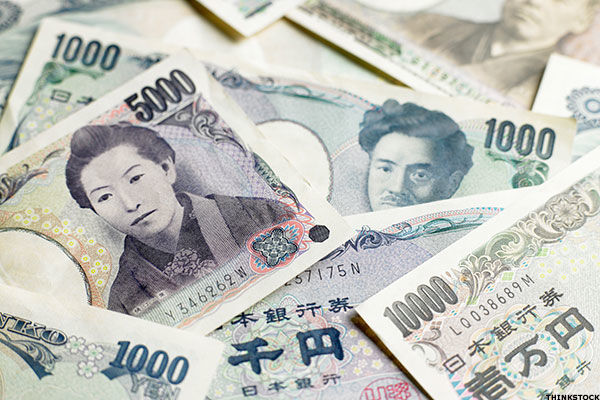
Higher oil prices explain part of the weakness, with Japan importing all its oil, the bulk of it via the Strait of Hormuz. So with Brent crude above $120 in early trade, there’s a threat to Japan’s growth and inflation prospects.
The Bank of Japan (BoJ) would desperately love to raise interest rates, a move that should lead to a stronger currency, only for geopolitical events to disrupt its plans. The BoJ on Tuesday opted to keep interest rates unchanged at 0.75%, the lowest among the G20 nations bar one (Switzerland). But three of the nine board members dissented, preferring to raise rates, with the majority citing inflationary pressures from the Middle East as motive for their caution.
2 Reasons for Jitters
Currency markets are jittery for two reasons: the immediate threat of intervention into markets by Japanese authorities who like to keep currency traders on their toes; and the longer-term trend toward a weaker U.S. dollar, a pattern that was playing out before the onset of the Iran war, which provoked a flight to quality back into U.S. dollars.
After failed attempts at verbal intervention by Tokyo officials looking to talk up yen strength, Japan did in fact intervene on Thursday for the first time in almost two years, as first reported by the Nikkei and confirmed by multiple sources. That sees the Japanese government buy the yen to prop it up, expensive efforts that can only work short-term.
Japanese finance minister Satsuki Katayama indicated earlier on Thursday that the moment to take “decisive action” on the currency was nearing, coded language warning actual intervention is close to hand. That was echoed by the Ministry of Finance, warning of action “on all fronts” to support the yen.
Long-Term Dollar Weakness, Yen Strength
Where do we go from here?
T.S. Lombard has a timely longer-term piece of research, put out on April 22, indicating that it’s time to go long on the yen and short on the dollar. Such a play would run counter to the trends of the last five years, a period that has seen the yen run up from “normal” levels around ¥108 to the U.S. dollar to Thursday's high level above ¥160.
The yen, then, has lost 48.8% of its value against the U.S. dollar in just five years. That’s incredible for a major-currency pair.
It’s a great time to go on vacation in Japan. Likewise, it’s a great time to seek out Japanese assets.
I’m in the process of selling my home in Hong Kong. One of the places I’d love to put some of the proceeds to work is in Japan, perhaps a holiday ski/summer home in Hokkaido or the Japanese Alps.
For U.S. investors unlikely to take such a direct step into Japanese markets, the obvious answer is to buy unhedged Japanese equities. They will gain in value purely on the exchange rate alone if the Japanese yen does reclaim some of that ground lost against the U.S. dollar.
A Highlight Among Global Macro Trends
Lombard called the persistent weakness of the yen at a time the central bank wants to raise interest rates “one of the more interesting stories in global macro right now.”
Crazily, the yen even weakened when the BoJ did raise rates, moving rates out of negative territory in March 2024. That was the first rate hike in Japan for 17 years!
The yen weakened from ¥149 to ¥152 despite that move higher on rates, with traders put off by the cautious language from the central bank, suggesting future moves would be slow and small.
That has proved to be the case. Even though the central bank has hiked four times in all since early 2024, it has taken the short-term policy rate to just 0.75%. The central bank wants to see any inflation and price hikes accompanied by wage gains, which have proved elusive.
There was positive news on the wage front from data released earlier this month. Real wages rose 1.9% year on year for February, the fastest pace since 2021. The nominal wage gains of 3.3% outdid expectations and outran the pace of inflation, which currently stands at 1.5%.
Central Bank in Goldilocks Position
So the BoJ is in something of a Goldilocks situation, targeting modest inflation of around 2.0% and wanting wages to outpace that. Issues outside Japan are the wild card in all of this, first from tariffs and now the higher price of oil. Hence the need, according to BoJ Chair Kazuo Ueda, to “scrutinize and predict” inflation and economic risks before proceeding with hikes.
The fact that the next prospective chair of the U.S. Federal Reserve, Kevin Warsh, would like to cut rates would, under normal conditions, point to a weaker greenback. But we have a divided Fed, as indicated with Wednesday’s dissents on the decision to keep rates at 3.75%, with current chair Jerome Powell vowing to stay in place. There’s some suggestion the next Fed move could even be a rate hike.
It’s a confused picture to say the least. There’s also no end in sight to the Iran war, heightening the uncertainty, in particular over oil prices and inflation.
Lombard is looking past the Middle East conflict with its call to go long on the yen. Longer term, Japan’s domestic picture looks solid. Besides those strong wages, the Tankan survey of business confidence is positive, and industrial production is growing at the fastest rate in almost two years.
There’s also the risk for a U.S. soft patch. The headline figures on U.S. earnings and growth are turbocharged by the buildout of artificial intelligence infrastructure, with sectors like construction and consumption much softer. The jobs market remains in a fragile “low-fire, low-hire” equilibrium, and consumer confidence is fragile, at similar levels to the post-Covid recovery in 2020, despite a modest uptick in April.
Correct Calls So Far
Lombard correctly called both a “hawkish hold” from the BoJ and intervention by the Ministry of Finance to defend the yen’s level at ¥160 to the U.S. dollar. Lombard has put in place a short trade on the U.S. dollar-yen exchange rate at ¥159.24, with a 3% stop loss.
“USD/JPY will likely decline should U.S. consumer spending soften further over the coming months,” Daniel von Ahlen, Lombard’s head of macro strategy, explained in putting on the trade.
Both the Commitment of Traders report and Lombard’s proprietary tactical trade indicator point to yen positioning being “meaningfully short,” von Ahlen noted: “This adds to our conviction, as we struggle to see the case for JPY shorts to be ramped up further.”
U.S. equity investors can benefit from a strengthening yen by holding unhedged exchange-traded funds investing into Japan.
Chief among those are the large-cap-oriented iShares MSCI Japan ETF (EWJ) , the low-fee Franklin FTSE Japan ETF (FLJP) , and the JP Morgan BetaBuilders Japan ETF (BBJP) , which also has lower fees than EWJ.
Investors more interested in domestic Japan names can look to the WisdomTree Japan SmallCap Dividend Fund DFJ, the unhedged version of that fund to the DXJS hedged version.
For a direct ETF currency play, investors can consider the Invesco Currencyshares Japanese Yen Trust FXY. It gains when the yen gains.
Related: The Fed Isn’t Losing Control—It’s Sending a Message