How to Handle Nvidia as China Probes the Tech Giant
Here's my plan -- and some charts -- as China throws traders off guard.
You've reached your free article limit
You've read 0 of 1 free Pro articles.
Early on Monday morning, Bloomberg News reported that Nvidia NVDA was under investigation in China. The point here is the investigations were for certain issues that were not really expected by investors. Here, we'll look at how to handle the meg-cap stock amid the news, check on valuations and the charts.
So, what's China probing? The Chinese State Administration for Market Regulation had opened an investigation into the chip maker's recent behavior, as well as the circumstances around Nvidia's $7 billion acquisition of Mellanox Technologies, which was completed in April 2020.
Nvidia was granted Chinese approval at that time to go ahead with that deal on the one condition that Nvidia did not discriminate against Chinese companies going forward. Mellanox was an Israeli networking equipment company, by the way. Nvidia also agreed at the time that Chinese semiconductor designers would be given a chance moving forward to ensure that their products would work with Mellanox technology.
Geopolitical Underpinnings
Of course, this comes at a time when the outgoing Biden administration has imposed increased restrictions on the export of high-level U.S. technology to China that has forced Nvidia to tweak its existing AI accelerators to be able to sell chips to its Chinese customers. This also comes at a time when the incoming Trump administration has threatened to increase tariffs on Chinese exports to the U.S. unless China starts helping the U.S. get a better handle on both criminal elements and illicit drugs allegedly manufactured in China crossing into the U.S. from Mexico.
Just last week, China announced strict export restrictions on the export to the U.S. of "dual use" technologies that might have a military purpose. This is in addition to the restriction of rare earth minerals and metals such as antimony, gallium, and germanium. These materials are used in many types of technologies including in many technologies used for defense purposes. High purity gallium and germanium are increasingly being selected over silicon in the manufacture of high-end semiconductors. Estimates have been made by the U.S. Geological Survey that a total export ban of these two elements could result in a $3.4 billion hit to U.S. gross domestic product.
Should This Impact the Shares?
Nvidia shares sold off 1.8% on Friday after having given up small ground on Thursday. Clearly, somebody somewhere saw something coming. NVDA is also trading close to 3% lower this morning as well. Nvidia reported fiscal third-quarter earnings on Nov. 20. The company posted a solid EPS beat on a gargantuan revenue beat. Total revenue for the quarter came to $35.08, which was good for year-over-year growth of 94%.
Of that $35.08 billion, $5.42 billion or 15.4%, was generated by Chinese clients. For the first nine months of the fiscal year, Chinese clients have contributed $11.57 billion in sales or 12.7% of total revenue. Last year, China drove 16.9% of total sales for Nvidia. So, while Chinese sales have drifted toward a reduced market share this year from last as geopolitical concerns have ramped, this is still too large of a slice of the pie to ignore.
For now, I don't think current quarter estimates for earnings and revenue should be impacted. Right now, we're looking for roughly 72% sales growth. That said, going forward from there, question marks will arise.
The Plan
Is the stock expensive trading at 33-times forward looking earnings, 31-times sales and 53-times book? Well, it could be, if those projected future earnings and those sales change.
I showed you this chart almost three weeks ago after those earnings and told you that as long as NVDA was still hanging around the central trendline of our Andrews' Pitchfork model, that I thought I was OK staying long the name. That chart is evolving, though. Let's zoom in on the most recent action.
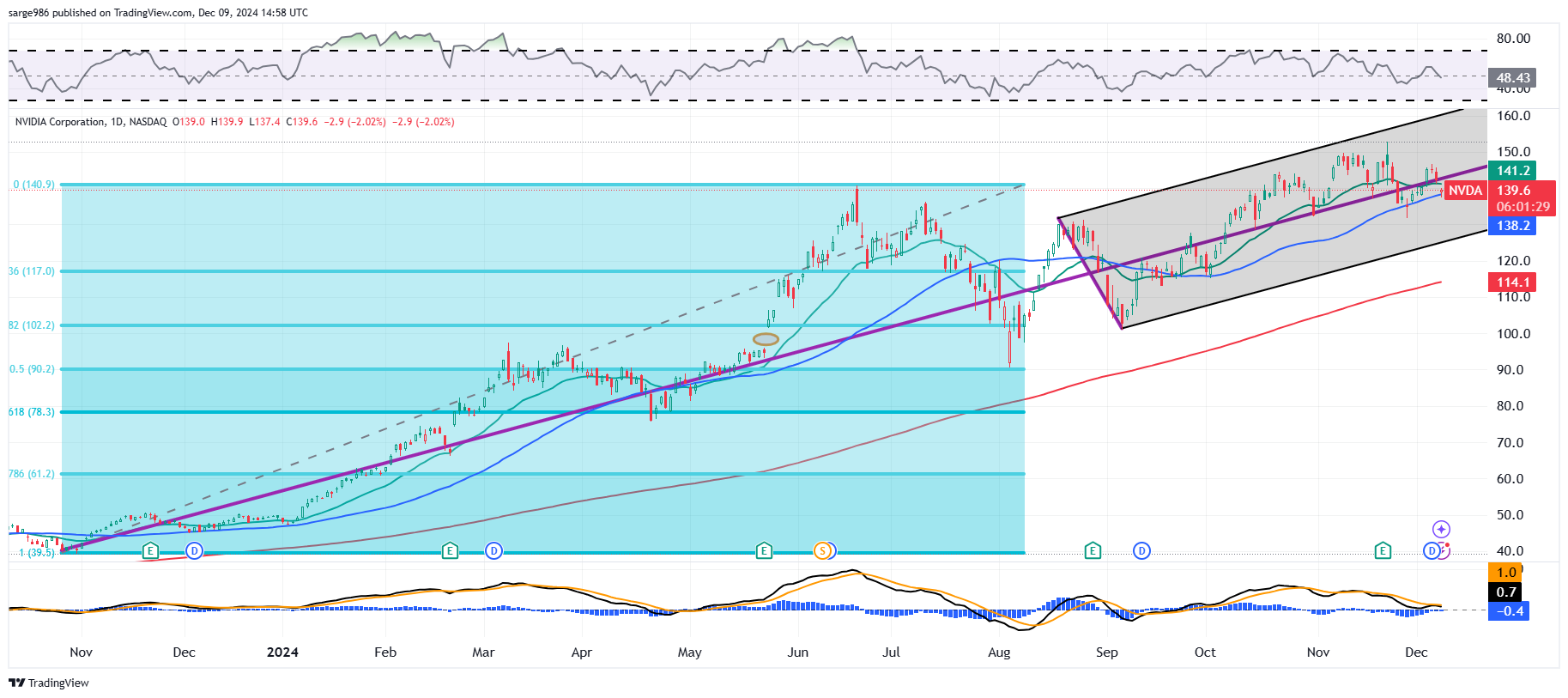
Now, readers will see that within the Pitchfork model, what looks like a head-and-shoulders pattern of bearish reversal is developing. The stock has surrendered its 21-day exponential moving average, which may have provoked some swing traders to bail out. But to this point, the stock's 50-day simple moving average has held. The downside pivot would be the neckline of the head and shoulders pattern, which is $132. That is where I will take some action if necessary.
I no longer add down to the 50-day simple moving average. That's a change. Now, I watch for a beak of the neckline. We see that line hold; the stock is probably a "buy" there. That line cracks, my plan would be to sell up to 40% of my position and try to buy most of it back should the downdraft take the shares down to their own 200-day SMA (currently $114).
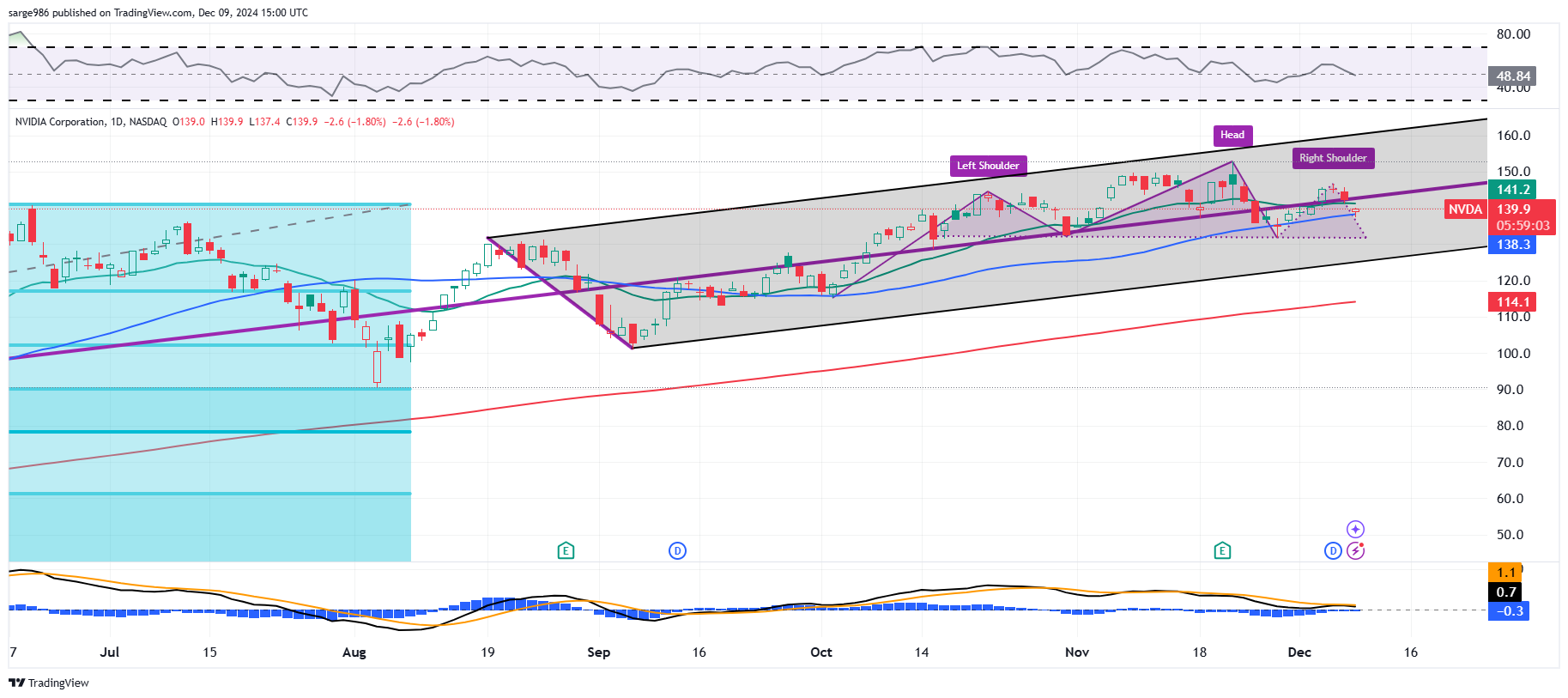
That neckline holds? I do not add, unless I see the stock trade above the $146 apex of the right-side shoulder. That would negate the pattern and at least technically, that the threat had passed. Anything between $132 and $146, I don't need to act. For those who were about to act, buying short-term protection really is not all that expensive right now. $146 calls expiring this Friday are going for about $0.47, while the purchase of $132 puts expiring this Friday are currently priced around $0.37. This way, the investor would have an add and a reduce set in stone at key levels through the end of this week.
At the time of publication, Guilfoyle was long NVDA equity.