Home Depot Was Once My Greatest Investment, But Now It’s a Flaming Mess
The do-it-yourself retail giant is no longer a “blue chip” name.
You've reached your free article limit
You've read 0 of 1 free Pro articles.
On Tuesday morning, do-it-yourself retail giant Home Depot (HD) released the firm’s fiscal first quarter financial results.
For the three-month period ended May 3, Home Depot posted an adjusted EPS of $3.43 (GAAP EPS: $3.30) on revenue of $41.765 billion. Those sales were good for year-over-year growth of 4.8%. Comparable sales for the quarter were up 0.6% from the same period last year. Comp sales in the U.S. were up 0.4%. While the top- and bottom-line prints both beat Wall Street’s expectations, the comp sales print fell short of the 0.8% growth that had been modeled in. Comp transactions hit the tape at a year-over-year contraction of 1.3%. This was a fourth consecutive quarter of year-over-year declines in this category.
In the press release, chair and CEO Ted Decker gave us the usual fluff:
“Our first quarter results were in line with our expectations. The underlying demand in our business was relatively similar to what we saw throughout fiscal 2025, despite greater consumer uncertainty and housing affordability pressure. As always, our associates provided excellent customer service during the quarter, and I would like to thank them for their continued hard work and dedication to serving our customers.”
However, CFO Richard McPhail did a much better job of painting an optimistic picture in a televised interview with CNBC on Tuesday morning:
“The homeowner in a relative sense is perhaps more protected financially than other customer cohorts and so we continue to see engagement. They continue to tell us that they are going to defer their spend on larger projects. That’s consistent with what they’ve told us the last few years.”
Operations
As revenue generation grew 4.8% to $41.765 billion, the cost of sales increased 6% to $27.984 billion. This left a gross profit of $13.781 billion (+2.4%) on a gross margin of 33%, down from 33.8%. Total GAAP operating expenses grew 5.7% to $8.8 billion, leaving a GAAP operating income of $4.981 billion (-3%). That put the firm’s GAAP operating margin at 11.9%, down from 12.9%.
After accounting for interest, other income and expenses as well as taxes, GAAP net income hit the tape at $3.289 billion (-4.2%). This worked out to $3.30 per fully diluted share, down from the year-ago comp of $3.45. After adjusting primarily for the amortization of acquired intangible assets, fully diluted EPS printed at $3.43m down from $3.56 a year ago.
Guidance
After reporting what seems like a mixed quarter at best, Home Depot reaffirmed previously issued guidance. Wall Street expected a guidance raise. For the full fiscal year, the firm sees total sales growth of 2.5% to 4.5%. This puts the midpoint of the range at growth of 3.5%. Wall Street was looking for something closer to 3.9%. Comp sales are seen anywhere from flat to up 2% for the year. For the year, gross margin is projected at 33.1%, while operating margin is projected at 12.4% to 12.6%. Adjusted full year earnings are seen landing anywhere from flat to up 4%. Wall Street was looking for growth of 2.4%, which is well above the midpoint of that range. This guidance has to be looked at as disappointing.
Fundamentals
For the period reported, Home Depot generated operating cash flow of $6.032 billion. Out of that number came capex spending of $844 million, leaving free cash flow of $5.188 billion, up from $3.519 billion for the year-ago comp, which is a significant positive. Out of that number came cash dividend payments to shareholders of $2.3 billion and $2.386 billion in paid down debt, which was sorely needed.
Turning to the balance sheet, Home Depot ended the quarter with a cash position of $1.601 billion and inventories of $27.28 billion. That put current assets at $37.172 billion. Current liabilities add up to $35.58 billion including short-term debt of $3.503 billion. While the current ratio is good for a barely passable 1.04, it has to be alarming to any investor that the short-term debt load stands at three times the cash position. This is Home Depot, not some underfunded biotech. Yikes! No — triple yikes!
Total assets amount to $107.904 billion, of which 30.3% is labeled as either goodwill or other intangibles. That’s in line with modern norms. Total liabilities less equity comes to $94.03 billion including a terrifying $44.828 billion in long-term debt. Terrifying because the firm has such a tiny cash position that is already overwhelmed by the debt that will come due within 12 months.
Interesting
On Monday night, ahead of this earnings release, analyst Brian Nagel of Oppenheimer, who I respect, reiterated his “hold” rating on HD, while cutting his target price from $405 all the way down to $310. Wow! Nagel is rated at five stars out of five by TipRanks. Over the past year, Nagel stands with a 59% success rate and an average return of 17.7%.
Opinion
The quarter was, in my opinion, disappointing despite the headline beats. The guidance was disappointing as well. Cash flows are decisively positive, but the balance sheet is an absolute embarrassment. One really cannot see Home Depot as a “blue chip” company when the balance sheet is simply a flaming mess. Obviously, I will not be putting any of my hard-earned dough into any kind of equity investment involving this name. My dad taught me better than that.
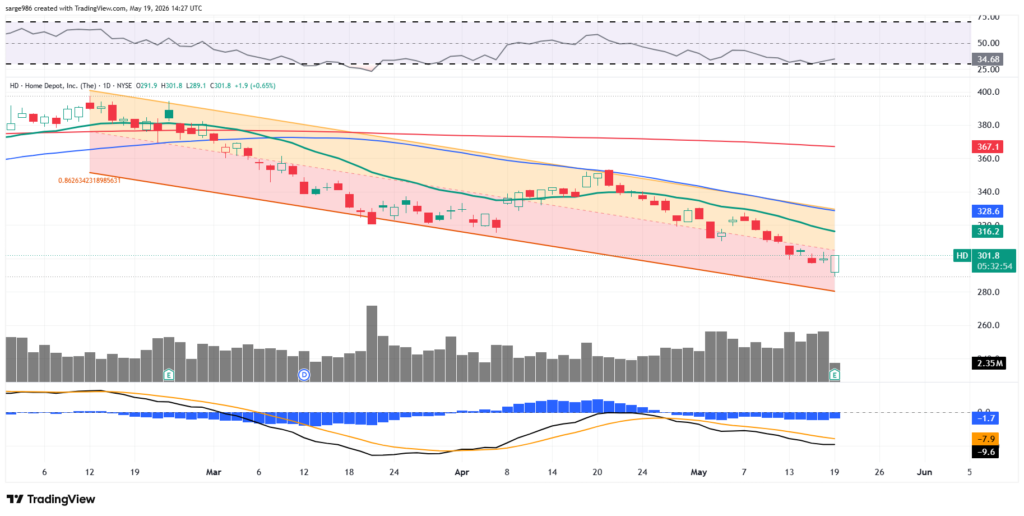
I could be wrong, but I see nothing here that would change the 2026 trajectory for this stock. That hurts, because HD was one the greatest investments of my career. Alas, that was a long time ago. With the share price running below its 200-day and 50-day SMAs as well as below its 21-day EMA, it would be tough to buy these shares even on weakness.
With relative strength weak, but not oversold, it would be tough to buy these shares. With all three components of the daily MACD sending bearish signals, it would be tough to buy these shares. About the only thing telling me that maybe HD is a “buy” is the fact that every single inductor that I follow sees HD as a “sell.” If I had to trade HD, I would probably get long a bear put spread expiring in late August after the next earnings release. The $300/$270 spread would go for a net debit of roughly $11.00 on Tuesday morning. That’s reasonable for a possible return of $30.00 for a $19.00 profit.
At the time of publication, Guilfoyle had no positions in any securities mentioned.