Exercise Caution With RH, Even as Stock Price Runs Wild
The retailer formerly known as Restoration Hardware is enjoying major gains after a Wall Street beat, but there's reason to be bearish.
You've reached your free article limit
You've read 0 of 1 free Pro articles.
RH RH, also referred to as "the old Restoration Hardware" by nearly everyone who mentions the name, released the firm's fiscal third quarter financial results on Thursday evening.
The stock had traded off a rough 4.4% or $17.57 on Thursday, only to rally more than 13% or more than $50 per share overnight. Still, that name. It's just as difficult to refer to this company as "RH" as it is to refer to the old Raytheon as RTX RTX, or the old Twitter as "X," but persevere through the marketing nonsense we must.
The numbers were not terrific. For the period ended November 2, RH posted an adjusted EPS of $2.48 (GAAP EPS: $1.66) on revenue of $811.732 million. While that top-line print was good enough for year-over-year growth of 8.1%, it just met expectations. The adjusted bottom-line number fell significantly short of what Wall Street was looking for.
So, why the rally? Despite Q3 revenue growth of 8.1%, total demand growth increased 13%. The firm mentioned tremendous growth in demand for the month of November that has not only so far carried into December, but has accelerated. November total demand growth was up 18%, while demand growth for the RH brand specifically grew 24%. Current quarter guidance was strong, and that's what any stock needs, a rosier looking tomorrow regardless of past performance. The majority of the adjustment was made for the purposes of asset impairment.
Operations
As revenue grew 8.1% to $811.732 million, the cost of that revenue increased 9.6% to $361.34 million (+6.1%). This took the firm's gross margin from 45.3% down to 44.5%. GAAP operating expenses decreased by 10.2% to $259.872 million, leaving a GAAP operating income of $101.468 million, which was up a stunning 97.1%. GAAP operating margin improved from 6.8% to 12.5%. That's impressive. On an adjusted basis, operating margin improved from 7.3% to 15.0%.
After accounting for interest, non-operating income and expenses and taxes, GAAP net income/loss printed at $33.168 million, up from $-2.187 million. That works out to $1.66 per fully diluted share, up from $-0.12. On an adjusted basis, earnings per share of $2.48 compares very well to the year ago comp of $-0.42.
Guidance
Based on the sudden and so far sustained increase in demand, RH felt comfortable with the following outlook: For the current quarter, RH sees total demand growth of 20% to 22% and revenue growth of 18% to 20%. Wall Street had been looking for revenue growth close to 12%, so this is a huge beat. The firm also sees an adjusted operating margin of 12.2% to 13.2% and an adjusted EBITDA margin of 18% to 19%.
For the full year, the firm sees total demand growth of 9.9% to 10.4% and revenue growth of 6.8% to 7.2%. That's up from prior full-year guidance of 8% to 10% demand growth and 5% to 7% revenue growth. This is a hugely positive revision. The firm also sees a full year adjusted operating margin of 11.5% to 11.7%, and an adjusted EBITDA margin of 17.2% to 17.4%.
Fundamentally Speaking
For the first nine months of the fiscal year, RH generated operating cash flow of $35.869 million, which is down significantly from the year ago nine-month comp of $316.172 million. Out of that number came capex spending of $179.897 million, leaving free cash flow for nine months negative at $-144.028 million. A year ago, at the nine-month mark, free cash flow stood at $184.332 million for the year. So, it's been a tough year so far for RH as far as cash generation goes. The firm obviously was in no position to return capital to shareholders.
Turning to the balance sheet, RH ended the quarter with a cash position of $87.012 million and inventories of $978.553 million, placing current assets at $1.278 billion. Current liabilities add up to $896.267 million. This includes no shorter-term debt, but does include deferred revenue of $307.922, which we know is not a true financial obligation.
This puts the firm's headline current and quick ratios at 1.43 and 0.33. Remember, we're not so tough on retailers' quick ratios as long as inventories are moving and, if demand is indeed there, then these inventories could be correctly valued. Once these ratios are adjusted for deferred revenue, they rise to 2.29 and 0.54, respectively. Not bad at all.
Total assets amount to $4.464 billion, that includes just an inconsequential number for goodwill and other intangibles. Total liabilities less equity comes to $4.647 billion (which actually turns shareholder equity into a shareholder deficit), including $1.908 billion in longer-term debt in the form of two separate term loans and an asset-based credit facility. Though nothing is due to mature within a year, this firm is over-indebted. A debt-load of more than $1.9 billion with a cash position of $87 million? Yikes.
Wall Street
Since these earnings were released last night, I have only found seven highly-rated (four-plus stars at TipRanks) sell-side analysts that had opined on RH. Among the seven there are four "buy" of buy-equivalent ratings and three "hold" of hold-equivalent ratings. After allowing for changes (there were three target price increases), the average target price across the seven is $470 with a high of $550 (Steven Forbes of Guggenheim) and a low of $400 (Peter Benedict of Robert W. Baird). Once omitting those two as potential outliers, the average target across the remaining five stands at $468.
My Thoughts
The guidance is impressive. The quarter reported? Not so much. Cash flows? Need help. The balance sheet? It's obvious that at least the current situation has been well-managed, but this balance sheet cannot be called rock solid or fortress like. Those cash flows better improve this coming year, or that balance sheet with all of that debt will weigh upon performance and probably the share price.
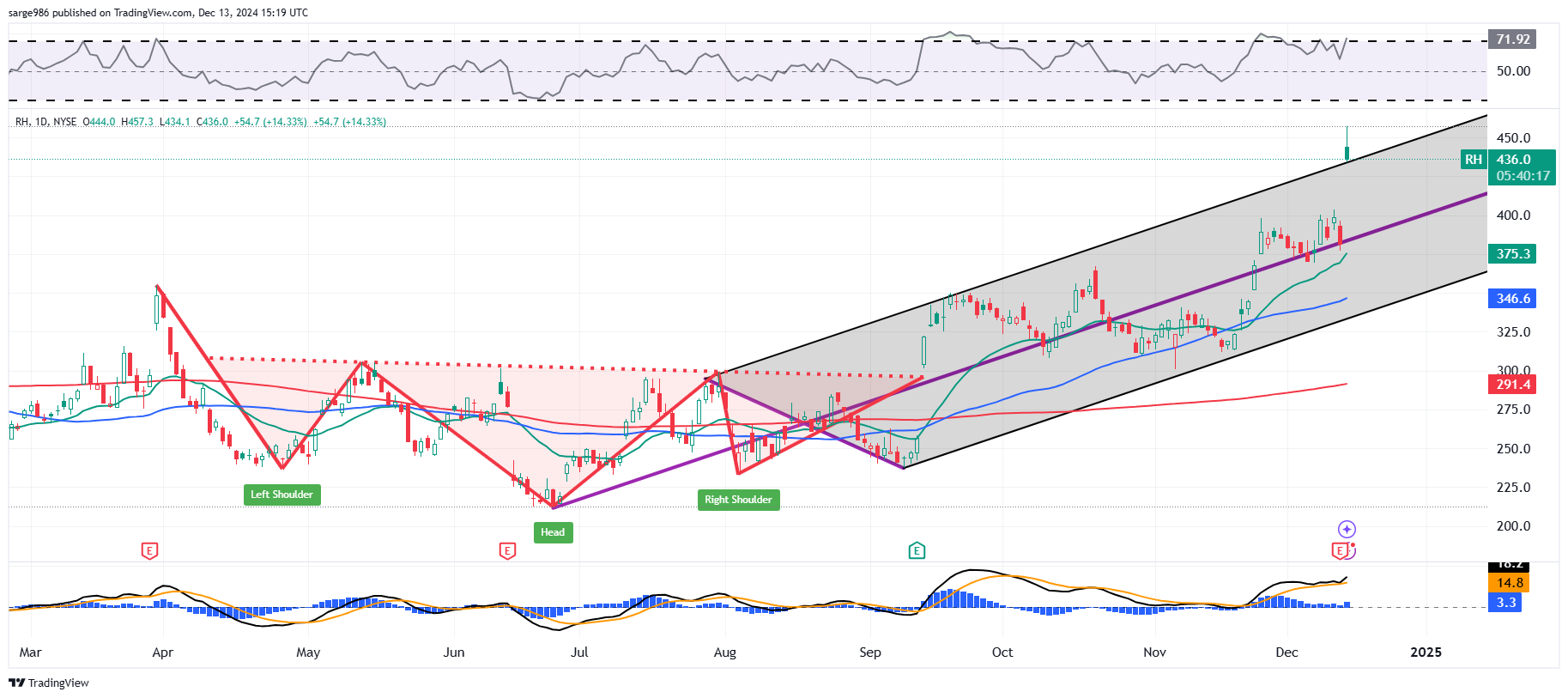
I'd be careful about today. I am not interested in getting long this name, given the fundamentals. Technically, the stock put together an inverse head-and-shoulders pattern this past spring into summer. That produced the upward trend that I have drawn up a Pitchfork model to illustrate that goes back to the nadir of the inverse head and shoulders.
Readers will see that the stock has broken out from the upper trendline of the Pitchfork this morning and has left all of its key moving averages behind. Relative Strength is solid but has now entered into overbought territory. RH, as a stock, has never been able to maintain an RSI reading of 70 or greater for very long. The daily MACD is set up bullishly. For now. Coming off of that inverse head and shoulders, my target for RH would have been around $380.
I could be wrong, but I see this guidance as potentially setting shareholders up for disappointment. I would rather short this stock on this strength than hop on board on strength. That said, with 23% of the float held in short positions, I am not going to do that.
While that does imply that at least part of this morning's pop is a squeeze and, being unwilling to short the equity, a bear put spread feels like a better way to make a negative, risk-averse bet on the stock. Maybe I'll get long a $435/$425 December 27 bear put spread for a net debit of roughly $4 if that trade is still there after publication of this article. Otherwise, I'll look for something else.
At the time of publication, Guilfoyle had no positions in any securities mentioned.