Drone Firm AeroVironment Crushes Expectations, When Is the Right Time to Buy?
The unmanned aircraft name turned heads on Wall Street and I have a trade idea.
You've reached your free article limit
You've read 0 of 1 free Pro articles.
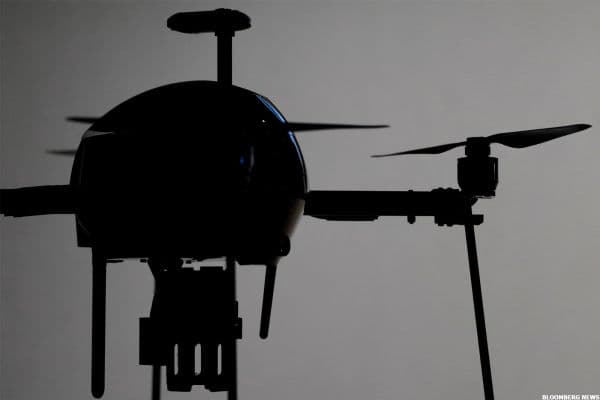
On Monday evening, small- to medium-sized unmanned aircraft designer and manufacturer AeroVironment (AVAV) released the firm’s fiscal fourth quarter financial results. Many investors think of the Arlington, Virginia based firm as a drone maker, which it is, but this firm is more than that.
The firm is well-known for its “Switchblade” Kamikaze drones that loiter above a target and the strike. The firm’s aircraft are also used for reconnaissance and surveillance missions by U.S. and allied militaries. The firm also specializes in systems designed to detect and eliminate hostile drones and continues to develop both ground-based and maritime-based drones as well.
For the period ending April 30, the firm posted an adjusted EPS of $1.84 (GAAP EPS: $1.26) on revenue of $641.616 million. These top- and bottom-line results both easily beat Wall Street’s expectations while that sales print was good enough for an incredible year-over-year growth of 133.3%. Wahid Nawabi, who is president, CEO and chairman of AeroVironment, commented in the press release:
“Fiscal 2026 marked a transformational year for AV, which included the completion of our largest acquisition, meaningful investments toward diversifying our portfolio in critical areas aligned to our customer’s highest priorities, and the strongest financial performance in our history.”
Nawabi went on:
“We remain focused on executing with excellence and strengthening our supply chain to accelerate the commercialization of our platforms. AV is well-positioned to capture the rising global demand across lethal and non-lethal drones, counter-UAS, space and advanced technologies and deliver long-term shareholder value.”
Operations
As mentioned above, sales grew 133.3% to $641.616 million. Within that number, product sales increased 106% and sales of related services grew 334.7%. The cost of those sales printed at $438.991 million (+151.3%). That left a gross profit of $202.6 million (+102%). Gross margin fell from 36% to 32% largely as a result of negative gross margins across the services side.
After accounting for all operating expenses, GAAP operating income hit the tape at $56.941 million (+312.1%). Once we work in interest, other income and expenses as well as taxes, GAAP net income landed at $63.174 million (+279.1%). This works out to $1.25 per fully diluted share, up from the year ago comparison of $0.59. After adjustments for the amortization of intangible assets, acquisition-related expenses and net value changes of the firm’s investments, the EPS print runs at $1.84, up from $1.61.
Guidance
For the full fiscal year just started, AVAV is projecting revenue of $2.125 billion and $2.225 billion, adjusted EBITDA of $305 million and $325 million and an adjusted EPS between $3.02 and $3.24. I don’t see this as especially string guidance and I think the market may regret the nearly 30% overnight pop. Wall Street was looking for full-year guidance of something close to an adjusted EPS of $4.00 on revenue of $2.185 billion. The guidance put the midpoint of the sales range below that consensus. In addition, the firm’s expected adjusted profitability for the year is well below what the street was looking for.
Fundamentals
For the full year completed, AeroVironment “generated” operating cash flow of -$78.404 million. On top of that, the firm dished out $62.544 million in traditional capex spending and $23.674 million on the acquisition of capitalized software. This put free cash flow (cash burn) for the year at -$140.948 million. The firm is obviously in no position to return capital to shareholders.
Turning to the balance sheet, AeroVironment ended the period with a cash position of $632.297 million and inventories of $312.856 million. That left current assets at $1.89 billion. Current liabilities add up to $439.237 million. This includes no short-term debt. This leaves the firm’s current and quick ratios at 4.30 and 3.59, which is very healthy.
Total assets amount to $5.717 billion. This does include goodwill and other intangibles of $3.424 billion, which is a lot. at just less than 60% of total assets, for me at least, this does raise eyebrows. Total liabilities less equity comes to $1.316 billion. This includes long-term debt of $728.967 million. Though this is not covered by the cash position, this is still a very decent balance sheet, even with the enormous valuations posted for intangible assets.
Opinion
I have already told readers that the guidance bothered me. The stock, as I finish up this piece, is no longer up 30% as it was overnight. It is now mid-morning, and the shares are up a rough 18% from Monday’s closing price. It’s not just the guidance that was weak, so are cash flows. The business is growing rapidly, but cash flows are going the wrong way. The balance sheet is good enough, but it is not “awesome.” I think the shares may have flown too far on Tuesday morning. I see that four sell side analysts have lowered their target prices on Tuesday morning and three of those have made significant cuts. Not one has increased their target price.
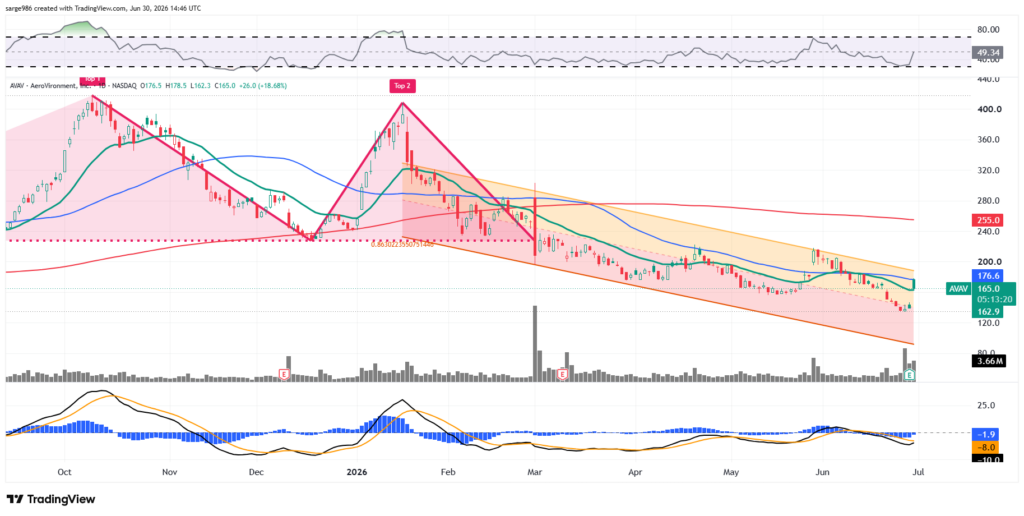
Readers will see that AVAV came out of a winter double-top pattern of bearish reversal and sold off though Monday. The lower trend is contained neatly here in a Raff Regression model that has not come close to breaking even on the overnight rally.
Readers might be sharp to notice that AVAV was rejected this morning at its 50-day SMA, which is where a lot of the pros make their decisions. That thin blue line is the upside pivot. I will not consider buying this stock anywhere close to that line. I would rather pay up once the line is cracked. To be honest, I would not mind getting long a July 17 $160/$150 bear put spread for a net debit of $4 or so in an attempt to win back $10.
At the time of publication, Guilfoyle had no positions in any securities mentioned.