Disney's Balance Sheet Makes It Uninvestable
After reporting its latest financial results, the entertainment giant has work to do before it can be a reasonable investment.
You've reached your free article limit
You've read 0 of 1 free Pro articles.
The Walt Disney Company DIS released the firm's fiscal fourth quarter financial results on Thursday morning. For the three-month period ended September 28, Disney posted an adjusted EPS of $1.14 (GAAP EPS: $0.25) on revenue of $22.574 billion. Both the top and adjusted-bottom lines did beat Wall Street's expectations, while year-over-year revenue growth amounted to 6.3%. That was the fastest pace of year-over-year revenue growth for Disney since the March quarter of 2023. The adjustments made to earnings were made primarily for restructuring and impairment charges and secondarily for the amortization of acquired intangible assets.
Notably, the movies "Inside Out 2" and "Deadpool & Wolverine" helped drive a rough $316 million in operating income at Content Sales/Licensing and Other during the quarter reported. Additionally, the Experiences segment posted records for revenue and operating income for the full fiscal year driven by the parks.
Operations
As revenue generation ramped 6.3% to $22.574 billion, costs and expenses increased 3.5% to $19.829 billion. This left an operating income of $2.78 billion, up from $2.083 billion as operating margin improved from 9.8% to 12.3%. After accounting for restructuring and impairment charges, interest, other income/losses and taxes, GAAP net income attributable to shareholders printed at $460 million, up from $264 million. That works out to GAAP earnings per diluted share of $0.25, up from $0.14.
Segment Performance
- Entertainment generated revenue of $10.829 billion (+14%), producing operating income of $1.067 billion (up from $236 million), on an operating margin of 9.9% (up from 2.5%).
- Linear Networks revenue was down 6%, producing operating income that was down 38%.
- Direct-to-Consumer revenue was up 15%, producing operating income that swung positive.
- Content Sales/Licensing revenue was up 39%, producing operating income that swung positive.
- Sports generated revenue of $3.914 billion (up small), producing operating income of $929M (-5%), on an operating margin of 23.7% (down from 25.1%).
- Domestically, ESPN revenue was up 1%, producing operating income that was down 5%.
- Experiences generated revenue of $8.24 billion (+1%), producing operating income of $1.659 billion (-6%), on an operating margin of 20.1% (down from 21.6%).
- Domestic Parks revenue was up 3%, producing operating income that was up 5%.
- International Parks revenue was down 5%, producing operating income that was down 32%.
- Product revenue was up 1%, producing operating income that was up 1%.
Streaming Results
We'll break out the results for Disney's streaming services separately, though outside of ESPN+, they are included in the "Direct-to-Consumer" component of the Entertainment segment.
- Disney+ paid U.S. and Canadian subscribers grew 2% to 56 million, as ARPU dropped 1% to $7.70.
- Disney+ paid international (ex-Hotstar) subs grew 5% to 66.7 million, as ARPU grew 3% to $6.95.
- Disney+ Hotstar (India) paid subs grew 1% to 35.9 million, as ARPU dropped 26% to $0.78.
- Hulu SVOD paid subs grew 1% to 47.4 million, as ARPU dropped 1% to $12.54.
- Hulu Live TV & SVOD paid subs grew 5% to 4.6 million, as ARPU dropped small to $95.82.
Acronyms:
SVOD: Subscription Video on Demand
ARPU: Average Monthly Revenue Per User
Guidance
For fiscal year 2025, Disney sees high single-digit adjusted EPS growth, and a rough $15 billion in operating cash flow, out of which will come roughly $8 billion in capex spending. The firm is also targeting $3 billion in share repurchases for its corporate treasury. Disney sees double-digit percentage growth in Entertainment segment operating income and 13% reported growth in Sports segment operating income as Experiences segment operating income grows 6% to 8%.
Looking further out, Disney is projecting double-digit adjusted EPS growth for fiscal 2026, as well as double-digit growth in operating cash flow. For fiscal 2027, the firm sees double-digit adjusted EPS growth.
Fundamentals
For the full fiscal year 2024, Disney generated operating cash flow of $13.971 billion, out of which came capex spending of $5.412 billion. This left free cash flow of $8.559 billion. Out of that number, the firm repurchased $2.992 billion in common stock for its treasury, while paying out $1.366 billion in cash dividends to shareholders.
Turning to the balance sheet, Disney ended the period with a cash position of $6.002 billion and inventories of $2.022 billion, bringing current assets to $25.241 billion. Total liabilities add up to $34.599 billion, including shorter-term debt of $6.845 billion, but also deferred revenue of $6.684 billion which is not a true financial obligation.
At the headline, these numbers put Disney's current and quick ratios at 0.73 and 0.67, respectively. That's fairly awful to be honest. Once adjusted for the deferred revenues, these ratios improve to 0.90 and 0.83. These ratios still do not pass muster. Disney's balance sheet does not get a passing grade from your author. Additionally, the fact that cash on hand (-57.7% over 12 months) cannot cover the short-term debt-load creates the necessity to refinance at least a portion of those borrowings at prevailing interest rates.
Total assets amount to $196.219 billion. Of that, $84.065 billion, or 42.8%, of those total assets are in the form of goodwill or other intangibles. I find that to be an awfully high percentage, but if anyone can claim a large value for intangible assets, I would imagine Disney can. Total liabilities less equity comes to $90.697 billion including another $34.599 billion in longer-term debt.
Obviously, Disney does not have a balance sheet that one would envy. Fortunately, the company does produce large enough cash flows to keep paying the shareholders and fix the balance sheet. An idea might be toning down the repurchase program until the balance sheet looks a lot stronger, but who am I?
My Thoughts
The stock is now trading with a $110 handle, up almost 8% on the day. The firm had a good quarter. Cash flows are strong. The Parks are strong. The Studios are strong. Guidance is strong. I just talked about the balance sheet, which has long been a black eye for this firm. This is a business that has just announced price increases. Will they eventually price out middle class America? Possibly. I like Disney. Honestly. I want to just invest in the firm. but we cannot act on emotion. This stock is tradable. The company? I would rather not invest in Disney until that balance sheet shows marked improvement.
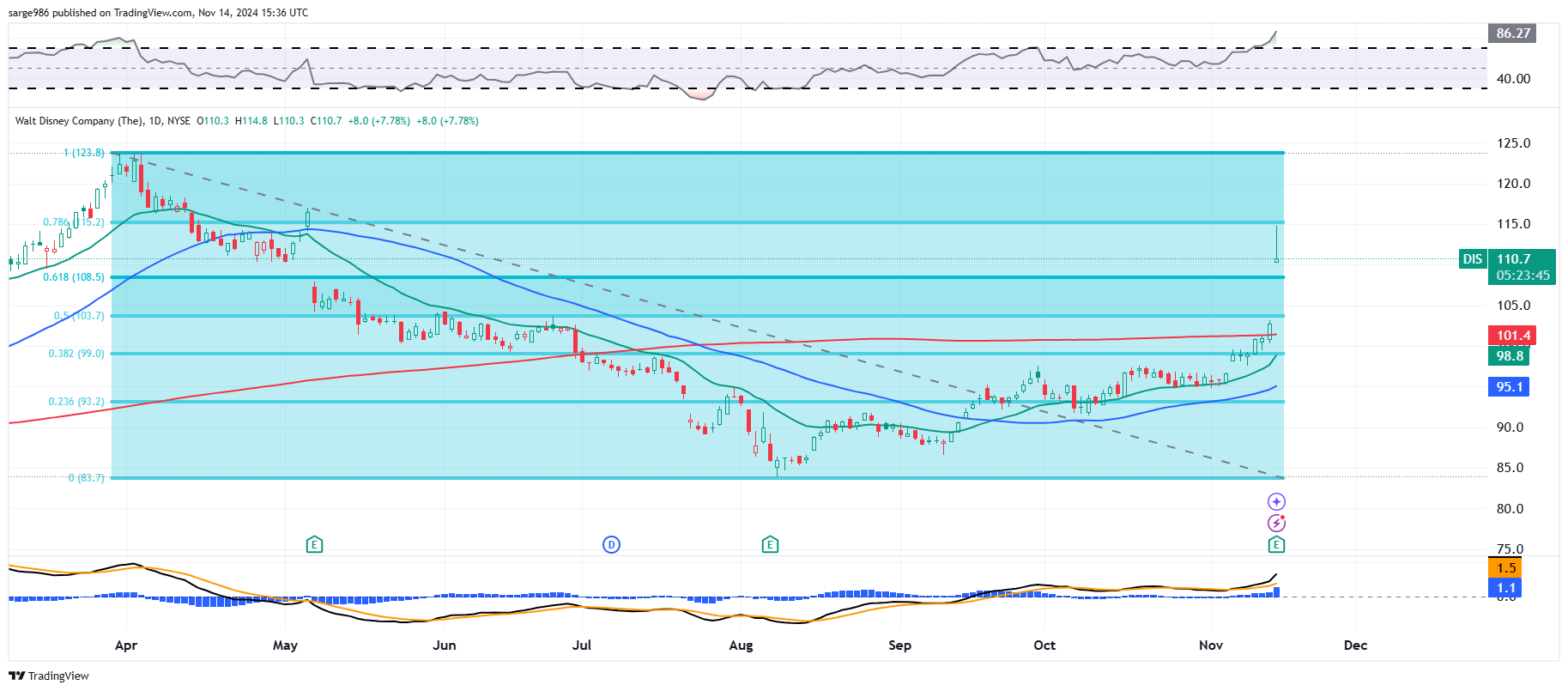
Readers will see that, despite a suddenly stronger daily MACD and a suddenly "overbought" reading for relative strength, that the shares of DIS were sharply rebuked at the 78.6% Fibonacci retracement level of the stock's late March through early August sell-off.
I think that a number of portfolio managers have probably had to add long-side exposure to the name given the taking and now holding of its 200-day SMA on Wednesday. That line currently runs at $101.40. Is there a chance that this line is retested given the gap opened up by this morning's opening?
Yes, there is a chance. I think there is a good chance. Wanna buy Disney? I think your best entry point will not be today. The stock is probably short-able for a small trade, but I wouldn't get carried away either in size or duration.
At the time of publication, Guilfoyle had no positions in any securities mentioned.