Buying More Sandisk After Outstanding Results
The memory and storage firm has an excellent balance sheet.
You've reached your free article limit
You've read 0 of 1 free Pro articles.
On Wednesday evening, Sandisk (SNDK), a firm spun off by Western Digital (WDC) that had become a major player in the memory/storage business, released the firm’s fiscal fourth quarter financial results.
Sandisk focuses on the sale of NAND flash memory chips, solid-state drives and USB drives. Sandisk is not really in direct competition with U.S. industry king Micon Technologies (MU). To be clear as we get started, your author had been in the memory/storage trade for much of the year. Of the above-mentioned names, your author remains long MU, is down to an odd lot in SNDK and has been completely out of WDC for weeks.
For the period ending July 3, Sandisk posted an adjusted EPS of $39.25 on revenue of $8.965 billion. These results are simply incredible. The top-line results beat Wall Street by almost a half a billion dollars while deflecting sequential growth of 51% and year-over-year growth of 372%. The adjusted bottom-line result beat Wall Street by almost $5. Amazingly, the GAAP EPS print of $43.97 beat Wall Street by almost $11. Almost $11, gang!
The firm also announced an expansion of its common stock repurchase authorization. The firm’s board of directors approved an additional $14 billion buyback program, bringing total remaining authorization up to $15.5 billion. This is a firm with a market cap of $200 billion (yes, that fluctuates), so the board basically authorized the repurchase of almost 8% of the company.
CEO David Goeckeler made what I took as a disappointingly perfunctory statement in the press release. Goeckler wrote: “We closed fiscal 2026 with a leading technology portfolio, established data center as a key growth pillar, and deepened our customer partnerships. Our technology and products are well positioned to create value for our customers and generate growing and durable free cash flow.”
Operations
As the firm grew sales 372% to $8.965 billion, the cost of those sales actually contracted 1.4% to 1.383 billion. This left a gross profit of $7.582 billion (up 1,422%, not a misprint). That took the firm’s gross margin from 26.2% all the way up to 84.6%. Again, no typo here. Total GAAP operating expenses grew 13.5% to $545 million, leaving a GAAP operating income of $7.037 billion (up from $18 million). After adjustments, gross margin improved from 26.4% to 84.6% and operating expenses increased 20% to $484 million.
After interest, other income and expenses, as well as taxes, GAAP net income/loss printed at $6.903 billion (up from -$23 million). This works out to $43.97 per fully diluted share, up from the year ago comp of -$0.16. On an adjusted basis, net income hit the tape at $6.162 billion, up from $42 million. That works out to $39.25 per fully diluted share, up from $0.29. Adjustments were made primarily for changes in the values of the firm’s investments.
Business Unit Sales Performance
Datacenter generated revenue of $2.977 billion (up from $213 million)
Edge generated revenue of $5.432 billion (up 392%)
Consumer generated revenue of $556 million (down 5%)
Guidance
For the current quarter, Sandisk is projecting revenue of $10.3 billion to $10.8 billion. At the midpoint, this range falls just short of the $10.62 billion that Wall Street was looking for. Adjusted EPS is seen at $44.00 to $46.00 versus the $44.21 that Wall Street had in mind. Operating expenses are projected at $520 million to $540 million and adjusted gross margin is seen at 83% to 85%. Investors appear to be mildly disappointed in this guidance, though I don’t really see that. More than likely, this is just a profit-taking party that we are seeing this week.
Fundamentals
For the period reported, Sandisk generated operating cash flow of $7.126 billion. Out of that number came capex spending of $43 million. This resulted in free cash flow of $7.083 billion, up from $49 million. Now take out another $110 million in expenses related to Flash Ventures and a $1.938 billion impact from prepayments related to the new business model (NBM) and free cash flow becomes $5.035 billion (still up from $77 million). Out of that number, Sandisk repurchased $4.524 billion worth of common stock for the firm’s corporate treasury.
Turning to the balance sheet, Sandisk ended the quarter with a cash balance of $4.762 billion and inventories of $2.698 billion. That puts current assets at $12.78 billion. Current liabilities add up to $5.581 billion. This includes no short-term debt. That leaves the firm with a current ratio of 2.29 and a quick ratio of 1.81. This current situation is aces.
Total assets amount to $22.507 billion. Just $22.25 billion of this total could be considered intangible, which is fine. Additionally, the firm holds marketable equity holdings of $1.777 billion that are considered by the firm to be long-term investments but could easily be added to the cash position in a crisis. Total liabilities less equity comes to $6.771 billion. There is also no debt of any kind on these books. This is a top-notch balance sheet.
Opinion
There is a ton to like here. Sales are soaring. Profitability is through the roof. Cash flows are more than robust. There’s been a huge increase in the share repurchase authorization. The balance sheet is beyond clean and able to support almost anything. Guidance was a hair below consensus. On that note, we already know that the memory/storage shortage will extend at least into 2028.
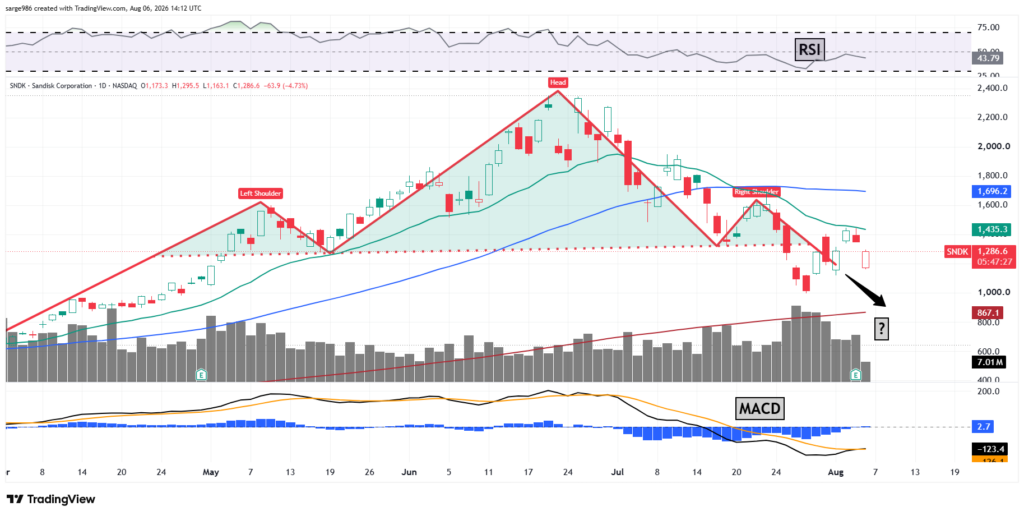
The technical setup is bearish. The stock is coming out of a head-and-shoulders pattern of bearish reversal with a $1,325 pivot. That puts my add level right around $1,000, maybe a little lower. I either add between that spot and the 200-day SMA or on a momentum move above the 21-day EMA. I do not think I will exit my odd-lot just yet. Instead, I look to rebuild that position, intelligently.
At the time of publication, Guilfoyle was long MU and SNDK equity.