Boeing's Still Riding on a Wing and a Prayer
The company embarks on a $19 billion capital raise. It's got new leadership. Will it all fly?
You've reached your free article limit
You've read 0 of 1 free Pro articles.
Is Boeing getting desperate? Looks like it with its reported plan to raise $19 billion in capital. But it might also be acting out of necessity.
I wrote to you almost a month ago to discuss Boeing BA and its plethora of problems. I was not positive on the stock. I really never have been -- not since a conversation I had with an Air Force staff sergeant on the tarmac in Panama when I was a much younger man making a living hanging out in rain forests. The company, in my certainly not first-hand opinion, appears to have had persistent cultural issues that have at times run deep, and certainly appear to have lasted through the decades.
The stock did try to rally at one point mid-October, but after failing to reach a deal with roughly 30,000 employees, the stock simply hit a brick wall at its 50-day simple moving average. The stock went out on Friday trying to hang on to its 21-day exponential moving average and not lose the swing crowd. That will change this morning. The stock will likely sell off further on the news, but the news released early Monday will create some much-needed flexibility to keep on keeping on.
I will say that these laborers striking against Boeing simply must not realize that their employer is deep in the bog and it's hard to see how the strike does not force mass layoffs.
The News: Raising Capital
The first whispers came overnight. Bloomberg News reported that Boeing was preparing to raise at least $15 billion in capital as soon as today -- though the total came out $4 billion higher.
Bloomberg reported that the raise would likely include a combination of equity and convertible debt. Boeing had recently filed a shelf registration and received authorization from the Securities and Exchange Commission to issue new debt and equity to reinforce it credit rating, improve its balance sheet and avoid being downgraded by the ratings agencies to "junk" status. All three credit ratings agencies currently rate Boeing's debt at their respective lowest rungs for investment grade.
This came on the heels of a Wall Street Journal report last week that Boeing was looking to exit its space business completely and that Lockheed Martin and Boeing were looking to sell their jointly owned ULA (United Launch Alliance) business to Sierra Space for $2 billion to $3 billion.
A few hours later, the Boeing Corporation reported the launch of concurrent, but separate underwritten public offerings of 90 million shares of common stock (par value: $5), and $5 billion worth of depository shares. It expects to grant the underwriters the right to purchase up to an additional 13.5 million shares of common stock and an additional $750 million of depository shares to cover potential over-allotments. Each share of preferred stock will automatically convert for settlement on or about Oct. 15, 2027, unless converted earlier.
The net proceeds of these offerings could total as much as $19 billion and will be used by Boeing for general corporate purposes, which may include debt repayment, use as working capital, capital expenditures, as well as funding and investing in the company's subsidiaries.
It Was Only Five Days Ago ...
Boeing reported a third-quarter adjusted loss $10.44 per share on revenue of $17.84 billion. The earnings print missed estimates by a country mile, no ... make that two country miles. The revenue print also fell short of Wall Street's modest expectations and reflected a year-over-year contraction of 1.4%.
On the bright side, the company's order backlog, if it can be trusted at this point as one might find clientele looking to Europe, China or Brazil for the manufacture of their civilian airliners at some point. This was the 13th consecutive quarter that Boeing posted a negative EPS. Projections are for more. The last year that Boeing posted a full-year profit was 2018. By all means, though, stay out on strike. Hope your skills are transferable.
For the September quarter, Boeing generated operating cash flow loss of $1.345 billion. For the trailing 12 months, Boeing has seen an operating cash flow loss of $5.249 billion. Free cash flow for the quarter came to negative $1.956 billion -- and for the trailing 12 months, came to negative $7.262 billion. Nice job, fellas.
Turning To the Balance Sheet
Boeing ended the September quarter with a cash position of $10.47 billion and inventories listed at $83.241 billion. That put current assets at $109.436 billion. Current assets add up to $97.3 billion including $4.474 billion in debt maturing short-term and unearned revenue of $57.931 billion. Now, I often tell you that unearned revenue is not a true financial obligation, but one of goods or services or both owed.
That is true, but it does turn back into a financial obligation if those goods and services are not rendered. This is now an issue for Boeing as its assembly lines have been idled for some time hurting its 737 MAX aircraft; and regulatory issues have caused other problems. The current ratio stands at a passable 1.12, but its quick ratio drops to a somewhat scary 0.27. That's all a matter of what those inventories are really worth is sold in bulk.
Total assets amount to $137.695 billion, including only $10.123 billion in goodwill and other intangibles, so that's not an issue. Total liabilities less equity came to a whopping $161.257 billion including long-term debt of $52.923 billion. That's potentially problematic at the company's current rate of cash burn, which is why they had to go to the investing public this morning hat in hand.
Bottom Line
I am no fan of Boeing. You all know that. I have never been shy about that. I do not think Boeing can be a solid investment until it gives me a reason to believe in the management or labor force. Both have lived in fantasy land for too long. Even though leadership has changed hands more than once, I have not seen anything that has obviously improved. Until now. Maybe.
CEO Kelly Ortberg is new, starting in August, and seems to be getting aggressive. We'll give him a chance to screw up as badly as the last two CEOs had, before we include him in the mess. I like that he is not a Boeing-lifer. That means he grew up elsewhere. Ortberg spent a career at Rockwell Collins, where he rose to CEO. He stayed through its merger into United Technologies and then through the merger into Raytheon Technologies, which is now the RTX Corporation RTX. We'll give him a chance. Maybe he can be to Boeing what Larry Culp was to General Electric, now GE Aerospace GE.
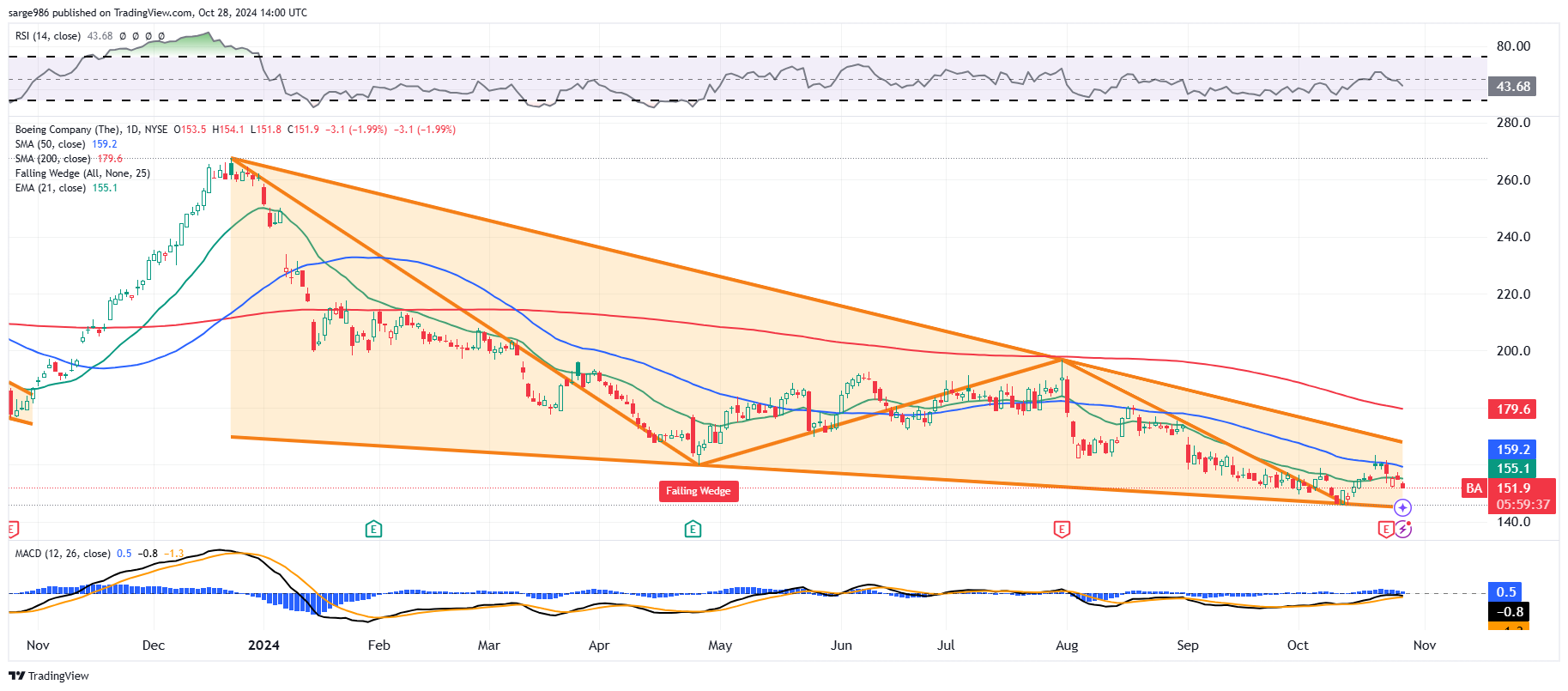
What we see here is a chart of Boeing going back to last December. This ends up looking like one big falling wedge pattern to me, which is a pattern of bullish reversal. Do I buy some here? Maybe for a trade. I told you; I can't invest in this name until a whole laundry list of items are corrected. The stock bottomed at $146 about three weeks ago. I think that f it got there, a purchase price below $150, but above that low, could work out as a trade. I would not go in large. This would be a smaller-sized position.
At the time of publication, Guilfoyle was long LMT, RTX, GE equity.