After its 35% Run Is Meta Still a Buy?
Taking a close look at the Big Tech giant amid massive AI spending and a stock price surge.
You've reached your free article limit
You've read 0 of 1 free Pro articles.

Have a stock you’d like Neil’s opinion on? Please email him at [email protected]
Meta Platforms (META) ripped 11.4% on Monday, its best day since the post-Liberation Day market rebound. The stock is up roughly 35% in the past month, the most recent leg on the back of the September 8th launch of Muse, Meta’s personal AI agent, which has since shot to the top of Apple’s free-app chart and flipped the narrative from “AI burning-cash laggard” to “potential monetization leader.”
In full disclosure, I’ve been long Meta since early August, when it successfully tested its 52-week low — but what do I do with it now? Unfortunately, as you will see, my screen doesn’t give a clear answer, so I trimmed a little and am holding the rest for now with a stop at $728.
Let’s take a look.
Fundamentals
The underlying business is solid: a wide moat built on nearly 4 billion users that advertisers want access to. Previously very asset-light, it sports enviable 82% gross and roughly 38% operating margins, with revenue still compounding 22% a year — above its 18.5% five-year average — even at a nearly $1.9 trillion market cap. The strength is the advertising engine — a cash machine throwing off tens of billions in free cash a year, with pricing power still lifting revenue per user.
And the hope behind the recent price spike is revenues will be supported by the AI layer Meta is building on top of the advertising business — subscriptions to Muse and the Meta One bundle, take-rates on agentic commerce as its assistant starts transacting for users, enterprise and API-licensing fees tied to the coming Watermelon frontier model, and, further out, renting excess data-center capacity to other AI labs. Little of it is material yet, but that promise is what has investors excited. Muse holds a 4.9-star rating across 25,000-plus reviews and around 557,000 daily users as of Sept. 19 per Sensor Tower date (via BofA), so people are using it, not just downloading it.
Earnings had been similarly stellar, compounding at around 18% a year over the past five years, but this year we saw the first big issue — earnings growth flattened out as the company’s AI spending ramp outpaced the top line. Capex has run near $89 billion over the past year and is expected to increase in 2027, adding to Reality Labs’ continuing to lose well over $15 billion a year.
This will also dent those operating margins, which Morningstar models easing from the 42% peak in 2024 toward the mid-30s as depreciation and compensation build.
But the good news is Meta is a company with the balance sheet to absorb the spending. S&P rates it AA−, even as free cash flow to equity turns negative.
Valuation
On a forward earnings basis, valuation hasn’t been particularly demanding but the recent run-up has seen them lift to around 24 times, a little above the market multiple.
On price-to-free-cash-flow-to-equity (FCFE), one of my preferred metrics because it strips out the noise and asks how much cash the business is actually returning, we run into the cash-flow issue noted above. Meta trades at a blended 264x — “blended” being FAST Graphs’ mix of the latest actual and the current-year estimate — against a ~27x norm, and the figure turns negative next year as the AI capex wave swamps the cash the ad engine generates.
What the analysts say
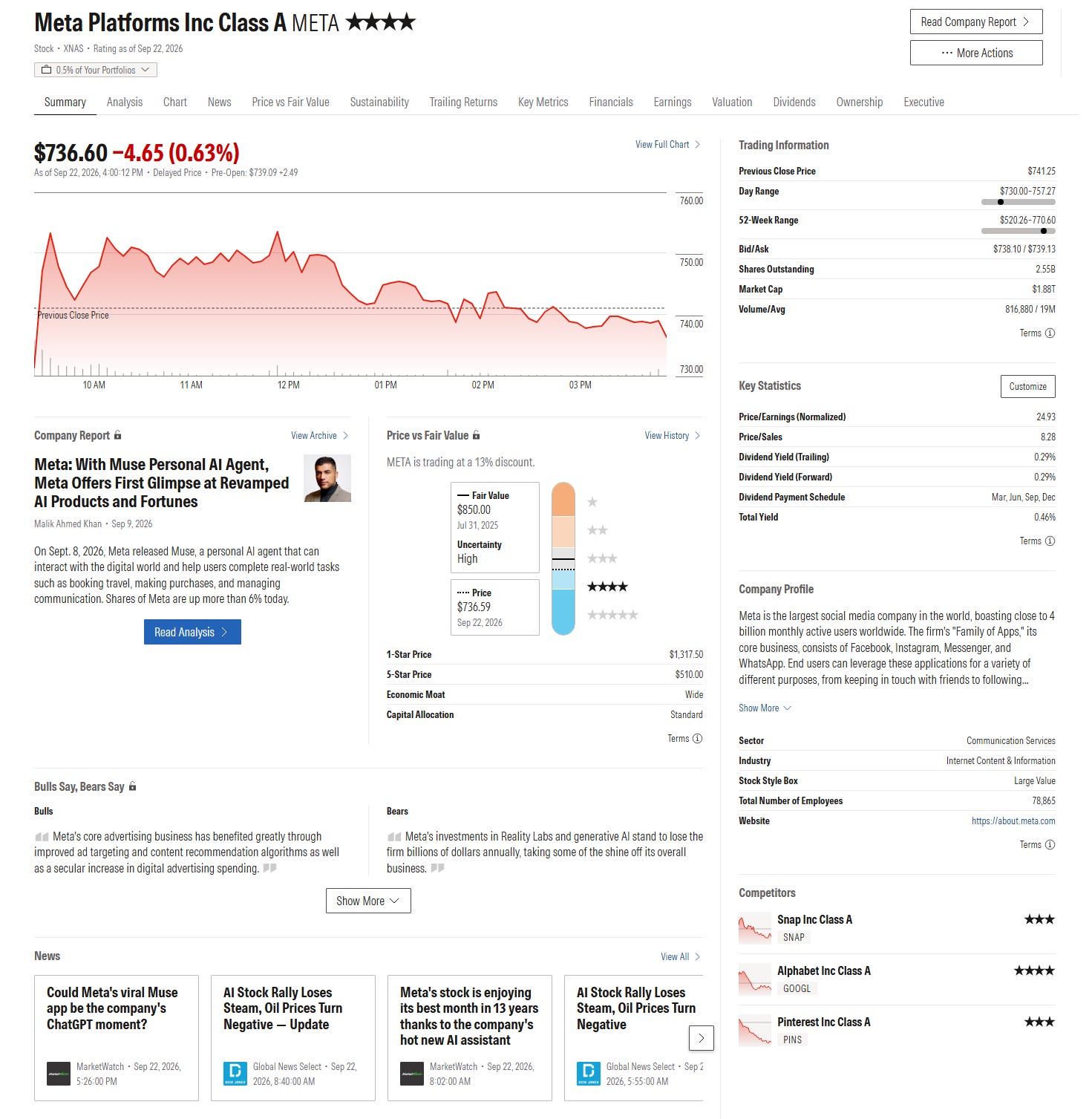
Morningstar has its quirks with plenty of critics, but unlike momentum-sensitive Street targets, I like that its fair value number is built from a long-term discounted-cash-flow view of the business with no consideration for the current stock price. They give it an $850 fair value, about 15% above spot.
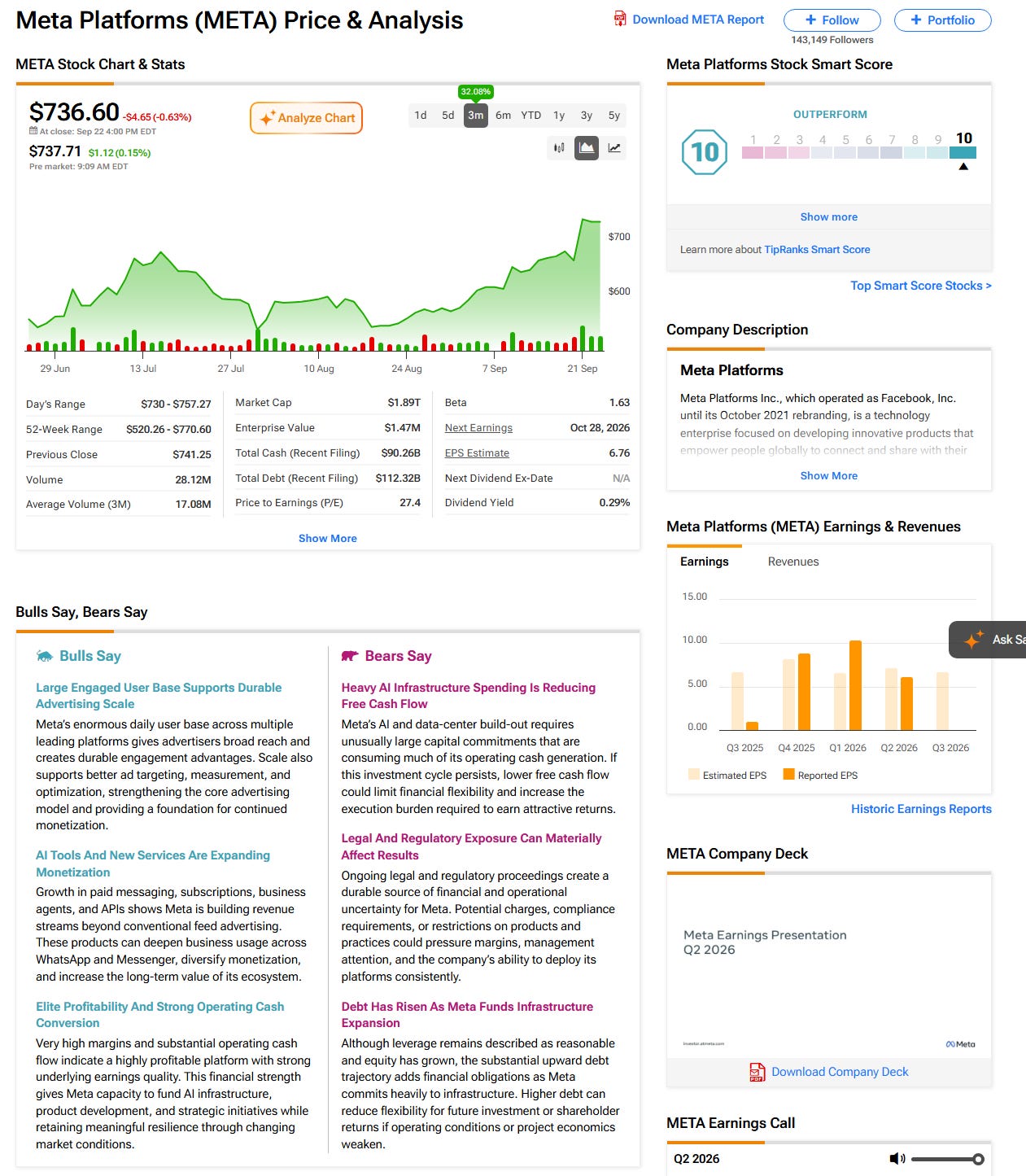
Looking at Wall Street broadly, according to TipRanks it’s a Strong Buy across 44 analysts, no sells, and a 9-of-10 (Outperform) Smart Score on TipRanks. The current average of the 12-month targets sits at $763.67, but as Stephen “Sarge” Guilfoyle notes (more on his take below) the six top-rated (4-star-plus) analysts to weigh in recently have an average $832 target — high $875 at Jefferies, low $796 at Wells Fargo.
Morningstar sees a clear social-media winner whose AI monetization the market underappreciates; Goldman ($725) frames Muse as a “conversation-to-action” shift that plays to Meta’s scale; BofA ($810) points to a roadmap advancing on both custom silicon and subscriptions, with the coming Watermelon frontier model the catalyst they’re all watching next.
BofA’s Tuesday update notes though Muse’s monetization is not near-term — Ads, subscriptions, commissions, etc., are unlikely to be material before 2028 — meaning the near-term driver from here is multiple expansion rather than earnings upgrades, and that multiple has already re-rated as mentioned above from a below-market multiple a few months ago.
The technicals
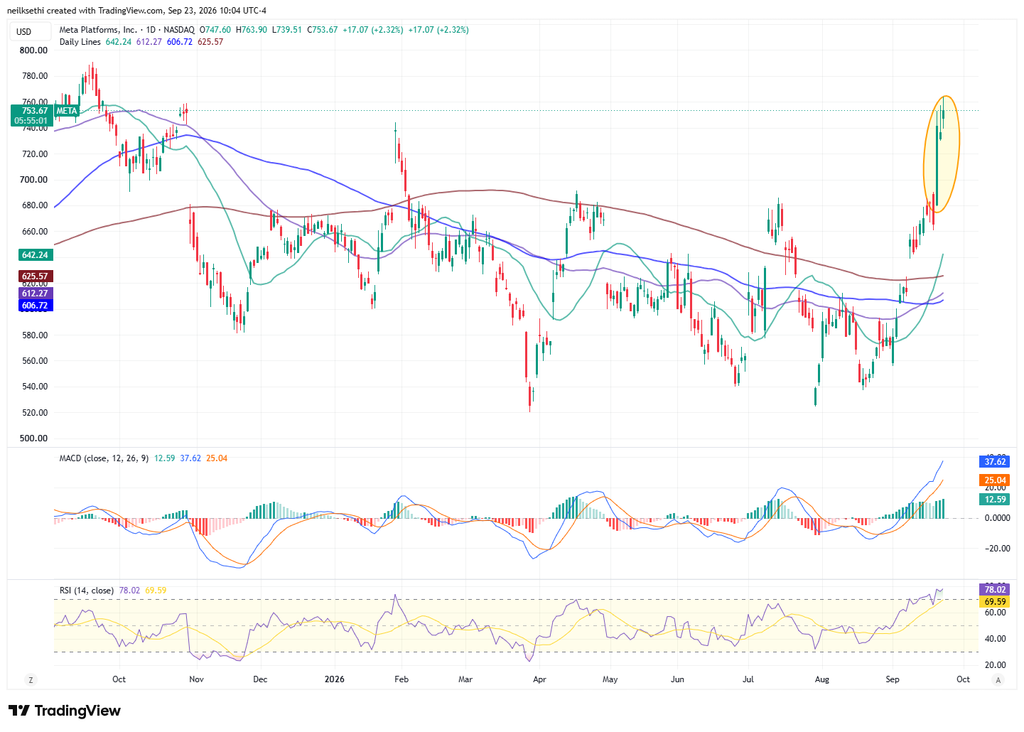
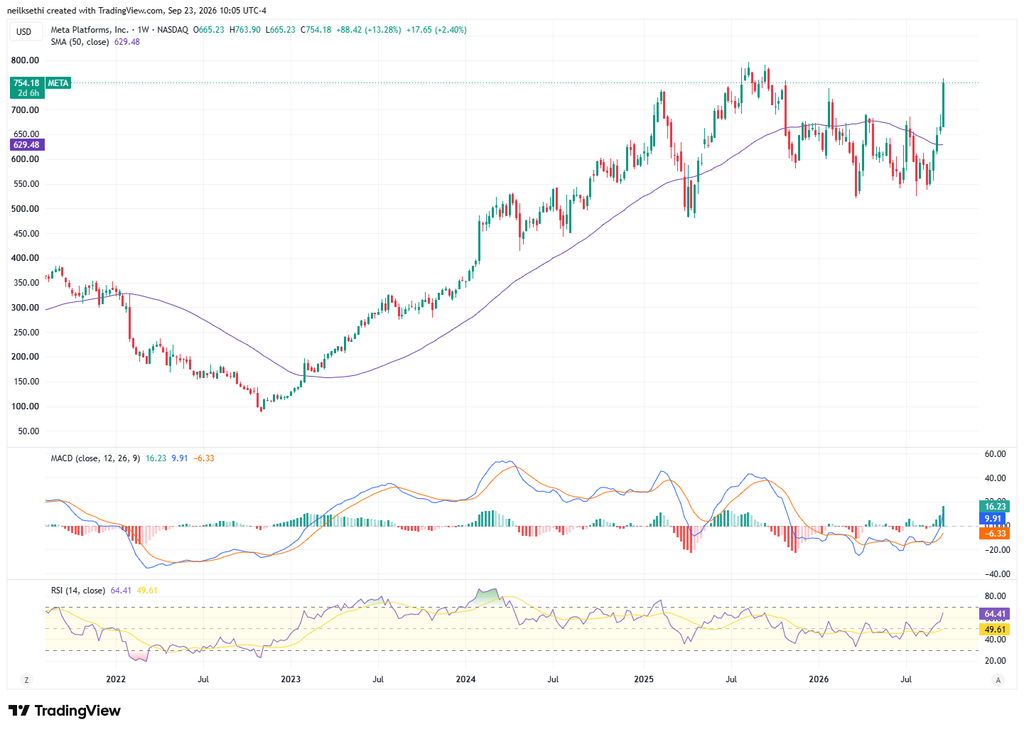
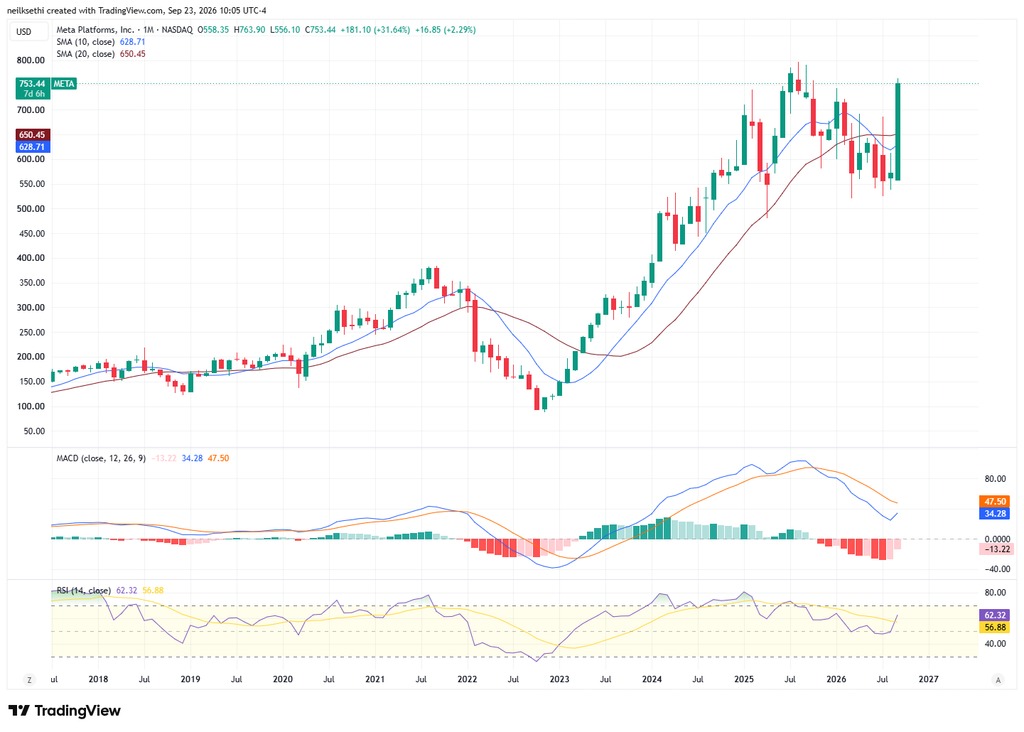
Note on all charts the colored lines are moving averages (the average price over the lookback period — days on the daily charts, weeks on the weekly charts):
20 = green
50 = purple
100 = blue
200 = brownException is monthly charts where blue is 10-month moving average and brown is 20-month moving average.
MACD = Moving average convergence/divergence line, a measure of momentum that compares longer term and shorter term momentum to gauge if a move is strengthening or weakening.
RSI = Relative Strength Index (basically what it sounds like) = measures the strength of the move comparing gains to losses over the given lookback window (I use the standard 14 periods).
This was a genuine breakout: Monday’s move came on 49 million shares against a 17 million average, pushing the price to the highest since October 2025, well above every moving average I track on the daily, weekly and monthly time frames. Momentum in the short and medium terms is strong with both daily and weekly MACD’s in a positive configuration and the RSIs well above 50. The monthly RSI is as well, although the monthly MACD hasn’t yet confirmed (but monthly signals really should only be read at month-end).
I see support at roughly $690, $630 and $525, with resistance at $760 (which it is battling with today), $790 and the ~$800 prior-peak zone.
Bob Lang gave his take on Tuesday noting the “amazing move up for Meta Platforms (META) on Monday puts the stock on a trajectory to hit all-time highs…. MACD remains on a buy signal from late August. The chart shows a series of higher highs and higher lows, that is a bullish trend. Exceeding the twin highs from April and July was huge; a few more days up and Meta will be in the $800s.”
Daily Chart
Weekly Chart
Monthly Chart
TheStreet Pro’s take
Meta is a holding of TheStreet Pro Portfolio (which Bob Lang, quoted above, helps oversee) and currently rated a Two (“stockpile on pullbacks”). On Tuesday, they decided to ring the register — as noted by Chris Versace in this piece — selling a slice near $749 to lock in a high double-digit gain and lifting his checkpoint to $590, while keeping META a meaningful ~3.5% of the book.
His reasoning:
Following the trade, we will still have have meaningful exposure to META and we continue to see it benefiting from the ongoing shift to digital shopping and management expanding that across more of its platforms. We do see Meta leveraging AI to drive subscription businesses, enhance advertising business and drive greater internal productivity.
But again, the pronounced move in META shares means expectations have risen considerably and that leaves room for the market to be underwhelmed. There is also the competitive response from other AI companies that could impede Meta from reaching lofty Wall Street expectations….
Stepping back, the reception over the last several days for Muse validates that consumer AI adoption and usage is primed to accelerate if privacy and trust concerns are addressed.
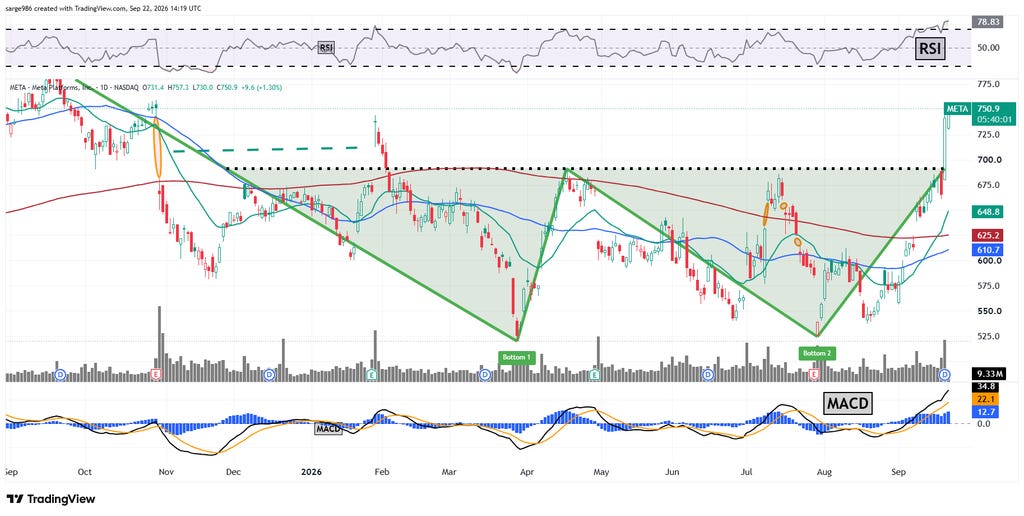
Separately as noted above Sarge posted on this Tuesday. After having called META a buy September 11th, he’s now tactically taking the other side based on the chart:
Relative Strength is now well beyond what most would consider to be technically overbought levels. The daily MACD looks a bit stretched as well.
Based on the $691 pivot, META’s price target could be as high as $830, in my book. That said, I would not be surprised if after this parabolic move, the shares make some kind of an attempt to consolidate or at least feel around for support.
I will be shorting a small amount of META shares after this piece goes to publication. My best-case scenario would be a retest of pivot. That said, I’d cover eagerly below $725.
Where I Come Out
As noted up top, I trimmed a little of what wasn’t a large position on Tuesday and am holding the rest with a stop at $728. I see several caution flags: the stock looks terrible on a cash-flow basis, with FCFE set to run negative while the buildout continues, and earnings growth will likely continue to soften as depreciation expense comes through while monetization is in the future, as noted by Chris expectations are now high with room for disappointment, and after a 34% run some consolidation would be in order. Another catalyst could come from the Meta Connect event today with CEO Mark Zuckerberg scheduled to speak (I believe at 7pm ET).
The longer-term question isn’t the quality of the franchise — it’s whether the AI spend pays off on an acceptable timeline. If the hoped-for revenue drivers hit, the stock may be a bargain here. But misses will likely be dealt with harshly after the run. I’m certainly not adding here, but I very well might on a pullback toward that $690 shelf.
At the time of publication, Sethi was long META.