A 'Double Upgrade' Creates a Double-Edged Trade
Just what can we do with this name that got a leadership shakeup, restructuring plan and an outlier 'double upgrade'?
You've reached your free article limit
You've read 0 of 1 free Pro articles.
Very quietly, almost two weeks ago, SolarEdge Technologies SEDG announced the appointment of Shuki Nir to his new position as chief executive, effective immediately. Nir had been the firm's chief marketing officer since June, and succeeds Ronen Faier, who had pinch hit as Interim CEO since August, and who will remain aboard in an advisory role. Nir also replaced Zvi Lando as a member of the SolarEdge board of directors.
Then, late Monday, news broke that Goldman Sachs had "double upgraded" SolarEdge from a "sell" to a "buy," while raising the target price for the stock from $10 to $19. Goldman believes that estimates "are now finally bottoming" for SolarEdge and thus creating a somewhat attractive risk/reward proposition for the shares. Goldman noted the restructuring efforts that have included effective cost reductions. For those unaware, SolarEdge has undertaken a "shrink to grow" strategy that at least Goldman thinks has put the stock in a better position to better leverage both cost structure and improve product sales mix.
Fly in the Ointment
The stock, SEDG, has been under intense pressure for about a year and a half. SEDG closed on Monday evening at $12.32, which was down a little more than 1% for the session. back in April of 2023, the stock traded above $320 per share. That's worse than ugly. The stock is trading with a $15 handle on Tuesday morning, up more than 20%.
I don't like to beat on analysts who are either new or have not done well of late, but the fact is that the analyst behind the Goldman Sachs double upgrade is Brian K. Lee, who is rated at a little less than two stars by TipRanks. According to TipRanks, Lee has posted a 44% success rate of his calls over the past year with an average return of 0%. He is ranked by the service as the number 6,124th top analyst of the 9,231 total that the service is tracking.
By comparison, over the past three weeks, Canaccord Genuity's Austin Moeller (4 stars) reiterated a "hold" with a $16 target, Oppenheimer's Colin Rusch (5 stars) reiterated a "hold" without setting a target, and Morgan Stanley's Andrew Percoco (4 stars) reiterated a "sell" rating with a $9 target price. This does not mean that Lee is incorrect in his call, but it does mean that for him to be right, several colleagues of his with better track records have to be wrong.
When Will We Know More?
SolarEdge is set to report fourth-quarter financial results in mid-November. Currently, Wall Street is looking for an adjusted loss per share of around $1.52 or a unadjusted loss per share of close to $2.50. Revenue is expected to land at $187.5 million. This would compare to an adjusted loss per share of $0.92 for the year-ago comp, while reflecting year-over-year contraction (not growth) of almost 41%. Readers should also know that for the third quarter, SolarEdge posted an adjusted loss per share of $15.30 (GAAP -$21.10) on revenue of $260.9 million.
These top- and bottom-line numbers both badly missed Wall Street's projections. The firm's adjusted gross margin for the quarter printed at -265.4%, which is something I don't know if I have ever seen before. I certainly haven't seen anything like it in decades. Impairments and write downs came to a mere $1.03 billion. Yikes.
Fundamentals ... Not Awful
The company has enough cash on hand to handle its shorter-term debt-load if it chooses to go that route. The current and quick ratios stand at 2.34 and 1.46 respectively. This is not only passable, it's better than decent. Of course, cash flows have been awful. For the most recent quarter, SolarEdge has generated operating cash flow of negative $465.6 million. For the past two quarters in aggregate, that number is negative $645.7 million. Prior to that, the firm was able to generate positive operating cash flows.
My Thoughts?
Readers will see that SEDG has traded in a less severe downward sloping trend since June than it had been in prior. Neither the stock's reading for Relative Strength nor its daily Moving Average Convergence indicator tell us much at all. But the stock does seem to approach and hit resistance at its 50-day simple moving average (the blue line) and retreat. This has happened at least four times since September.
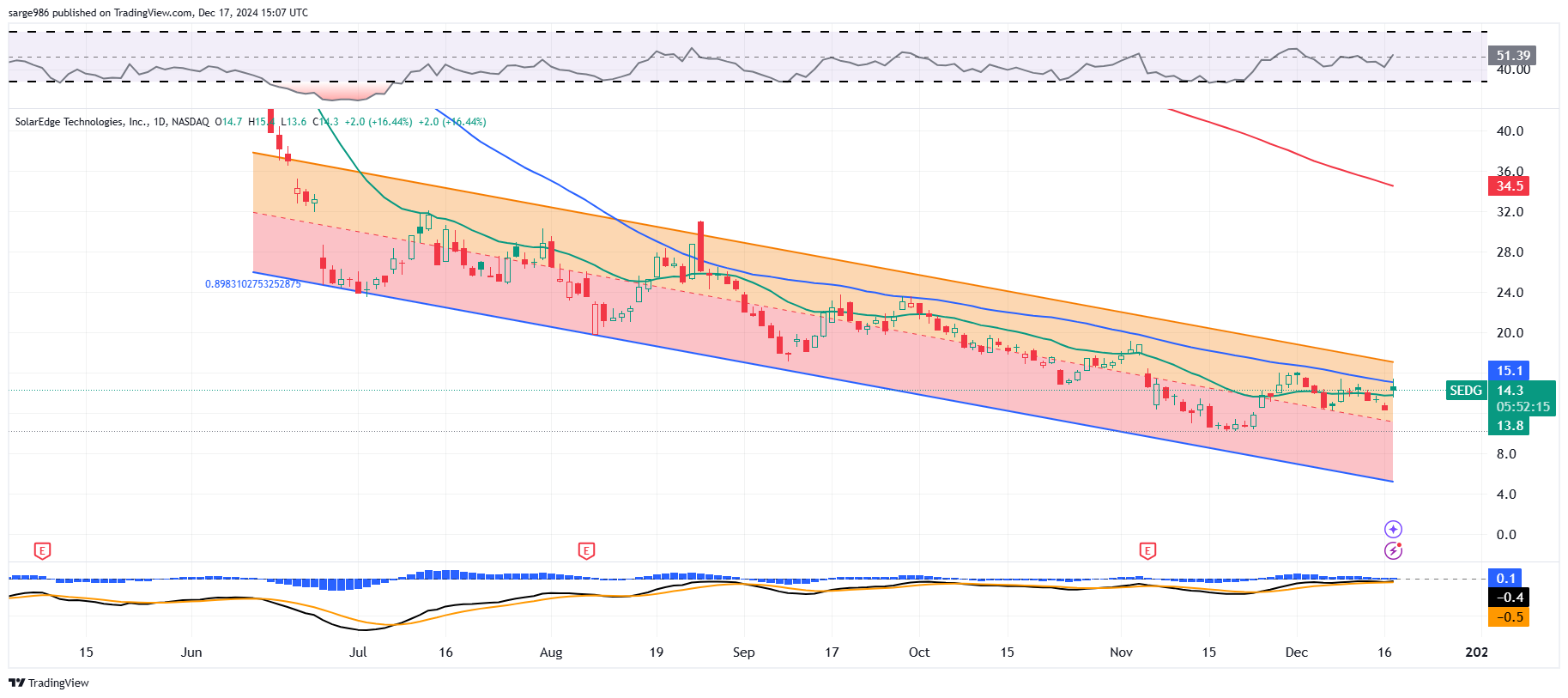
I would think of this stock as a short idea if not for the fact that 40% of the entire float is currently held in short positions. That greatly increases the probability for a squeeze. Fortunately, for us, the stock seems to be trading between its 21-day exponential moving average (green line) and that 50-day simple moving average.
I don't think there is an investment here until the 50-day simple moving average is taken, tested from above and holds. That said, a trader could purchase the shares for a short-term time frame at that 21-day line (currently $13.80) with the idea of getting out at $15 or so. Just remember, if that 21-day line cracks, that we have an 8% rule for a reason. I wouldn't go home for the evening wearing a long in this name if that line fails at some point today.
At the time of publication, Guilfoyle had no position in any security mentioned.