Corning Slips After a Big Run — And That May Be Exactly What Bulls Wanted
Here's why the fiber optic networker’s post‑earnings selloff may be a gift for AI infrastructure investors.
You've reached your free article limit
You've read 0 of 1 free Pro articles.

On Tuesday, shares of Corning (GLW) dropped by nearly 9%. The fiber optics networker and AI infrastructure play narrowly beat analysts’ forecasts for earnings and revenue.
Corning earned $0.70 cents per share, just ahead of the projected $0.69. Revenues came in at $4.34 billion, while analysts were looking for $4.30 billion. The narrow beats failed to inspire investors, as Corning shares sold off on heavy volume.
It’s worth noting that even though earnings and revenue were just ahead of estimates, Corning experienced a 30% year-over-year increase in earnings, and an 18% jump in revenues in Q1.
Corning's Forward Guidance
Investors were disappointed by Corning’s forward guidance for the second quarter. Corning estimates earnings growth of 25% and revenue growth of 14% in Q2, down from 30% and 18% in the prior quarter.
Since Corning barely beat first-quarter estimates, it makes sense for the company to temper second-quarter expectations. I expect Corning to beat these lowered expectations when it reports second-quarter earnings in early August. I don’t believe the stock has peaked, thanks to ongoing demand for AI infrastructure
Corning’s Technical Picture
Just last week, shares of Corning closed at an all-time high of $175. Even after Tuesday’s pullback, the stock has gained 68% year to date. The fiber optic sector has been overheating, so a pullback is welcome at this point.
Despite Tuesday's losses, Corning’s bullish trend remains intact. In fact, Tuesday’s pullback is consistent with the stock’s current trend of higher highs and higher lows.
Our initial plan, described here, involved buying on a pullback in the vicinity of Corning’s 50-day moving average (blue). That entry occurred in late March (point A).
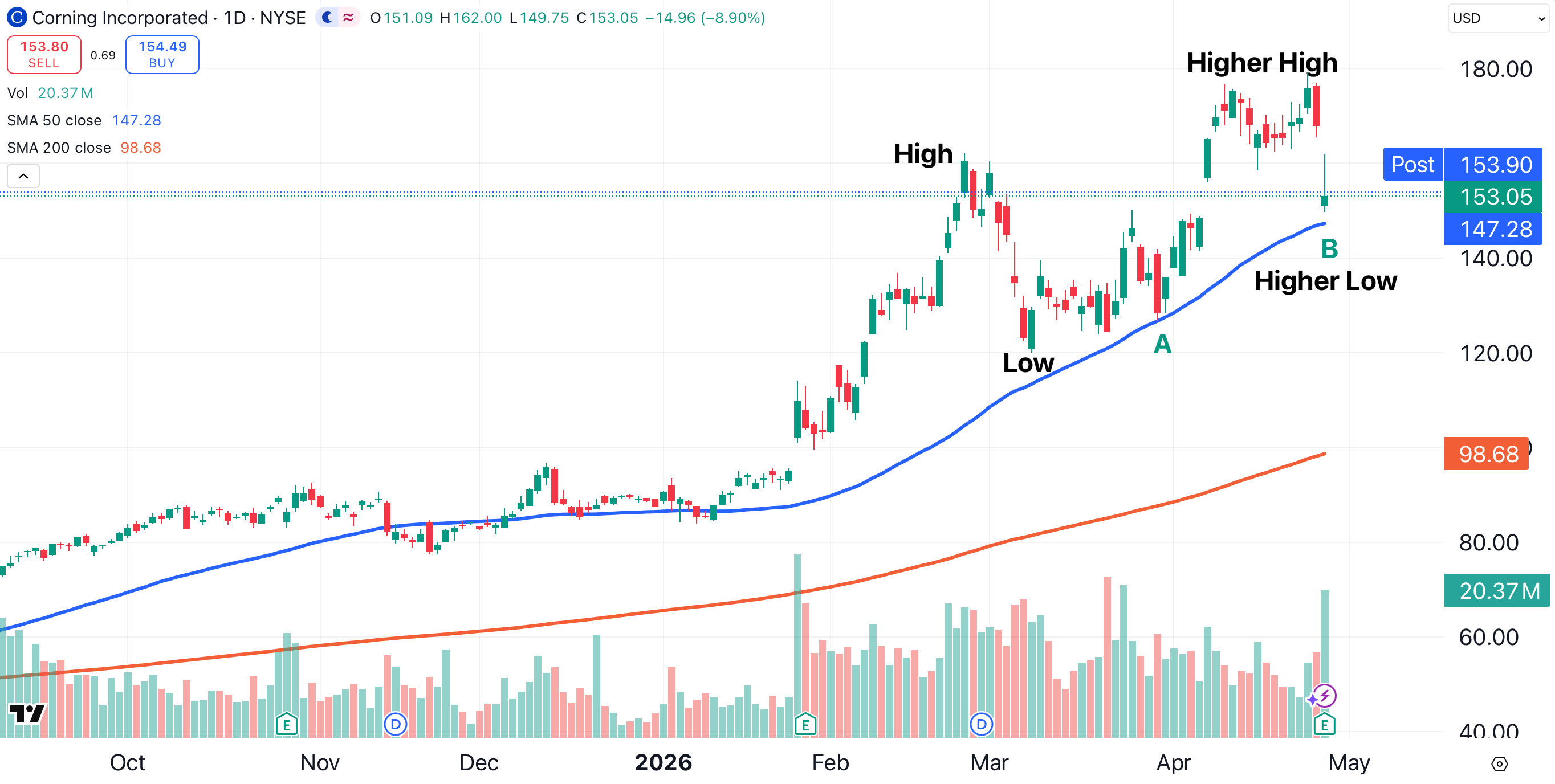
Now the stock is once again nearing that key moving average (point B), which is currently located at $147. If Corning drops a bit further and reaches its 50-day MA, we plan to add to the position.
Average Higher, Not Lower
This puts us in the position of raising our overall entry price, or "averaging up," to about $137. I strongly prefer adding to a winning position, a tactic that institutions often use, as opposed to increasing the size of a losing position.
"Averaging down" is the bane of retail traders, sometimes leading to large losses.
Perhaps some investors are confusing averaging down with dollar cost averaging, a legitimate investment technique. Dollar cost averaging consists of investing the same amount of money at regularly scheduled intervals, whether the price has moved higher or lower. It is a tactic often used by mutual funds investors.
Related: Why Did the Meta Deal to Buy Manus Fall Apart?
At the time of publication, Ponsi was long GLW.