Rise in Diesel Prices Becomes Headwind for Margins and Earnings
Duration remains a key, but year-over-year increases are flashing a yellow light
You've reached your free article limit
You've read 0 of 1 free Pro articles.
We’ve touched on the increase in diesel prices, which are up again on Tuesday per data from AAA, but let’s take a closer look at the sharp climb to year-ago levels and think about those implications for what’s ahead.
The below snapshot from AAA shows a gallon of diesel fuel is at roughly $6.27 per gallon, up from $5.44 just a month ago and $3.658 a year ago.
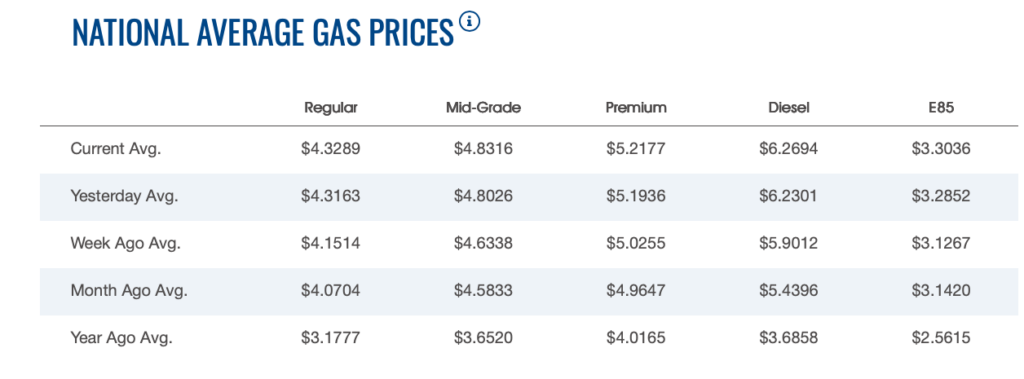
But those are snapshots in time, and to get a better indication of diesel fuel prices and the impact on corporate earnings, we have to trace the data back further and fill in the gaps. That brings us to the below chart from the St. Louis Fed’s FRED data base, and the latest figure in that chart is $5.967 per gallon on September 7.
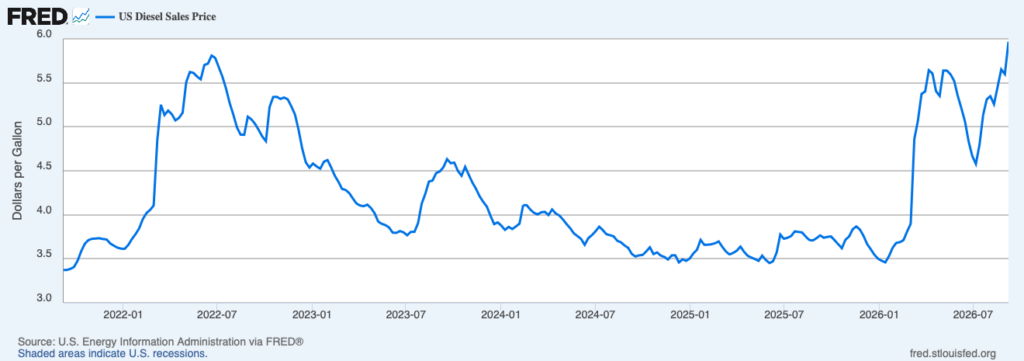
Looking at the source data, as in diesel fuel prices collected and published by the Energy Information Administration, the average price for a gallon of diesel fuel was as follows:
Q3 2026: $3.768
Q4 2025: $3.745
Q1 2026: $4.077
Q2 2026: $5.34
Q3 2026 QTD: $5.398
Some matholympics to put some context around those figure:
The QTD S3 2026 figure reflects diesel prices in the upper $4 for the first half of July, while the last two figures (September 7 and September 14) are near or well above $6. With no end in sight for the U.S.-Iran war and related disruptions, if we assume diesel prices are little changed over the next two weeks or so, that means a Q3 2026 average near $5.50. However it also means the price of diesel starting the final quarter of the year would be between $6.00 and $6.25 or so.
Now for the math:
The estimated Q3 2026 diesel price of about $5.50 is up modestly compared to Q2 2026, but up a considerable 46% compared to Q3 2026. Similarly, at the potential midpoint for Q4 2026 of $6.125, a gallon of diesel would be about 64% higher compared to Q4 2025.
If those are the figures we are looking at, and that will hinge on the duration of the U.S-Iran war and related conflicts, they will be an inflation driver as those prices work through the economic system. They will also be a margin headwind for companies that count diesel prices as a significant part of their business, especially those that few or no other business levers to offset those higher costs.
While companies like FedEx (FDX) and UPS (UPS) use fuel surcharges to dampen the impact of higher fuel prices, diesel fuel is sizable input cost for many companies, especially those that manage their own delivery fleets.
That means companies like PepsiCo (PEP), Coca Cola Consolidated (COKE) and Amazon (AMZN). In Coca-Cola Consolidated’s 10-K, it says the following about fuel costs:
The Company uses significant amounts of fuel for its delivery fleet and other vehicles used in the distribution of its products.
PepsiCo doesn’t break out its diesel or fuel costs either, but we know that in 2025 it’s shipping and handling expense was $16.7 billion and that figure includes PepsiCo’s distribution system costs. At PepsiCo total shipping and handling accounted for almost 18% of 2025 sales, and even if we guesstimate the cost attributed to the distribution system, which replenishes beverage and snack food locations, odds are that cost it isn’t going to be miniscule.
As far as Amazon goes, the company has a sizable and growing fleet, which means we could see some pressure on North American and international margins. But let’s remember that unlike Coca-Cola Consolidated or PepsiCo, Amazon has Amazon Web Services and the fast-growing, high-margin advertising business that can limit the impact of higher diesel prices to the company’s bottom line.
We also have to consider companies that use diesel powered heavy equipment like United Rentals (URI), Vulcan Materials (VMC), Granite Construction (GVA) or our own Waste Management (WM). That brings us back to our comment on Tuesday morning about assessing comments about pricing from Waste Management when it reports its current quarter results in late October to early November.
The point we’re aiming to make is that diesel prices, like higher gas prices, are a headwind. While higher gas prices are one for disposable incomes, consumer spending and aggregate retail revenue, higher diesel prices are a cost that companies will have to contend with and that means (some of) those earnings expectations may need to rethought.
More Pro Portfolio
- Closing Out This Position as Fed Rate Hike Odds Rise
- 26 Signals Across 9 Portfolio Themes
- Weekly Roundup: A Good Week to Lose Less as Market Stumbles
At the time of publication, TheStreet Pro Portfolio was long AMZN and WM.