What Do Asian Markets Tell Us About Higher Trade Tariffs?
Stocks aren’t selling off for major Chinese exporters, and that in itself gives clues about what to expect for the U.S.-China trade relationship.
You've reached your free article limit
You've read 0 of 1 free Pro articles.
So are the new tariffs on Chinese goods set at 10%, 60% or 70%? Nobody really knows.
Asian markets have been buffeted by the prospects of higher U.S. taxes on imports from the region. President-elect Donald Trump has pledged to impose duties of 60% on all goods from China.
But in a social-media post this week, he has threatened an “extra 10%” on Chinese goods, as well as tariffs of 25% on all U.S. imports from Canada and Mexico.
Trump cites a new line of reasoning, too. These tariffs are now aimed at stopping imports of the synthetic opioid fentanyl, as well as illegal immigrants.
Trump in his first presidency harped on about trade deficits, and the need to protect U.S. manufacturing jobs. Those lines of argument are noticeably absent in his new justifications.
So is this a new War on Drugs? Migrants? Deficits? Jobs?
“Yes!” I’m sure Trump would say, deploying what some see as strategic ambiguity, and others view as muddled thinking. And indeed mud is about as clear as the situation gets.
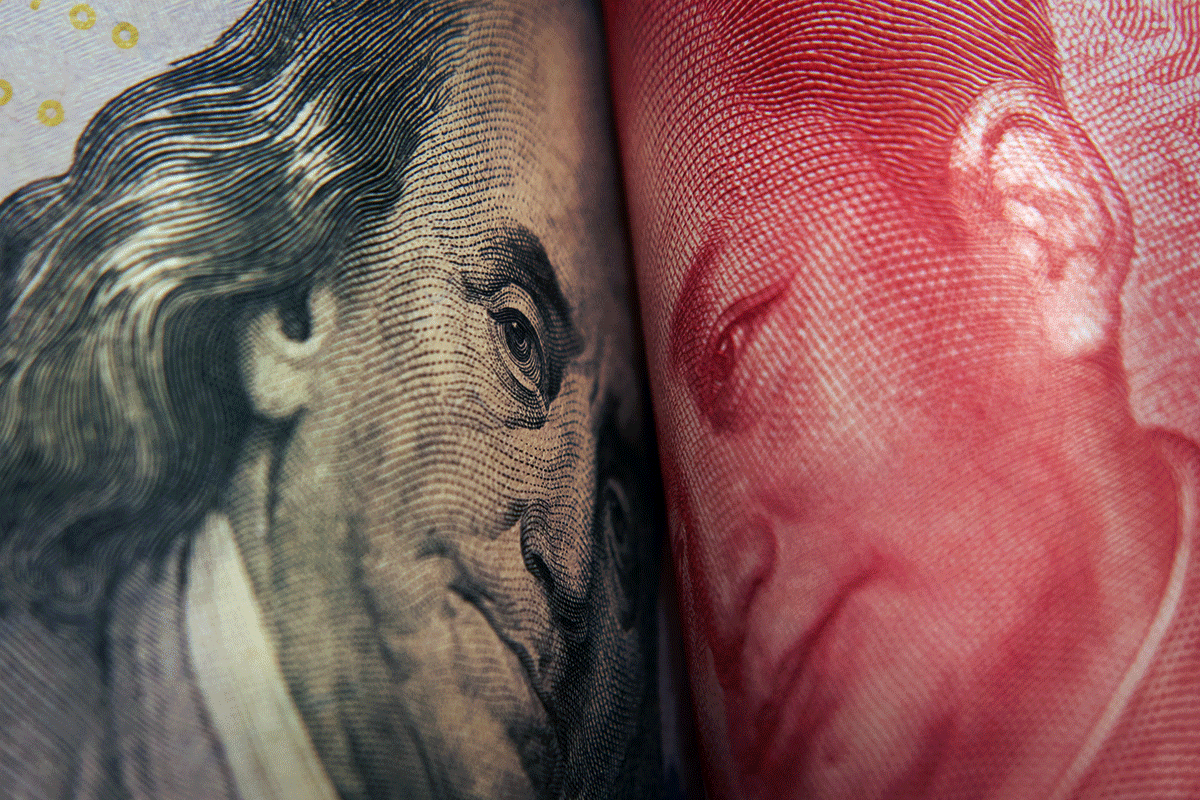
You get the feeling Trump is making this up as he goes along, talking tough without a clear justification for where he sets higher trade duties, or why. He is picking numbers from the sky.
One thing is for sure, though, if we do get higher tariffs: The price of U.S. goods, and therefore inflation, is going to rise. That’s why we’re now hearing that the U.S. Federal Reserve, per the newly released minutes to its last interest-rate meeting, is discussing holding fire on any future rate cuts, mainly because they think any progress on curbing inflation may stall.
U.S. companies and consumers will pay the price for duties, whatever the details.
There wasn’t any mention of exemptions. The Canadian tariffs would hit U.S. oil imports, with Canada the source of 4.3 million barrels of crude per day out of the 6.4 million that the United States imports, according to S&P Global.
Higher China tariffs are particularly punishing for the likes of Apple AAPL, which can’t diversify its production base rapidly enough in places such as India and Vietnam but still gets around 90% of its electronics assembled in China.
You’ll note that Apple is not “reshoring” jobs. It can’t, while maintaining profits, due to high U.S. labor and production costs. It is simply ramping up production in other Asian emerging markets. Its overdependence on a supply chain in China was laid bare as a weakness thanks to the pandemic. And that is doubly true now – if it stomachs the full freight of higher duties, its profit margin will effectively fall to zero, according to calculations by The Nikkei business daily.
The likes of Microsoft MSFT, Dell DELL and HP HPQ have ramped up production in China ahead of Trump taking office, The Nikkei adds. They're looking to stockpile electronic components, just in case.
A 60% U.S. tariff on Chinese goods would certainly be very disruptive news for China, at least temporarily. It would be hard to diversify the customer base rapidly for Chinese manufacturers.
The United States imported $500 billion in Chinese goods at last count, and the current effective tariff rate is around 14%, according to S&P Global. An increase to 60% would knock not only the Chinese economy, with economic growth lower in 2025 as a result, but also U.S. growth.
Faced with this new tariff threat to China, S&P has knocked its growth forecast to 4.1% for Chinese GDP in 2025, down from its earlier 4.3% projection. Its 2026 forecast is 3.8%, down from 4.5%.
Higher tariffs are bad news for China, of course, but they’re not devastating. If the United States doesn’t want to buy Chinese goods, other nations will. Southeast Asia in particular is taking up much of the U.S. slack.
As a bloc, ASEAN nations overtook the European Union in 2020 to become China’s largest trading partner, rising to 15.2% of China’s total foreign trade for the first 10 months of 2023, according to Statista. The European Union is next, at 13.4%, and the United States behind that at 11.2%.
So if Chinese goods become uncompetitive in the United States, they’ll be sold elsewhere. It’s not clear what kind of exemptions we might see on Chinese goods, too. The devil will be in the details.
Trump often outlines dramatic plans only to walk them back or quietly drop them altogether when they prove difficult to implement. I would say the market sentiment in Asia indicates that companies and investors alike are uncertain what the environment will be like after Trump takes office in January.
We can see from Chinese markets that investors are in a holding pattern rather than selling off the U.S.-oriented exporters that might suffer in the face of higher duties on freight. China would likely respond to higher tariffs, too, both with restrictions on select U.S. goods and likely subsidies to affected producers.
Both the Hang Seng index in Hong Kong and the CSI 300 index in mainland China dipped on news of Trump’s Nov. 5 election. Hong Kong stocks were down 2.2% the day after the U.S. vote, while Chinese shares, also affected by a pledge of stimulus from Beijing, barely budged, down 0.5%.
Since then, Chinese shares have continued to lose a little ground. But both mainland and Hong Kong stocks got a fillip today, with the CSI 300 up 1.7% and the Hang Seng ahead 2.3%, reflecting the remote chance that Chinese goods may now only face an added tax of 10%, rather than that headline 60% figure.
Combined, Mexico, Canada and China account for around 40% of U.S. trade. The threat to impose hefty extra trade duties on all that commerce would be very bad for U.S. business.
So is this just a negotiating ploy? That’s possible. We saw during the last Trump administration that he attempted to use higher China tariffs to secure a favorable trade deal with China.
Ultimately, China did not deliver on the $500 billion in U.S. goods and services that it pledged to buy. In fact, it didn’t buy any additional U.S. goods, according to the Peterson Institute for International Economics.
So these are likely the opening shots not so much in a new trade war but a new trade negotiation. Let’s hope, for the sake of American investors, that no one ends up shooting themselves in the foot.
At the time of publication, Frew McMillan was long MSFT.