Trump Underscores Shift With China While Near Tiananmen Square
Will Trump give away the U.S. position on chips and Taiwan in return for increased orders of Boeing jets and U.S. soybeans?
You've reached your free article limit
You've read 0 of 1 free Pro articles.
The leaders of the world’s two largest economies have been meeting today in Beijing. While there are few expectations of any overarching agreements to come out of the summit, we should of course heed the posture of the two countries and direction of the talks in the Chinese capital.
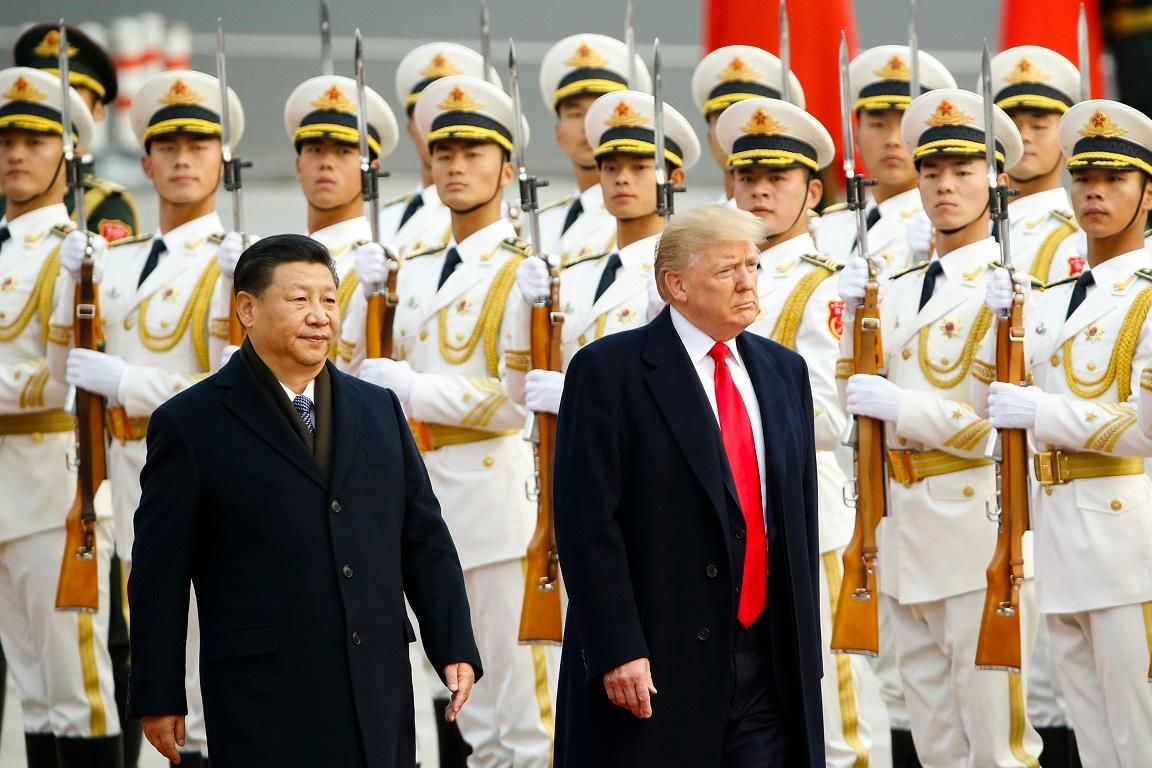
U.S. President Donald Trump and Chinese President Xi Jinping on Thursday toured the Temple of Heaven, with Xi greeting Trump outside the Hall of Prayer for Good Harvests. Xi explained the significance of the temple, where construction began in 1406 under the Ming Dynasty, noting that Chinese rulers have visited it to pray for national prosperity, social harmony, and favorable harvests.
“It reflects the traditional Chinese concept that the people are the foundation of a state, and only when the foundation is solid will the state be stable,” Xi said, according to official Chinese news service Xinhua.
Trump Takes in 21-Gun Salute
The world is in such a fractious state that many observers would feel it is a win simply for the United States and China to be talking again on a relatively even keel. But there’s concern that Trump, distracted by the Iran war and looking for quick wins, may give away too much in his eagerness to strike deals.
China has gained in stature internationally given the erratic policymaking under Trump. Xinhua calls the Beijing summit “a meeting closely watched by the world,” and relishes the sight of Xi and Trump treating each other as equals. Trump on this trip is calling Xi a “great leader,” and China a “great country,” appearing to enjoy the 21-gun salute and march-past by the guard of honor outside the Great Hall of the People in downtown Beijing.
“Today is a fantastic day,” Trump said at the subsequent banquet in the hall, just to the west side of Tiananmen Square, and site of the most important meetings of China’s government.
Beef on Menu as China Resumes U.S. Meat Imports
Chinese chefs served specialties such as Peking roast duck and zha jaing mian, noodles topped with a soybean sauce. But they played it safe by including international dishes that cater to Trump’s tastes, too, with beef ribs, lobster in tomato soup and salmon in mustard sauce, and tiramisu for dessert.
Notably, China on Thursday granted permission for U.S. shipments of beef to resume to China, 14 months after officials let the necessary licenses expire in response to Trump’s first foray on tariffs. Trump during the summit pushed Xi and China to buy more American goods, agricultural products being top of the list.
Tariffs? What Tariffs?
The tension over trade duties that prevailed last year has evaporated in 2026. Not only did China and the United States declare a truce last October in their tit-for-tat tariffs, but two U.S. court decisions have also ruled Trump’s tariffs illegal. China for now faces the same 10% tariff as much of the rest of the world, even if that tariff mechanism was ruled illegal by the U.S Court of International Trade.
Xi praised the “generally balanced and positive outcomes” from the latest round of trade talks, calling it “good news” for the citizens of both nations.
China, for its part, says it is working to open up its economy further, and shorten the list of problems.
Heading into this summit, the U.S. side was emphasizing what analysts have dubbed the “Five Bs.” They are: Boeing jets; U.S. beef; soybeans; and the creation of a board of investment and board of trade.
China has been emphasizing the “Three Ts.” They are: tariffs, technology and Taiwan.
Boards of Investment and Trade
And, indeed, U.S. Treasury Secretary Scott Bessent said on Thursday that the United States and China are discussing the formation of a board of investment designed to fast-track business deals between the two nations. Bessent is also in Beijing, and says the board would seek to make it easier to do deals in “non-sensitive areas.”
The board of trade would perform a similar function to free up two-way trade in non-critical industries. Bessent said it may remove tariffs on about $30 billion in trade in lines of business that the United States is not seeking to re-shore. He cited fireworks as a Chinese import where tariffs could be removed, while discussions in Beijing include increased purchases by China of U.S. energy.
Trump is accompanied by a contingent of top executives from major U.S. companies with China operations. They include the chiefs of Apple (AAPL) , Boeing (BA) , BlackRock (BLK) , Blackstone Group (BX) , Citigroup (C) , Mastercard (MA) , Meta Platforms (META) , Micron Technology (MU) , Tesla (TSLA) and Visa (V) , with a clear emphasis on manufacturing and finance.
It’s likely we’ll see a flurry of China-U.S. deals. Trump already said on Thursday that China has agree to buy 200 Boeing jets, although it’s not clear which airlines are part of that order. Boeing shares are actually falling 4.0% on the day because there had been speculation the order could be as large as 500 planes.
Nvidia There After All
Nvidia CEO Jensen Huang was a late addition to the squad. Having initially been left off the list of CEOs, he joined Air Force One in Alaska at Trump’s invitation, Trump said on social media.
It’s good timing. The U.S. government has cleared some 10 Chinese companies to buy Nvidia’s second-most-powerful chip, the H200, Reuters reported on Thursday. They include e-commerce platform Alibaba Group Holding (BABA) (HK:9988), its rival JD.com (JD) (HK:9618), WeChat super app operator Tencent (TCEHY) (HK:0700), and the TikTok app inventor ByteDance, which is unlisted.
The U.S. Department of Commerce has also approved computer company Lenovo LNVGY (HK:0992) and contract electronics manufacturer Foxconn HNHPF (TW:2317), full name Hon Hai Precision Industry, which is based in Taiwan but is the largest private employer in China, with some 1.3 million employees.
Nvidia shares are up 3.6% as a result. Prior to U.S. restrictions on chip sales, China made up 13% of the company’s business. But Huang says that figure, at least officially, has fallen close to 0.0%, even if suppliers still smuggle Nvidia chips into China from markets such as Singapore.
In an editorial on Thursday, The New York Times warned that Trump’s China policy has weakened the U.S. position. It worries that Trump may seek short-term gains on farm-goods sales, for instance, by giving up U.S. restrictions on chips or even weakening the U.S. commitment on Taiwan. The Trump administration has alienated U.S. allies such as Japan, Australia and India that can help constrain China’s power, the editorial states.
Warning on Taiwan
Xi grabbed the initial headlines on Thursday with his warning that U.S. missteps on Taiwan could worsen Sino-U.S. ties.
“If handled poorly, the two countries will have clashes or even conflicts, putting the entire relationship in great jeopardy,” Xi said. “The U.S. side must exercise extra caution in handling the Taiwan issue.”
What Chinese media call the “Taiwan question” or "issue" is the most-important issue in China-U.S. relations, according to Xi. Chinese media need to dance around what the “question” is with Taiwan, since officially Taiwan is simply part of China, even if the truth on the ground is anything but simple.
Taiwan is an independent, self-governed island with its own government, military and laws that calls itself the Republic of China. But mainland China, known as the People’s Republic of China under the Chinese Communist Party, claims the island is a rogue province. It’s the legacy of the retreat to Taiwan of the republican forces under Chiang Kai-shek at the end of China’s civil war. It irks Beijing no end that Taiwan’s administration for many years continued to claim it is the legitimate elected government of all of China, after the Communists seized power by force.
Pause on Arms Sales
Despite Xi’s “warning,” there’s little new on Taiwan. Still, it gives Trump pause for thought after congress in December approved an $11 billion shipment of weapons to Taiwan, an arms deal that the State Department has held up ahead of this summit. It remains to be seen if Trump will push that through.
The U.S side has made no mention of Taiwan in discussions of this summit. A spokeswoman for Taiwan’s government responded to Xi’s comments by stating that China’s military threats are the “sole cause” for instability in and around the Taiwan Strait.
Xi and Trump also discussed the Middle East, Ukraine war and Korean peninsula, according to the Chinese news agency, although there were few details aside from that the topics came up. Trump is essentially seeking a favor from Xi, in hoping China can press Iran to engage in peace talks and free up shipping through the Strait of Hormuz.
China Shares Posting Slim Gains
Chinese shares have largely been treading water this year, buffeted by the ramifications of the conflict in the Middle East. In Hong Kong, where most international investors get their China exposure, the Hang Seng is up 3.0% in 2026, while the Shanghai composite is up 5.2% on the year.
Chinese tech stocks have led the way, like their counterparts in the West. That explains the outperformance of the Shenzhen stock exchange, which has a decided tech leaning. The Shenzhen composite has advanced 14.1% so far this year. Both indexes have recovered from their low points on March 23, induced by higher oil prices and potential disruption to trade, and rallied into the black.
We are seeing individual stocks like Nvidia and Boeing move on deals out of Trump’s three-day trip to China, which ends with tea and further talks with Xi on Friday. Overall, the talks should not destabilize markets, and U.S.-China tensions on trade are finally back on fairly stable ground.
It will be a busy year for in-person meetings between Xi and Trump. Trump said he is inviting Xi to visit Washington in September, with a state visit to the White House announced for September 24. China is on Thursday suggesting that Trump will also travel to Shenzhen for the APEC Summit, which is due to take place on November 18 to 19, while Xi is likely to attend the G20 Summit when it takes place in Florida on December 14 to 15.
Related: What Investors Can Expect From Trump's Trip to China
At the time of publication, McMillan was long AAPL and NVDA.