The Ugly Stick Haunts Wall Street
A mirror shatters as Goldilocks finds out that industrial output is too small and that inflation could get too big (again).
You've reached your free article limit
You've read 0 of 1 free Pro articles.
Someone left the cage open on Tuesday, the first day of the holiday-shortened workweek, and the first day of September, a consistently performance-impaired month. Out it came. The "Ugly Stick" was roaming about yesterday, and everything it touched was worse off for the acquaintance.
That the selloff came off of a "month-end" artificial markup was in a way, healthy. That the pressure lasted all day long and that the major indexes closed near their lows was not healthy, in any sort of way.
The pressure, already on equity markets through the opening bell, accelerated about thirty minutes into the session, as bad economic news was actually bad news for financial markets. The release of the ISM (Institute for Supply Management) Manufacturing PMI for August reinforced not just the idea that the U.S. economy remains mired in a nearly two-year "industrial recession," but that the shrinking of this part of the economy is actually still getting worse. That might have been good for the markets as poor economic performance could provoke a more aggressive Federal Open Market Committee, as our central bankers prepare to shift monetary policy toward an easier stance.
Unfortunately for those hoping and praying for a quicker route to lower short-term interest rates, the ISM Manufacturing PMI also provided evidence of the coming re-ignition of inflation at the producer level. This will ultimately cook off into a renewed acceleration of consumer-level inflation and is what I have warned readers about for months going into the later part of this autumn and winter.
ISM Manufacturing PMI
The results of this survey for August were not just lousy. They were bad on a special level that renewed the recessionary, and "hard landing" talk up and down Wall Street. The headline print hit the tape at 47.2, which is deep in contractionary territory. This was the fifth consecutive month for headline-level contraction for the series, and incredibly the 21st month of contraction in the last 22. New orders, which is the most important subcomponent in any manufacturing-focused survey, plummeted all the way to 44.2, also a fifth consecutive month of contraction.
Going down the list, production dropped to 44.8, as employment printed at 46, for a third-consecutive month of declining manufacturing-based employment. Order backlog fell all the way to 43.6. For those who are not familiar with this kind of survey, 50 is the line between expansion and contraction, and once the numbers reach levels lower than a rough 47.5 or so, they really represent a screeching slowdown. To slow down each month from the month prior and to still be slowing down at this pace almost two years into the slide is simply stunning.
Didn't anything important go up? Oh, you bet. Prices not only printed in expansion from the month prior for an eighth-straight month, but pricing accelerated to 54 from July's 52.9. This puts a serious wrench in the market's plans for a sustained easier trajectory for monetary policy. The Fed simply cannot tackle both of its mandates: full employment and price stability if both need attention at the same time.
On That Note... GDPNow 2%
In response to this survey, on Tuesday the Atlanta Fed revised its real-time third quarter GDPNow model back down to growth of 2.0% (quarter over quarter, seasonally adjusted annual rate) from 2.5%, after having revised the model from 2.0% to 2.5% late last week. Looking at the internals, Atlanta tweaked lower its inputs for both personal consumption expenditures and gross private domestic growth. Atlanta is expected to revise this model again later this morning after the July Trade balance and July Factory Orders both cross the tape.
Currently, Fed Funds futures trading in Chicago are pricing in a 61% likelihood for a quarter-percentage point rate cut in two weeks and a 39% probability for a half point cut. By year's end (or the Dec. 18 policy meeting), these markets are still pricing in a stunning 77% chance for a drop in the target range for the Fed Funds Rate of 100-basis points or more to 4.25% to 4.5%.
Does that sound much to you like markets think the Fed can stick to the "soft landing" or "Goldilocks" narratives? I'll do you one better. Go out to July 2025, so less than a year from now. These markets are pricing in a 100% probability for an aggregate cut of two percentage points or more by July 30. Kids, if the Fed has to be that aggressive, we'll be up to our eyeballs in cottonmouths and alligators. Kiss your optimistic narrative goodbye.
These markets are pricing in a 100% probability for an aggregate cut of two percentage points or more by July 30. Kids, if the Fed has to be that aggressive, we'll be up to our eyeballs in cottonmouths and alligators.
Perhaps the financial media should start explaining gross domestic income to the masses and its relationship to GDP, so that the ones who haven't already figured out for themselves what's coming, can prepare. I mean an economy growing 3% doesn't wobble around with housing data, consumer sentiment surveys, consumer savings rates, and core capital spending all in the dumpster at the same time.
Marketplace, a Crude Awakening
Of course, equities were slapped around sharply. They were hardly alone. WTI Crude was roasted in anticipation of reduced global demand as not just the U.S., but many parts of the planet slow and flirt with recession. Treasuries sold off as well. However, it was equity markets that did make the most noise.
The S&P 500 gave up 2.12%, as the Nasdaq Composite traded sharply lower, surrendering 3.26%. There was to be no solace found in the smaller caps or the transports. The Russell 2000 was taken out to the woodshed for 3.09% as the Dow Transports "only" gave back 1.15% for the session. That made the Transports the out-performing index of the day, which is incredible.
While the sharp selloff was broadly felt, no index felt it like the Philadelphia Semiconductors. That index was down a jaw-dropping 7.75% for the session. Leading that group to the downside were Nvidia NVDA, KLA Corp KLAC, and On Semiconductor ON as those three gave up 9.53%, 9.52%, and 9.13% respectively.
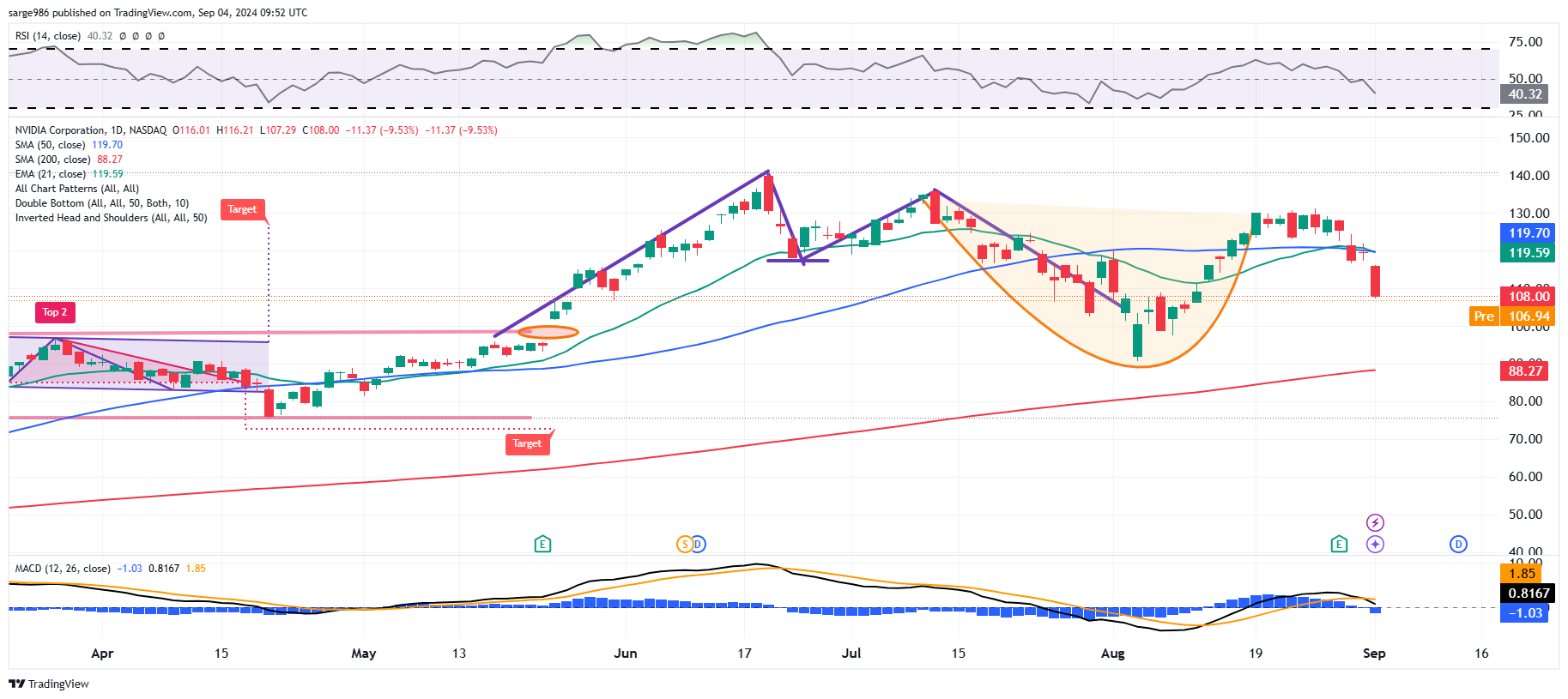
Interestingly, after the closing bell on Tuesday, Bloomberg News reported that Nvidia and "other firms" had received a subpoena tied to the Department of Justice investigation of the company on concerns that it might have violated antitrust laws. Nvidia holds a rough 80% share of the market for artificial intelligence-level accelerators. I wonder if anyone had this news ahead of everyone else. Not accusing, mind you. Just wondering. I did add a small portion of NVDA overnight for a trade around my core position, which as readers know, had been reduced.
Readers may recall my mention of NVDA's then "shallow" handle that had been built upon that cup pattern and my concern that the stock could hold its 50-day simple moving average. Well, the handle is no longer shallow, and the stock did not maintain contact with its 50-day SMA.
Breadth
Eight of the 11 S&P sector SPDR exchange-traded funds closed out the Tuesday session in the red with Technology XLK leading the way lower at -4.59%. Energy XLE followed, but not so closely behind at -2.49%. Not surprisingly, the four defensive sectors claimed the top four rungs on the daily performance tables. The Staples XLP easily won the day at +0.7%.
Losers beat winners by a rough 8-to-3 at the New York Stock Exchange and by about 7-to-2 at the Nasdaq. Advancing volume took just a 22.2% share of composite NYSE-listed trade and a 33.6% share of composite Nasdaq-listed activity. Trading volume, however, was not fully convincing. Trade did remain elevated for a second consecutive session, but did not grow across the board from Friday's end of month push.
While aggregate Nasdaq-listed trading volume did increase 5.1% day over day, aggregate NYSE-listed trade contracted 7.7% on a day over day basis. Trade was also slightly lower across the membership of the S&P 500, though the index did hit its 50-day trading volume SMA for a second straight day.
So, was Tuesday's activity meaningful? I think so, at least for the semis and probably for many AI-type stocks by extension. But to know for sure, there would have to be some follow-through within a few days. At least we do know that the defensive stocks were respected, meaning that there should be places to hide if this gets worse.
Tapping Corporate Bond Markets
Bloomberg News is also reporting that a record number of what it refers to as "blue-chip" companies tapped corporate bond markets on Tuesday, led by the likes of Ford Motor F and Target TGT. Apparently, 29 of these large-cap companies made for busiest-single-sales day in terms of number of issuers leaning on lenders at the same time on record. Olivia Raimonde, who wrote the piece for Bloomberg, states that debt underwriting professionals are expecting U.S. corporations to borrow about $125 billion through high-grade bond sales this month.
'ZScaling' Up, 'ZScaling' Down
After the closing bell, cyber-security provider Zscaler ZS went to the tape with fiscal fourth-quarter financial results. Readers may recall that I wrote a generally positive piece on the name on Tuesday. Oh, Zscaler beat Wall Street's expectations for adjusted earning per share, unadjusted EPS and revenue generation. All good, right? Uhm, no.
The stock is off some 15% overnight, as Zscaler guided the current quarter and coming fiscal year below Wall Street's projections, well below in the case of adjusted profitability. For the current quarter, ZS now sees an adjusted EPS of $0.62 to $0.63 vs. the $0.72 that Wall Street had in mind. For the full year, ZS sees an adjusted EPS of $2.81 to $2.87. Wall Street was up above $3.25 on that metric. Ugleeee.
Economics (All Times Eastern)
7:00 - MBA 30 Year Mortgage Rate (Weekly): Last 6.44%.
7:00 - MBA Mortgage Applications (Weekly): Last 0.5% w/w.
8:30 - Balance of Trade (July): Last $-73.1B.
10:00 - Factory Orders (July): Expecting 4.6% m/m, Last -3.3% m/m.
10:00 - ex-Transportation (July): Expecting 4.6% m/m, Last 0.1% m/m.
10:00 - JOLTs Job Openings (Nov): Last 8.184M.
10:00 - JOLTs Job Quits (Nov): Last 3.282M.
4:30 p.m. - API Oil Inventories (Weekly): Last -3.4M.
The Fed (All Times Eastern)
2:00 p.m. - Beige Book.
Today's Earnings Highlights (Consensus EPS Expectations)
Before the Open: DKS (3.85), DLTR (1.04), HRL (.36)
After the Close: CASY (4.52), HPE (.47)
At the time of publication, Guilfoyle was long NVDA equity.