The Market Is Not De-Risking, Yet
We have seen rotation and de-grossing, but little evidence of de-risking and plenty of reasons to expect further selling in stocks.
You've reached your free article limit
You've read 0 of 1 free Pro articles.
I continue to like energy. The commitment to growing both traditional and new energies sources is real and is increasingly important to support AI and data centers. Also, owning energy-related stocks and commodities remains my favorite “geopolitical tail risk” hedge.
I think yields, especially at the long end, will drift higher. Whatever the current takes are on various economic policies, we remain convinced that, as the presidential campaigns continue, we will become painfully aware that no one cares about doing anything to stem the growth of the deficit.
I remain on heightened watch for a potential “surprise” or “wildcard” geopolitical event while the nation and the media are so focused on domestic issues.
Interest Rate Cuts Incoming
I continue to see 75 bps of cuts this year. The data is likely to support a cut by September at the latest, if not by July. The data, in my view, already supports a July cut, but that is unlikely to occur.
One thing that is becoming extremely clear to everyone, and something that we’ve been pounding the table on for months, is that a rate cut ahead of the election will be portrayed as helping the incumbents by all of those looking to oust the incumbents. The political backlash against a Fed cut, as undeserved as such backlash would be, could pose longer-term threats to how America and monetary policy are viewed — unlikely in a good way.
Having said that, the daily reminders that the deficit is heading higher are likely to take their toll on the long end of the yield curve. That rise in yields will be driven by a “normalization” of yield curves and a return to risk premium. The first stop would be zero, then possibly as high as 20 bps between twos and 10s. Also, I think we can forever retire inverted yield curves as a very useful signal of an oncoming recession.
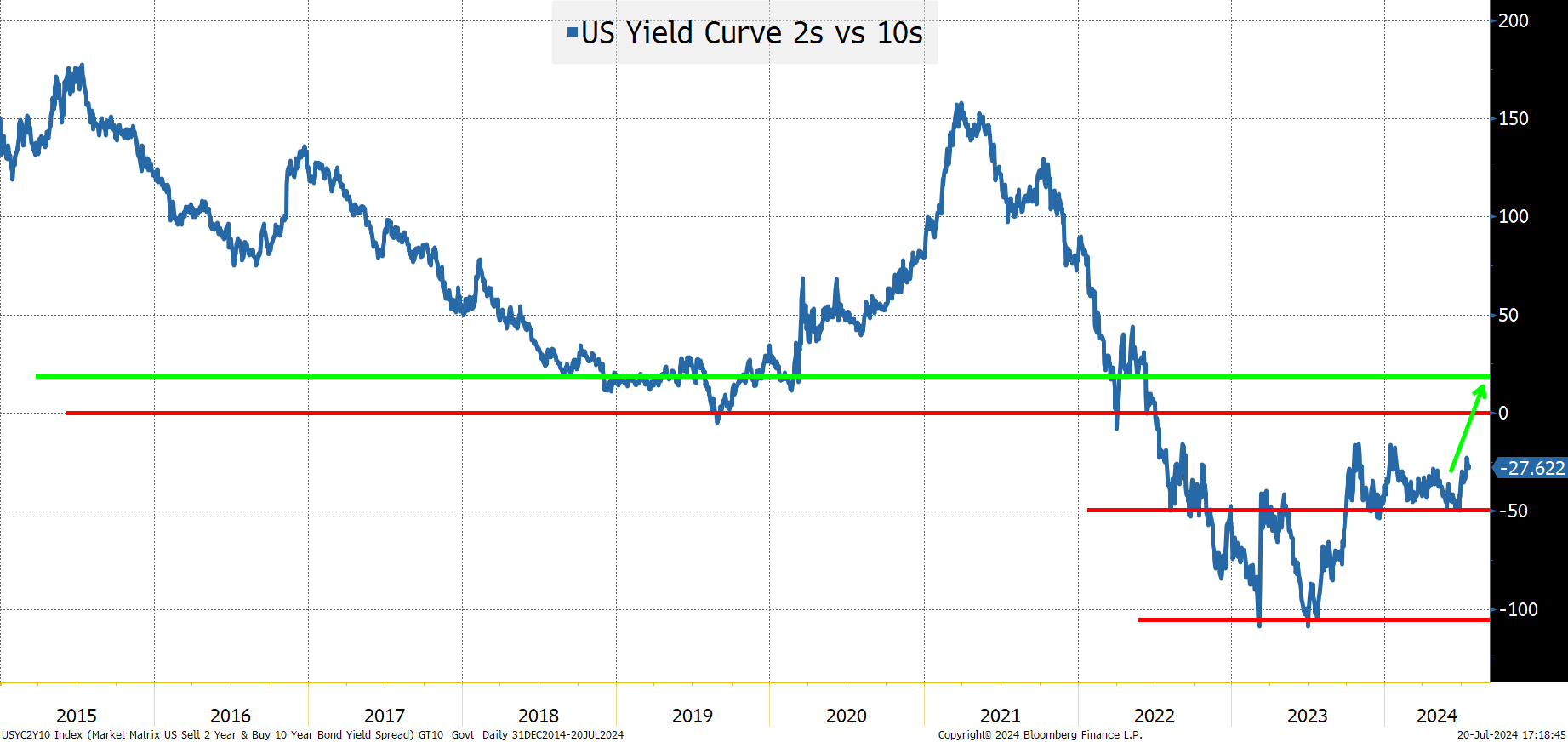
'De-Grossing' of Equities
On the equity side, we certainly saw “de-grossing,” where hedge funds in particular scaled back both their longs and their shorts. That helped contribute to a week where the S&P 500 lost 2%, the Nasdaq lost 3.7% and the Russell 2000 gained 1.7%. The equal-weighted S&P 500 also outperformed the regular S&P 500, though it finished to the downside.
De-grossing is cutting longs and shorts. Often “simplifying” complex portfolios. It tends to be a hedge fund/quant fund/CTA strategy. It can feed into “risk parity” strategies (strategies that attempt to harness the correlations and volatility of stocks, bonds and commodities to generate alpha).
On the “individual investor front” this likely played out as “rotation.”
IWM, a Russell 2000 ETF, for example, has large inflows starting late last week — consistent with de-grossing or rotation, not risk aversion. In a similar vein, RSP, an equal-weighted S&P 500 ETF, experienced inflows and has the most shares outstanding since it was launched in 2003.
Rotation and de-grossing are not de-risking.
The fact that NVDL (the leveraged NVDA ETF, though I don’t understand why they SEC approves such things) had inflows. This is one of many signals, to me, that we haven’t seen de-risking, let alone anything resembling capitulation.
I think there are a lot of things that call for actual de-risking and selling pressure for stocks (and, to some extent, bonds):
- Summer “liquidity” or lack thereof may concern investors
- More uncertainty and unprecedented events surrounding our election may not be an ideal backdrop for risk.
- Heightened concern about geopolitical risk and activity across the globe are threats.
- Indices, with heavy concentrations of a few names, sitting near all-time highs and having performed well year to date (S&P up 15% and the Nasdaq 100 up 16%, which seems low), may promote profit taking. Which would hit the “momentum” factor hard and produce more selling.
- While it is early in the earnings season — and trying to figure out results versus what was expected versus what happened to the stock and whether it was earnings related or just market noise is a guessing game — we may well be entering a period where the hurdles are quite high for stocks to perform on the back of earnings.
The Nasdaq 100 is down almost 6% from recent highs, and nearing its 50-day moving average (DMA) (19,522 close versus 19,321 50-DMA), we could see the 100-DMA come into play (18,627) which be another 5% drop from here, taking us to our 10% downside target.
Expect de-risking and, while “rotation” sectors will outperform, we should have better entry points later this summer!
At the time of publication, Tchir had no positions in any securities mentioned.