Scorching Semis Surge, All Eyes on Inflation, No Time to Panic
My advice amid elusive truce and locked up Strait? Keep calm or get eaten. Also, Qualcomm & Micron lead, chart looks ... bullishly postured.
You've reached your free article limit
You've read 0 of 1 free Pro articles.

Incredibly, the big cat had not picked up my scent. I had been out there for a while. I was caked in disgustingness. I probably just smelled like my environment. It had been at least a week, maybe two, since I had seen a bar of soap or a change of clothes. We just kind of looked at each other. It felt like an eternity, but it was probably just a second or three.
I had been the rear guard for a planned ambush. That's a two-man job. The other Marine was ill, so I sent him to go find the corpsman, and manned the post by myself. I was a confident kid, more fascinated by -- and not afraid of -- the jungle or what lived out there.
That said, there are animals that one can happen into that one should be afraid of, and jaguars are such a beast. So, we looked at each other. You gonna eat me, little buddy? He wasn't so little. He was bigger than I was. If you do try, I'm gonna to try to kill you too. Whisper. Soothe the beast.
I slowly reached down (really slow) toward my right hip and unsnapped my Ka-Bar. The cat broke and ran at the sound of that barely audible snap. In a flash it was as if that cat had never been there at all. I allowed myself to feel manly for a few seconds and then I went about my business. If I had panicked, I am sure that cat would have moved forward instead of running away. It's not easy but try not to panic as these markets move through dangerous moments.
No War? No Peace?
Passage through the Strait of Hormuz remained inert. Crude oil prices moved higher and continue to do so. Pres. Trump spoke to the media. The president referred to Iran's peace proposal as a "piece of garbage." Iranian leadership had responded to last week’s U.S. proposal with an unrealistic plan of their own.
The militarily beleaguered nation demanded the lifting of the U.S. naval blockade and demanded sanctions relief, while asking for financial reparations for war damage and at least some control over traffic through the Strait of Hormuz. That nation also came up with a plan that does not exactly surrender their nuclear weapons program.
Not only did crude prices rise on that news, but bond traders sold U.S. Treasury debt securities allowing yields and interest rates to rise. U.S. equities rallied at the headline level for most of the day and did close slightly higher, despite a bout of profit taking that hit markets late in the session. A look under the hood reveals that stock markets were not nearly as healthy once under inspection on Monday than they had appeared on the surface.
Incoming Inflation Data
Perhaps at least some of that late Monday market weakness and at least some of this overnight weakness in equity index futures markets is due to profit taking not only in the wake of Iran's less-than-serious peace proposal, but also ahead of this week's April data on U.S. inflation. Later this morning, the Bureau of Labor Statistics will publish its data on April consumer prices. Tomorrow morning, that same BLS will release its April data on producer / wholesale inflation when it posts producer price index data.
For today's consumer price index data, which will certainly impact financial markets and the probabilities concerning the trajectory of short-to-medium-term future monetary policy decision making, Wall Street is expecting to see month-over-month inflation of 0.6% (down from March's 0.9% print) and year-over-year inflation of 3.7% (up from 3.3%). The Cleveland Fed is not quite so dire. That particular model shows April CPI growth of 0.45% (monthly) and 3.56% (annual). I am even more optimistic as readers will see below. My model shows April CPI of just 3.5% (annual) but does allow for monthly growth of 0.6%.
Once we move on to core (ex-energy, ex-food) pricing, Wall Street is looking for consumer-level inflation of just 0.3% m/m and 2.7% y/y. While slightly higher, these numbers are hardly catastrophic and should not, in my opinion, impact decisions that direct policy. At the core, for April, Cleveland is at growth of 0.21% and and just 2.56% respectively, while I am at 0.3% and 2.6%.
We're not far apart and if we're right, the Federal Open Market Committee should not move a muscle. As a Fed watcher and at least at one time, with different folks on the committee, an "off the record" Fed adviser, you do not take steps that would impact household (and commercial) demand based on what one sees as temporary (or transitory) shocks to supply. Let the pure dynamic between demand and supply in real time, be what impacts the elasticity of the equation.
There is no need to impact that dynamic artificially. Save that for when consumers move toward overheating (or the opposite) this economy. This is definitely not what we see before us and to slow economic activity at this crucial time when the balance between growth and labor market health is in such a delicate state, would in my opinion, be to commit policy error.
Related: Retail Joins the Downside as Market Wakes Up
Marketplace
On Monday, the S&P 500 gained just a tad, 0.19% for the day as the Nasdaq Composite inched 0.1% higher. Both of these major equity indexes did manage to close at record highs for those wondering. There were losses. The KBW Banks gave up 1.13%, while the Dow Transports gave back 0.77%. The semis? They remained hot as heck. The Philadelphia Semiconductor Index scored an additional 2.59% gain on Monday, led by Qualcomm (QCOM) , and Micron (MU) .
Breadth was weaker than its been on Monday, despite the green candlesticks posted by the major equity indexes. Five of the 11 S&P sector SPDR exchange-traded funds closed in the green, led by energy (XLE) , technology (XLK) and the materials (XLB) . The communication services (XLC) and the staples (XLP) sectors led the losers. Cyclicals did outperform defensives, which I am taking as a subtle positive.
Losers beat the winners by a three-to-two margin at the NYSE and by a rough five to four at the Nasdaq. Advancing volume took a 45.1% share of composite NYSE-listed trade and a 50.5% share of composite Nasdaq-listed activity. Not bullish, but at least not awful either. Aggregate trade was higher, across the listings of both exchanges as well as across the membership of the S&P 500. I find it hard to draw much from that though as the headline indices remained green despite the semi-negative breadth.
This daily chart of the S&P 500 remains nothing if not bullishly postured.
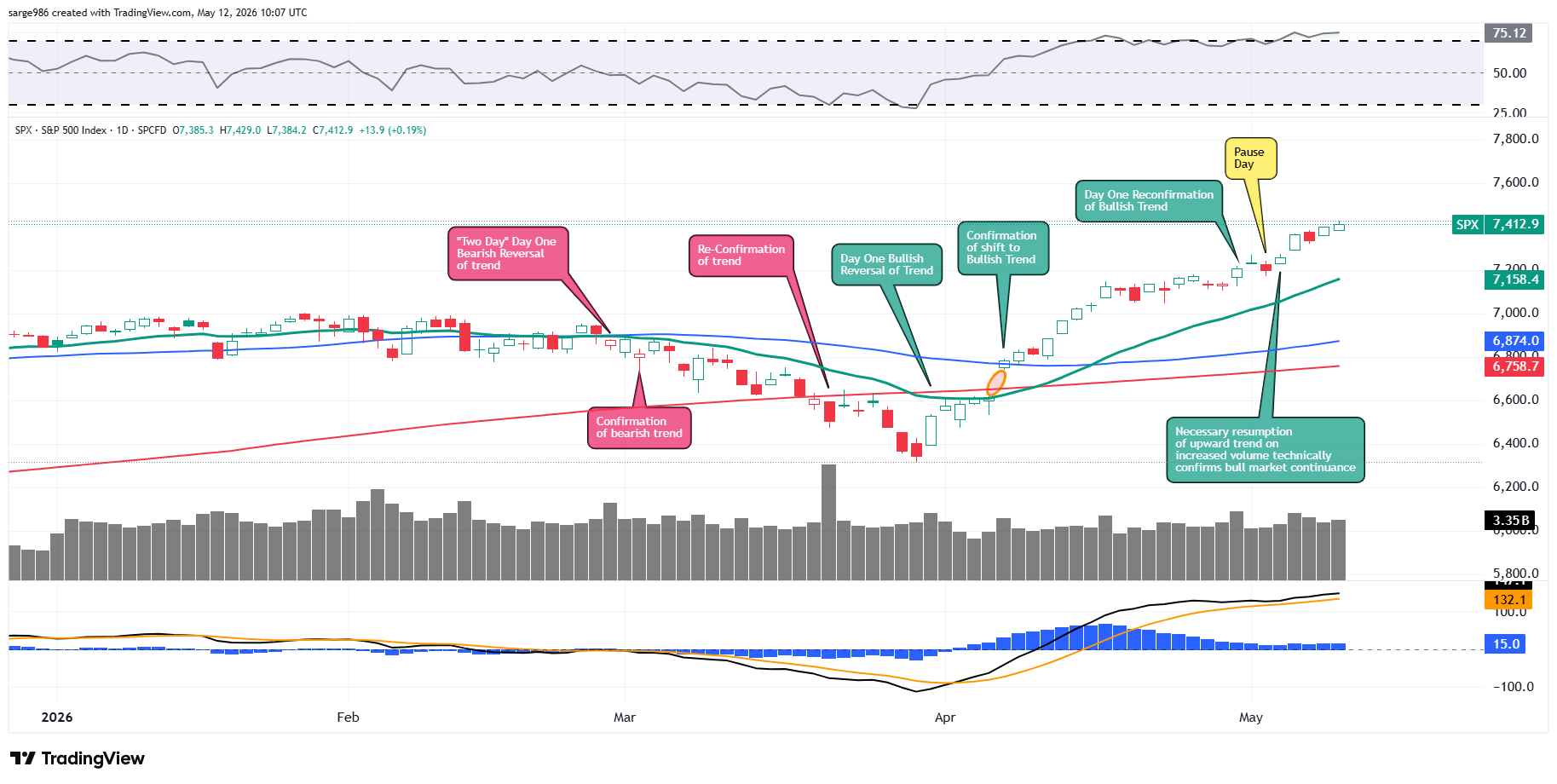
Are markets extended? Yes, and no. Daily indicators such as Relative Strength and the moving average convergence divergence look stretched, but a whopping five of those above-mentioned 11 sectors are not trading above their respective five-year average forward looking price-to-earnings ratios. Fundamentally speaking, the only way that this market is significantly overbought or overvalued is if 12-month forward-looking estimates for U.S. large-cap corporate profitability are simply incorrect.
Quote of the Day
“As the orchestration core of AI infrastructure buildouts, the Server CPU has gained significant traction over the past few months. This is driven by the Agentic AI/inference trend, fueled by the breakthrough of OpenClaw and Anthropic’s ARR surging to $44bn in April. For instance, in latest earnings calls, AMD projected a >35% CAGR for Server CPU TAM by 2030, and Intel said the shift toward agentic AI is driving a structural demand for CPUs, where the GPU-to-CPU ratio is tightening from 8:1 in training to 4:1 in inference. Based on our estimates, assuming inference accounts for 90% of AI workloads and GPU-to-CPU ratio for AI servers to reach 2:1 in 2030, we now expect Server CPU TAM to grow 54%/39% in 2026/2027, reaching $135bn by 2030 from $26bn in 2025, with a 5-yr CAGR of 38%. That said, we project incremental Server CPU demand of 6.7m/7.6m/6.3m units in 2026/2027/2028 respectively, bringing total server CPU demand to 30m/38m/44m units over the same period, with a 23% 3-yr CAGR.”
- Analysts at China-based broker-dealer GF Securities, led by Jeff Pu
That's a lot of technical and difficult to read mumbo-jumbo. What is Jeff Pu trying to tell us? Given the fact that x86 CPUs still dominate the space, I take this as Pu thinking that investors need to remain long Advanced Micro Devices (AMD) and Intel (INTC) while also considering Nvidia (NVDA) and Qualcomm (QCOM) . For readers about to ask... Yes, I remain long AMD and yes, I threw in the towel on my INTC short late last week at ($112) a loss. Thank goodness I did.
Song of Myself
(excerpt from section 44)
It is time to explain myself—let us stand up.
What is known I strip away,
I launch all men and women forward with me into the Unknown.
The clock indicates the moment—but what does eternity indicate?
- Walt Whitman (1892)
Economics
(All Times Eastern)
6:00 a.m. - NFIB Small Business Optimism Index (Apr): Last 95.8.
08:15 - ADP Employment Change (weekly): Last 39.25K.
08:30 - CPI (Apr): Expecting 0.6% m/m, Last 0.9% m/m.
08:30 - Core CPI (Apr): Expecting 0.3% m/m, Last 0.2% m/m.
08:30 - CPI (Apr): Expecting 3.5% y/y, Last 3.3% y/y.
08:30 - Core CPI (Apr): Expecting 2.6% y/y, Last 2.6% y/y.
08:55 - Redbook (Weekly): Last 7.8% y/y.
1:00 p.m. - Ten-Year Note Auction: $42B.
2:00 - Federal Budget Statement (Apr): Last $-164.1B.
4:30 - API Oil Inventories (Weekly): Last -8.1M.
The Fed
(All Times Eastern)
03:15 a.m. - Speaker: New York Fed Pres. John Williams.
1:00 p.m. - Speaker: Chicago Fed Pres. Austan Goolsbee.
Today's Earnings Highlights
(Consensus EPS Expectations)
Before the Open: (QBTS) (-0.08)
After the Close: (OKLO) (-.18)
At the time of publication, Guilfoyle was long MU, AMD, NVDA equity.