Next Fed Cuts Are Foregone but They Won't Fix the Yield Curve
The Federal Reserve has telegraphed its next rate cuts but it can't stop the 10-year yields from rising further.
You've reached your free article limit
You've read 0 of 1 free Pro articles.
It is unusual to say that I don’t really care that much about the FOMC meeting, but I don’t. Everything seems incredibly well telegraphed coming into this meeting:
- Markets are pricing in a 93% chance of a 25 BPS cut. We will get it.
- Markets are pricing in an 87% chance of no cut in January. We won’t get a cut.
The Fed tends not to deviate that much from market expectations, and the next two meetings appear pretty cut and dry right now, without some unforeseen large data (or geopolitical) surprises.
The hawkish sentiment expected is appropriate.
The only real weakness in the jobs data recently has been in the often (and rightfully) maligned Household Survey. The margin for error in the Establishment Survey is big enough to drive a truck through, and the Household Survey margin for error would let you drive a tanker ship (while blindfolded in rough seas) through it. The two surveys often deviate, significantly and over extended periods of time, but if we get any “normalization” we should see unemployment rates decrease in the coming months.
Inflation is proving to be sticky. As companies purchase inventory ahead of potential tariffs, we will see inflation remain sticky. Many investors and business owners are seeing the surge in NFIB Small Business Optimism (as one concrete example) and we are likely to see people prepare for that growth, which should keep prices elevated.
We have argued that the seasonal adjustments have been off for two main reasons:
- Shifting demographics. Basically, any upward adjustment for construction in the winter to account for Northeast slowdowns is erroneous now that the bulk of construction has shifted away from that region.
- Including COVID-era data. The timing of COVID lockdowns and re-openings has been included in the data and tends to create adjustments that overstate the strength of the economy in the winter and understate it in the summer.
So, seasonal adjustments should contribute to (artificially) higher inflation and jobs data in the coming months. It won’t be as impactful as last year, or the year before, but it will be a factor and will “manufacture” or “create” data that keeps the Fed on the sidelines.
Even the Neutral Rate seems to have settled around 3.75% toward the end of 2025, which is hard to argue with (I think it should be 4%, but that would be quibbling since we had the move from 2.875% over the past few months). Nothing the Fed says at this presser is likely to move the needle on the neutral rate, since I think they had every intention of getting the market to price it higher, and they have been successful.
How High Can Yields Go?
While the Fed meeting might be well telegraphed, I am still concerned about the long end of the yield curve.
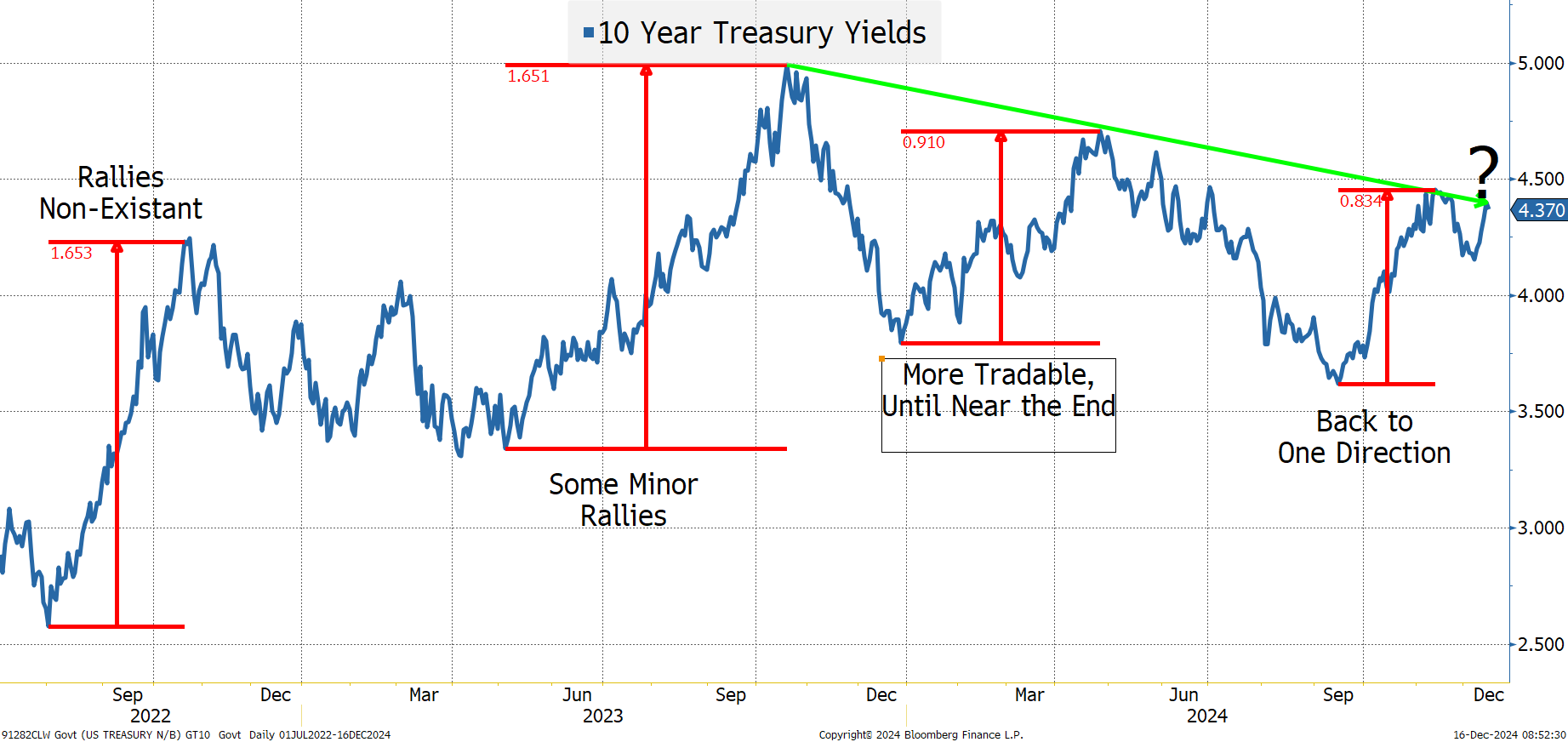
I haven’t liked how the moves to higher yields have generally been unidirectional (if that is a word). Despite all the positive messaging from DOGE, there is renewed concern about the path of the deficit.
I did enjoy Treasury Secretary Yellen expressing “regret” that they didn’t do more to contain the deficit, since it wasn’t very apparent that any time was spent on trying to control he deficit. Until the voters make it clear that the deficit scares them (and I don’t really think that was part of the message that voters sent at this election), both sides will continue to spend, because it generally helps them.
If we are correct on inflation, jobs and seasonal effects, there are some more problems out there for the rates market. We thought 4.4% and higher in the aftermath of the election was overdone and highly susceptible to a short squeeze. I don’t see that right now (and we haven’t seen it since it was at 4.2%). If anything, while we have been steadfast that the risk of a gap higher of 50 BPS is far more likely than a similar gap to lower yields, we must take our range up to the 4.4% to 4.6% area on 10s.
I'm bearish on the longer end of the yield curve (10s through 30s), though we will see how the market responds here at what seems like resistance.
Bottom Line
The FOMC will be boring, but that won’t stop 10-year yields from rising further.
The FOMC is likely to be a non-event for stocks, though given that the consensus has moved to “hawkish” pause, some form of “dovish” pause good provide stocks with a lift, especially as markets are likely to be illiquid and biased to the upside this time of year (yes, the so-called Santa Rally should be getting under way this week, if it hasn’t already).
At the time of publication, Tchir had no positions in any securities mentioned.