How the Stock Market Reacts to War Can Lead to a Big Portfolio Payday
In this edition of TheStreet Pro's Wealth Advisor Letter, we discuss the market's historical patterns during wartime, guiding investors through uncertainty, and designing a robust portfolio strategy.
You've reached your free article limit
You've read 0 of 1 free Pro articles.
When I first saw the long-term chart of the stock market with major wars highlighted, I never really thought I’d have to deal with those scenarios. As a young man, I assumed they would have little impact on my career.
Then stocks peaked on July 16, 1990, before the Gulf War. This marked the beginning of my real education working with clients during a military conflict. Following this peak, the market experienced a sharp decline as the crisis escalated, with Iraq invading Kuwait on August 2, 1990, leading to the Gulf War. Then stocks bottomed out while investors remained bearish and afraid to invest.
How the Stock Market Performed Around Recent Wars
Since many investors are concerned about major conflicts around the world, I thought I'd put together some facts to share. So I examined how the U.S. stock market performed around wartime. In particular, I analyzed six months before war started, during the war, and six months after the war ended. I included World War I, World War II, the Korean War, the Vietnam War, the Gulf War, the Iraq War, and the Afghanistan War. Here are the results:
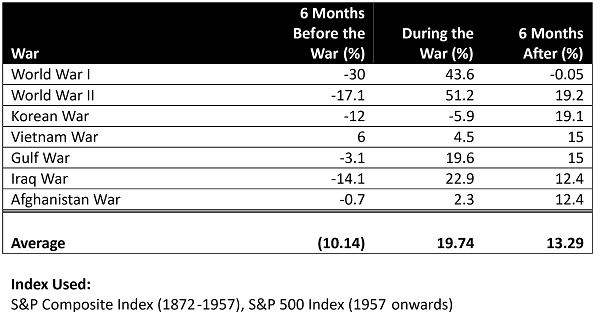
On average, the market dropped 10.14% in the six months leading up to these wars. Interestingly, during the war, the market rebounded with an average return of 19.74%, and six months after, it averaged a 13.29% return.
Compare this with the long-term average return of 9-10% in the U.S. stock market, which considers decades of wars, peace, recessions, and expansions. Analysis suggests that stocks decline before a war due to uncertainty but rebound during and after as things become clearer.
Skip the Crystal Ball—Focus on Facts and Let Probabilities Do the Talking
While history doesn't guarantee future results, we can use these patterns to talk to clients about diversification. If we build portfolios that include a mix of non-correlated assets — like Treasury bills, bonds, gold, and alternative strategies — our clients can be in a better position to profit in both up and down markets.
It's essential to have strategies that work in different market conditions, including private market investments and even guaranteed return instruments. A diversified portfolio can help clients weather these volatile periods better than trying to time the market perfectly, which is virtually impossible.
Focus on These Three Things
As advisors, a huge part of our job is to help investors do three key things: first, ensure they have a portfolio strategy designed to adapt to economic conditions; second, use a sound process for security selection, and third, match the portfolio risk to the client's tolerance. And I’ll just add one more — educate clients about history.
Don’t Avoid a Conversation About Military and Geopolitical Risks
The hardest task an advisor must do is guide people who feel fearful and overwhelmed. I don’t believe in avoiding the conversation, instead I talk about the possibilities and what evidence is present supporting or refuting a military conflict and then refocus the client's attention to the top three things — portfolio strategy, security selection, and risk tolerance.
No one really knows when war breaks, but advisors who discuss risks early and often don’t get caught with unhappy clients. In my experience, it's best to have a conversation with a positive, can-do attitude.
Attack Risk, Don't Just Manage It
We all know that during any crisis, many investors panic and sell out at the wrong time, missing out on the market rally while sitting on the sidelines. I’ve seen this time and time again with investors who never fully recover.
A retired friend and money manager, Tom Basso, who was featured in the book Market Wizards, came onto my podcast, The Market Call Show, and shared some of his insights.
He spoke about not just managing risk but attacking it. His approach is to quantitatively measure risk continually and take positions that perform well during declines. By building portfolios with fundamental value, growth, fixed income, guarantees, and strategies that attack risk, we can better help our clients withstand the fear and uncertainty that often come with war or economic downturns.
Robust Portfolio Strategy and Candid Conversations Win
Wartime is no joke and anything can happen, but keep the big picture in mind. Six months before recent wars, the stock market tends to show negative returns, but during war, markets typically recover, and they often continue to rise after the conflict ends.
This data shows that short-term volatility can be dangerous for investors if they react in the wrong way. Instead of trying to time the market, it’s better to focus on building robust, diversified portfolios to help clients navigate uncertain times with confidence. This includes allocating capital into strategies that attack risk as well as pick investments based on sound fundamentals.
What do you think are the best ways to think about investing in today’s headlines? I’d love to hear your thoughts about how to invest in uncertain times. Please share and follow for more.