Here’s Why This Asian Market Is the Big Rate-Cut Winner
There’s been serial disappointment for Asia’s worst-performing market, which should now rally after the Fed rate cut.
You've reached your free article limit
You've read 0 of 1 free Pro articles.
It’s been serial disappointment for 3½ years for Hong Kong stocks. But they just may be the biggest winners in Asia out of the U.S. Federal Reserve’s interest-rate cut.
In fact, the benchmark Hong Kong index, the Hang Seng, stands at a similar level to July 2000. In other words, you have made precisely 0.0% return on a buy-and-hold strategy in the quarter century since the turn of the millennium.
Japanese stocks are big immediate winners today, with the broad-market Topix in Tokyo up 2.0% at Thursday’s close, and the blue-chip Nikkei 225 up 2.1%. Asian currencies have also gained significantly Thursday.
The Hang Seng, however, matched Tokyo with a 2.0% advance. Given how beaten down Hong Kong stocks have been, I envision a bigger longer-term bounce in the city’s benchmark, which is up just 0.5% in the last year, whereas the Nikkei has been a particularly strong performer since the start of last year.
The weak yen has helped drive Japanese exporters higher, resulting in a 42.4% gain in the Nikkei since the start of 2024.
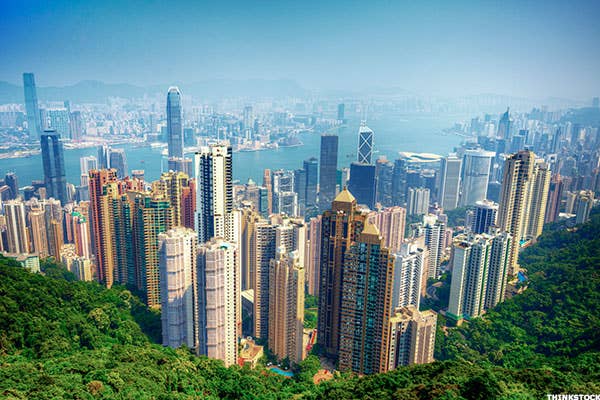
The Hong Kong dollar is pegged to the U.S. dollar, resulting in the city “importing” U.S. rates whether or not they match the underlying economic situation in Hong Kong. They have not matched the dire economic situation in the city ever since the Fed began its series of rapid rate rises.
China’s economy has been burdened first with the mainland’s futile, disruptive and expensive effort to wipe out Covid-19, then with a stop-start recovery where factories have been ordered back into production, but consumers can’t be goaded into spending.
So Hong Kong has had to contend with very high borrowing costs at a time that the local economy needed stimulus. Inflation is running at 2.5% and has rarely breached the 3% mark, so there was no need for the price-containment measures necessary in the West.
On Thursday, the territory’s central bank, the Hong Kong Monetary Authority, mimicked the Fed with a 50-basis-point cut in its base rate to 5.25% “with immediate effect.”
It’s the first in Hong Kong since 2020. Rates began rising in early 2022 and peaked at 5.75%, their highest level since pre-Lehman days in 2007.
Another reason that Hong Kong stands to be a major beneficiary of lower rates is that the city has some of the highest property prices in the world, and a host of listed property developers. But buying interest in real estate has dried up mainly due to stock-market losses.
The Hong Kong property market tends to lag the local stock market by 6-9 months. If we see a pickup in the Hang Seng, watch for the property market to change direction.
Mass-market property is becalmed at best, with prices falling to their lowest levels since 2016, while high-end listings are being priced at 46% below their pre-Covid levels, “dramatic price reductions,” according to Savills.
“Long story short, [the] lower rate is a positive catalyst for the sector,” Jefferies says in a summer note on Hong Kong property, looking ahead to the likelihood of a cut. “However, we think physical market recovery will take time, and companies’ fundamental improvement will likely be uneven.”
They favor the high-end developer Sun Hung Kai Properties SUHJY (HK:0016), and would be wary about companies with sizable completions, increasing capex costs and high fixed ratios, a situation facing New World Development NDVLY (HK:0017), Henderson Land Development HLDCY (HK:0012), Hang Lung Properties HLPPY (HK:0101) and Hysan Development HYSNY (HK:0014).
Hong Kong real-estate investment trusts (REITs) are also likely to gain as rates fall, a topic I’ll explore in the future. Link REIT LKREF (HK:0823) is the standard bearer there, the largest REIT in Asia by market capitalization, with a portfolio of needs-based shopping malls mainly in public-housing estates and some 79,000 parking spaces, a surprisingly good way of generating yield in cramped Hong Kong, with neighborhoods such as Mong Kok boasting by some measures the highest-density population in the world.
Property brokerage Jones Lang LaSalle agrees the rate cut is “good news for the market,” but believes property prices will continue to fall this year as developers rush to launch new projects and capitalize on the increasingly favorable rates. The Hong Kong economy is experiencing moderate growth, up 3.3% year on year in Q2, similar to the 3.2% pace last year.
It will take time for the property market to recover. Watch for the Hang Seng index to run up before property prices turn, meaning equity investors into Hong Kong should finally begin to see a decent return.