Helene Meisler Charts By Hand Because Simplicity Wins in Trading
While most investors rely on increasingly complex tools, Meisler sticks to hand-drawn charts and a straightforward process focused on sentiment, support, resistance, and discipline.
You've reached your free article limit
You've read 0 of 1 free Pro articles.
Introduction
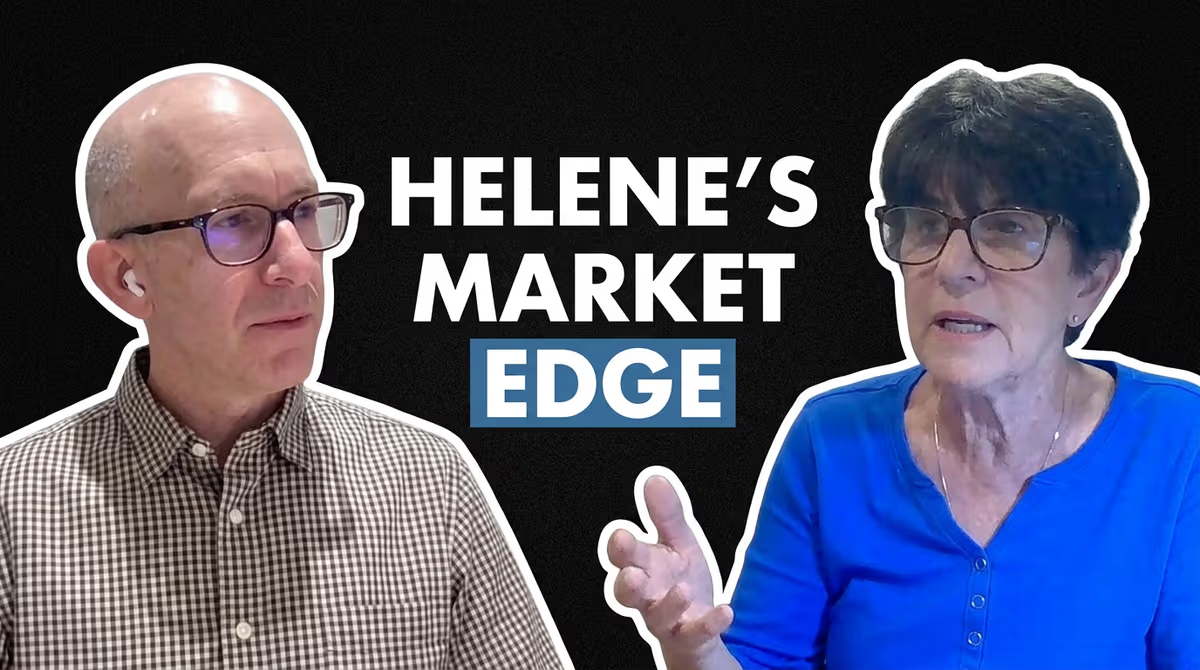
Next up in our series on getting to know TheStreet Pro’s contributors is Helene Meisler! Many of you are fans of TopStocks and lots more read her morning column. Helene makes technical analysis easy to understand because she keeps it simple.
In our discussion, we talk about how Helene ended up at TheStreet Pro, her thoughts on charting by hand, and why she doesn’t use the open price or volume in her charts.
Please enjoy and make sure to follow Helene here on TheStreet Pro.
Video
Transcript
Jason Meshnick (00:01.336)
So, first of all, I think I should apologize to all of our subscribers here because I’m the person who edits today’s guest’s work every day. And so while I think I do a pretty good job editing her work, the the titles I provide do not do them justice. Helene Meisler is one of my favorite contributors at the Street Pro. And the reason is that she starts from a big picture, top-down market sentiment and looking at the
indicators and the in indexes and from there she drops all the way down so to give us great trading ideas both from ideas that she comes up with on her own her her new ideas that she provides every day in top stocks all the way down to answering reader questions so with that we’re going to get to know Helene Meisler a little bit better today. So welcome Helene. Glad that you’re here joining me.
Helene Meisler (00:47.538)
Yeah.
Helene Meisler (00:57.963)
Nice to see you, Jason. Thanks for having me.
Jason Meshnick (01:02.062)
Great to great to talk to you. Okay. So what we’re gonna do is the same thing that I’ve been doing with the other contributors so far is we’ll ask a bunch of questions and these are all softball and fun questions just designed to help people get to know you a little bit better. So the first one, this might be the hardest one, okay. I’d like you to start with give us a fun fact about you, something that people may not know. It doesn’t have to be about investing, it can be whatever, whatever you want. Something
Some fun fact about Helene Meisler.
Helene Meisler (01:36.858)
Well you know, I think long term long time readers would know this, but perhaps more recent ones would not. I spent nine years living in Asia.
Jason Meshnick (01:52.46)
Yeah. Where where in Asia? Do you wanna do you wanna tell us?
Helene Meisler (01:52.924)
There you go. five years in Singapore and four years in Shanghai. And yes, and yes, I speak a tiny little bit of Chinese. I spoke it much better when I lived there.
Jason Meshnick (01:58.486)
Okay. And
Jason Meshnick (02:07.019)
It’s an important language to know these days.
Helene Meisler (02:09.667)
I didn’t did not keep up on it. Sometimes I go to the Chinese grocery store and I can’t remember the word for garlic and I’m like, are you kidding me? Anyway.
Jason Meshnick (02:18.189)
Well, it it’ll help with with the Chinese AI when we start using more of that. Great. So
Helene Meisler (02:23.193)
Right.
It will know the word for garlic for sure.
Jason Meshnick (02:29.173)
Yeah, exactly. So so many years in Asia and and has that has that colored any of the way that you look at your your market analysis?
Helene Meisler (02:38.833)
you know that’s funny that you ask that. I think one of the things I learned not about the US market was how all those other markets trade. like here’s a weird little thing. Most of the Asian markets close for lunch.
Jason Meshnick (03:01.077)
Right. Yeah.
Helene Meisler (03:02.477)
Which is was always just like the weirdest thing for me in in this day and age. Still, I mean I live there, I’m back in the States over 20 years now, and I still can’t believe that they close for lunch. I think we should, but no, so I what did I learn? I learned how small their markets are. Almost every every market in the world is compared to the US market.
Jason Meshnick (03:14.881)
Yeah.
Helene Meisler (03:26.479)
You know, what I I came into the you know, I started working in the markets in nineteen eighty-two, which means that I was there for that Japanese bubble that burst in nineteen eighty-nine. And it was such a huge do do you know the way these days everybody wakes up to see what the Cosby did, the Korean market did overnight because they care about the the semiconductors? That’s the way the Nikkei was back then in the late eighties. And
You know, it was a really important market and and it never you know, I did a little bit of work on it and at the time, but it never occurred to me until I moved to Asia how small the market there is. I mean, and of course it got smaller after the bubble burst. But all their markets are just tiny compared to ours.
Jason Meshnick (04:16.843)
And they’re more narrow too, right? They they have fewer sectors.
Helene Meisler (04:20.719)
Well it’s well well that that’s has to do with the size of them, obviously, but they just have fewer stocks that are important. I mean, you know, we all in this day and age cannot believe that, you know, five or ten stocks control the index. Well heck, the rest of the market the rest of the world has had markets like that for years, for forever. So maybe we’re following them. I don’t know. Maybe I should learn that.
Jason Meshnick (04:44.885)
Right. Right.
Right. Right, we’re following the rest of the world. yeah, and and my understanding too is that they’re a little bit more speculative. Or at least they were. when I spent some time in Singapore, we were talking about the the level of speculation and actually the sophistication around the speculative activity. banks providing access to incredibly sophisticated options platforms that, you know, people would either execute through the banks or other traders might understand on their own and do. I mean
You know, we we talk about options spreads with, you know, two, three, four options legs in them. They might have, you know, twenty or fifty in theirs. there there’s one of my favorites who was called I can’t remember what the what the official name was, but the informal name was something like, I’ll kill you later because because most of the time, you know, you’d either make a little bit of money or go broke on these things. So
Helene Meisler (05:28.837)
Yeah.
Helene Meisler (05:46.319)
Yeah, it’s there’s a lot of boom and bust, shall we say.
Jason Meshnick (05:49.72)
A lot of boom and bust. Yeah. My other the other funny thing that I learned, having worked in the data industry and dealing with some of the Asian markets, is that when you look at a quote board, red is up and green is down.
Helene Meisler (06:02.929)
Well you know I don’t remember that. I don’t remember that.
Jason Meshnick (06:05.889)
Yeah, that might just be limited to where were we? Hong Kong and Singapore were the two that we were dealing with. Might just be limited to those. But yeah, r yeah, red good, green bad.
Helene Meisler (06:13.997)
Okay. It it may be I I mean I went to I went to Tokyo for my first time on business in nineteen ninety-five and
We still have a f a a New York stock exchange floor and it was active and you know and I said well you know maybe I can visit the stock exchange and they all looked at me like why? There’s nothing to see. I mean it it’s it, you know, because it they were all electronic. Well before we were, you know, we’re the only place that has this floor.
Jason Meshnick (06:39.117)
Right. It’s an office.
Jason Meshnick (06:49.495)
Yeah.
Jason Meshnick (06:55.681)
Yeah, and and and now we don’t even have that really.
Helene Meisler (06:59.627)
Right. Now it’s a T V studio.
Jason Meshnick (07:02.059)
It’s a T V studio, it’s a glorified T V studio. great. All right, let’s let’s move on to your second question, which gets into a bit about your career. so what what was your tenure? How how long have you been with the Street Pro?
Helene Meisler (07:17.911)
I start I wrote my first column in January of nineteen ninety-eight.
Jason Meshnick (07:24.673)
Nineteen ninety eight. So twenty-eight years ago. Yeah. And yeah, amazing. Lots of change during that time. What were you doing before you got to the Street Pro? How’d you end up with us?
Helene Meisler (07:26.117)
Nineteen ninety eight.
Helene Meisler (07:30.491)
Coming up on twenty nine, yeah.
Helene Meisler (07:38.794)
so I went to work on Wall Street in ’82. and I sometime in I want to say after the 87 crash, but it was so it was probably 1988, Jim Kramer had become a a client of my firm’s. I was a Cowan and Company. And he knew nothing, having come from Goldman Sachs, he knew nothing about technical analysis. So
The salesman who covered his account asked me if I would spend some time with him and you know kind of teach him what I knew and all the rest and and so I did and Jim and I got to know each other rather well, you know, four or five times a day on the phone. You know, he left let me tell you what I’m seeing. What is this? What and anyway, and then I left Cowan in eighty-nine to go to Goldman and in in ’96 I moved to Asia.
And so I was just trading myself, you know, doing my own thing. And I’d seen an article in New York magazine that Jim Kramer had written and we had lost touch. And I sent him an email. He had an AOL address. And yes, and I sent him an email and he told me about
Jason Meshnick (08:55.661)
Didn’t everybody back then?
Helene Meisler (09:03.333)
that what he was doing with the street and and and you know like you know because of the time difference it was a twelve or thirteen hour time difference he you know I woke up in the morning and there were all these I but there were probably ten emails from him and and you know it was here’s what I’m doing, take a look at the site, give me your feedback and then the next one was, wait, wait a minute, what are you doing over there? And then the next email, you know and eventually he got to maybe you want to write for us. And so that’s how it happened.
Jason Meshnick (09:33.486)
That’s amazing. So all right. yeah, Jim Kramer really I mean he’s obviously so formative in the company. he created the company, but it’s amazing how the people who he was close to are still here with us. so I I love that. let’s move on to our third question. Let’s talk about your investment philosophy and style. and and what I’m kind of getting at here is, you know, from our subscribers.
What type of person would really get the most out of reading your content?
Helene Meisler (10:07.131)
So I like to say, I mean, I hate the term because it’s so overused, swing trader. But mostly I’m really just trying to find the swings. You know, people who are looking for the big call, is this the bottom of the bull market? Is this the top? That’s not my thing. I I just I’m I’m looking for when the variety of the the the
The majority of the evidence and the indicators that I use are saying, okay, it’s everything is oversold, sentiment is bearish, it’s time to be looking to buy. Sentiment is too bullish, everything is overbought, we’re looking to s for a swing down. I mean that’s that’s it. I’m I’m very simple. I you know, don’t look for me for all these big picture ideas and I I view the market really v rather simply.
I I do and and somebody who’s looking for me to, you know, have this big story and this, you know, big picture idea, you’re coming to the wrong person.
Jason Meshnick (11:13.473)
But but at the same time, you do have a very big picture. You’re looking at a a smaller time frame, right, an a narrower time frame, but you’re still taking in an incredible amount of information. the other thing that I love though is that your charts, it’s not like you’re putting a lot of information on them, right? You know, your your analyses are can be read pretty quickly, understood pretty well. Everybody knows what you’re thinking when you write it down.
Helene Meisler (11:40.93)
Yeah, I’m well I mean as anybody who reads me knows I chart by hand and there’s nothing else on the chart. So that’s that’s what I’m looking for in a chart is I’m looking for a plain chart that just has high low close and volume. And even at that, oftentimes I don’t
Jason Meshnick (11:50.805)
Exactly. Yes.
Ha ha ha.
Helene Meisler (12:11.235)
Like in my in my writings, I very rarely use volume on a stock chart. Because I don’t think it really matters that much unless it’s extraordinary. So I mean I’ve seen markets rally on low volume. You know, I I I don’t put I don’t put that much stock in just general volume in a stock. So but I do I do track it.
Jason Meshnick (12:17.356)
Right.
Jason Meshnick (12:28.737)
Yeah.
Jason Meshnick (12:35.287)
Sure.
Jason Meshnick (12:40.289)
And so you said you look at high, low and close. what about open? Don’t care about the open.
Helene Meisler (12:44.036)
Mm. No.
Helene Meisler (12:49.209)
You know, it’s it’s funny. no, when I learned to chart, we did high low close. I and and it’s just the way I was taught. And I never thought about tracking the open. And then I started to look at charts online, which was, you know, what, fifteen years after I’d started charting, because we didn’t have online charts really in my early days. And
And I was like, what is that little tick to the left all the time? And then I realized that there are a lot of people who watch open high low clothes. So yeah, I’m not a candle. It drives me nuts when someone sends me a candlestick chart. Drives me nuts. I I you know, I I don’t understand them. Yes, I’ve read Steve Neeson’s book, but I it’s too much going on.
Jason Meshnick (13:21.175)
Yeah.
Jason Meshnick (13:27.905)
Yeah, well candlesticks. Right? Ca candlesticks are based on the open, high, low, close.
Jason Meshnick (13:35.927)
Ha ha.
Jason Meshnick (13:47.775)
Yeah, y yeah, right. You are increasing your d data by thirty percent.
Helene Meisler (13:52.274)
It’s it’s just too much for me. You know, I have to know the names of them. I I barely know the names of the chart patterns I look at. I mean someone will say to me, Is that an ascending wedge? I’m like, You’re gonna make me go look that up? I don’t know what that is.
Jason Meshnick (14:06.957)
Right. the thing that I like about them is that you get the sentiment not only is the stock moving up or down, right? What is the overall trend? But you can see sort of that or more accurately, for the day, you can not only see did the stock go up or down on the day, but you can also see intraday, what did it do? Right? Did it
Was there was there buying, was there demand for the stock throughout the day? so you know people will look at something like, you know, IBM traded up, I’m making this completely up. stock XYZ was up five percent today. that’s right, that’s block. Yeah. stock well yeah.
Helene Meisler (14:40.923)
Which is now a stop, by the way.
It it’s like ridiculous. It changes name and ticker five times.
Jason Meshnick (14:51.125)
So so anyway, this the stock could be up, you know, five percent on a on a day, and that’s really interesting, but what if it opened up ten percent and it closed only up five percent? Right, and that’s that’s something that you that I feel like a lot of people miss out on when they focus. Yeah, exactly. Now the difference is
Helene Meisler (15:06.907)
Pencil captures it.
Jason Meshnick (15:11.263)
you’re you’re not looking at these in a naive way, right? You’re not a computer that’s just saying, yes, it was up five percent today. You’re actually spending your time looking at the chart and understanding the high and the low and and getting all that same kind of information. right. So so I think that’s valuable. you talk a lot about your mentor. so
So I I think, you know, we don’t talk enough about mentors here, but they’re really important to all of us. And in a lot of ways, you know, you’re a mentor to many of us at the Street Pro, even people that don’t interact with you on a daily basis, they still read your content and and they and and it’s educational in a lot of ways. Do you want to talk a little bit about your mentor and and what you learned?
Helene Meisler (15:50.672)
Well, I was just gonna say that it’s funny that you say that about the charts. you know, if it was up ten percent and it closed only up five percent, because when I first started charting, Justin Mamus, my my mentor, you know, he had the pile of charts was huge. Okay, but he only did like this many. And it was my job to do all the two hundred and fifty that he didn’t wanna do. And
Jason Meshnick (16:15.413)
Yeah.
Helene Meisler (16:18.853)
He was a work from home guy back in the 80s, just so you know. He only came to the office a couple of days a week. And so it was my job to do the charts and then call him, so I would do them after the market closed. And I had to call him that and I take notes. I can show you. I still to this day do it the way I did it then. I use a stenopad. Good stocks, bad stocks, okay?
Jason Meshnick (16:22.167)
Wow.
Jason Meshnick (16:45.964)
Uh-huh.
Helene Meisler (16:46.767)
And the following morning, and you know, you make notes on it, check marks and all sorts of things. And the following morning I’d have to call him and tell him.
Stock, take a look at that stock, you know, and I I’d have to go through all these charts. And after I was doing this for a while, I noticed that he’d come into the office two days a week, and he would, if I had flagged an interesting chart and he had come to the office, I can tell you that the next time I went to chart, that chart was missing and he’d taken it home with him because he used to take the interesting charts home with him.
And he used to lead me the doll charts.
Jason Meshnick (17:28.173)
That’s great. So you were yeah, you were his his assistant, his workhorse doing all doing all the hard work. He could he could have the glory. But in in the end it worked out.
Helene Meisler (17:31.995)
No.
Helene Meisler (17:41.115)
But yeah, yeah, but you know, it’s I I always think about that because I’m like, How come I never had somebody to pawn off the you know, the the utility stocks on?
Jason Meshnick (17:50.678)
Right, exactly. Well I’m I’m here as your editor. you know I I I help out, but just not in any ways that really matter to to streamline your workflow. Exactly. Yeah. awesome. That’s great. all right, so let’s get into just you know our our last few questions. so
Helene Meisler (17:59.634)
Not by putting the pencil to the paper.
Jason Meshnick (18:12.747)
People like to talk about like what was your best trade. I think that, you know, your best trade is actually a really bad question. So I I kind of ask it a different way. for you, what does a good trade look like?
Helene Meisler (18:25.457)
that’s a good question. well obviously one where your entry point is spot on. but I would say you know th there’s that old saw that buying is only half the getting it half right because you also have to sell it well.
And I have a terrible habit of buying it well and selling too early.
and i it’s just a long history. I mean I I’ll give you a a perfect example. You go back, I don’t remember how but let’s say sometime in the last decade before NVIDIA became such a hot stop. Okay? And I kept writing about this big base that NVIDIA had. Big base. I mean it was like
Years. It just kept going on. I I don’t even remember the numbers. Let’s just say it was trading between twenty and forty and twenty and forty. I mean I can picture the chart, which is why I can think twenty and forty, but it could be ten and twenty. I don’t remember. And I kept saying, this is just a big base. Someday this is gonna break out. You know, and then it did. Okay. And then let’s just say it went from 40 to 60 or 65.
And I was like, okay, that’s a great trade. We should take something off. And then, you know. bad trade.
Jason Meshnick (19:58.264)
Yeah.
Jason Meshnick (20:02.711)
Bad trade in the end. Exactly. Right. You had you did your analysis on the entry, right? But then you didn’t stick with it. you didn’t yeah. Was it a conviction?
Helene Meisler (20:10.617)
Right. I mean I did the same thing I did the same thing with L I T E for the longest time. and and actually have a subscriber who bought the stock. And he would keep asking for updates and you know, and every time I’d be like, god, it looks like it’s run too far. Maybe I would take something off, you know. And and I think it ended up being I I’m literally gonna tell you, I think it ended up being like
I don’t know, maybe the breakout was 20-ish and the stock went to what 800, 900, whatever. And and this guy held the whole way up. And finally, like he sent me a note, I don’t know, like a year ago. And he said to me, you know, I sold a little bit. Like, I can’t believe like I would have never held on that long. The stock went from 20 to 800 or whatever.
Jason Meshnick (20:49.505)
Yeah, good for him.
Jason Meshnick (21:05.515)
Right. But it but as you said before, that’s not your time frame. Right? You’re you’re looking for those smaller moves and you’re looking for the indicators. And in the meantime, while he held that one stock, you might have made twenty five trades in there. So it’s very possible that, you know, the overall wealth is the same. the effort’s a little bit higher.
Helene Meisler (21:09.009)
No.
Helene Meisler (21:26.45)
He didn’t have so many trades.
Jason Meshnick (21:29.321)
Exactly. Yeah, great. so with that, what did you learn from your worst trade or or what do you learn from a bad trade?
Helene Meisler (21:38.358)
Ugh, I have so many of those. I mean really, you find me any of these people who make it like they make money on every single trade, I want to call you out right now. Because there’s no way anybody’s that good. I mean, I’ve been doing this a long time and I, you know. I’ll tell you one thing that really irks me.
Jason Meshnick (21:40.246)
Ha ha.
Jason Meshnick (21:50.913)
They they’re market makers. Right.
Helene Meisler (22:08.247)
Is when when the setup is so perfect, let’s just say the market’s oversold, the sentiment is terrible, the chart looks great, and you go long. And then the stock has I don’t know bad earnings. And boom, opens down on a gap. And you’re like, you just feel so betrayed.
Helene Meisler (22:34.181)
I I don’t know another another word to use because you’re like, my God, you betrayed everything I stand for.
Because everything I every box I check should have worked. And then boom. So I you know, I there’s a list of those. I I mean I I can tell you or well this is not this is a little bit different, but a few months ago I thought Costco was a good chart.
Jason Meshnick (22:58.602)
I I’m sure. I and
Helene Meisler (23:12.207)
I want to say the stock was 1050, 1030, something like that. Okay. Broke out, had a terrific run up to like 1130, 1160. I mean, it was really a nice run. And then it started and then it was overdone and I did what I always do. I’m like, okay, let’s take something off. We’re up at resistance and you know, and then the stock starts to come down. I’m like, but you know, down here at 1030, it’s got a lot of support. It should hold eight.
didn’t even take a breather at ten thirty. I mean the stock just literally sliced through all that support like it was nothing. And and you feel betrayed because that’s not the way it’s supposed to be.
Jason Meshnick (23:56.363)
So what what what do you do? What’s the action that you take?
Helene Meisler (23:59.814)
Well either you take your loss.
you know, or you hold and hope for the best. I mean, which is never a good trade. you know, sometimes that works, the hope trade, but more often than not you just take the loss and you say, All right, I’ll come back another day.
Jason Meshnick (24:08.002)
Yeah.
No.
Jason Meshnick (24:21.195)
Yeah. So you continue your analysis, you continue to look at it. When when you enter something, do you tend to buy one time or do you think you know, do you leg into a position, leg out of a position? or are you pretty much like, The analysis looks good, I’m buying, okay, now I’m gonna sell.
Helene Meisler (24:38.329)
Okay, well I’ll give you I’ll give you recently I followed this sentiment indicator on a lot of commodities and called the DSI and gold kept coming down you remember oil would go up gold go go down and I kept saying somewhere in that three sixty area I’m a buyer on GLD and it came down I don’t know, I’m gonna guess.
It has spent the better part of the last month toying with three sixty. Okay? And to me
That’s the buy area. So every time it gets down into that anything, anything in that 360 area, you’re a buyer. You can nibble into it, you can buy it in one fell swoop and hold on. But you know, not all stocks give you a chance to buy like that.
I mean, you know, that really just hung a month. It just sat there for a month. And and so that to me, you didn’t have to be be incredibly actionable immediately. You could nibble in. Now, when I first got into the business, that’s the way most stocks traded.
And so I’ve had to change over the years because they don’t they they often don’t give you all those chances and and build that little base at support. They often just sort of come down, boom, and they’re gone. Especially if they’re technology stocks.
Jason Meshnick (26:25.505)
We used to say, you know, when I started the business in ninety two that it took three days for news to filter through the markets. Now it’s like three seconds.
Helene Meisler (26:36.303)
It you know, yeah, and and when I first so when I first got in the business we had what they called the thirty day rule if you worked at a firm like I did, which meant if you were trading stocks in your personal account and and it may still be this way, I don’t know. It’s been a while since I’ve worked at a firm, but if you bought a stock, you couldn’t sell it for thirty days. And so I had to learn, so you know
First few times I did a couple of trades. look at that. My chart worked, it popped right away. And then you know, it took two weeks, it hit my target price. I couldn’t sell. I had to wait. And sometimes it drifted all the way back down. Not good. So I had to learn to anticipate.
Jason Meshnick (27:18.861)
Right.
Helene Meisler (27:32.763)
How a stock would trade over the next 30 trading days to figure out would it be higher 30 days from now, not a week from now?
Jason Meshnick (27:44.491)
Right. Right.
Helene Meisler (27:47.024)
And it became like a little game for me to to, you know, okay, well, and you’ll see oftentimes on my charts, I’ll draw in how I think a pattern is gonna map out. And that comes from that.
Jason Meshnick (27:59.512)
Yes.
Okay. Yeah.
Helene Meisler (28:03.781)
Because I’m like, okay, it’s gonna do I think it’s gonna do this, it’s gonna do this, it’s gonna do this, and then you know, like I can envision how how the chart is gonna trade. And and so then I’ll I’ll sort of time it and like, okay, well looks to me like about thirty trading days, about six weeks out in time, it’ll be here.
Jason Meshnick (28:22.613)
Mm-hmm. I that’s really valuable because I I find that it it sets expectations. Right. We you know, when you write an article and say, this stock is a buy, here’s why, people just think, okay, it’s trading at twenty, it’s got a price target of thirty, it’s gonna go there tomorrow. But but when you trace it out and when you show here’s how I think it’ll get there, it highlights those highs and lows that that could happen in between. really just, you know, supply and demand factors. awesome.
What what investment wisdom do you have for our viewers?
Helene Meisler (28:55.963)
Ha ha.
Jason Meshnick (29:00.053)
Isn’t that a fun one?
Helene Meisler (29:04.689)
I don’t have any. I I you know because everything sounds, you know, so contrived. you know, I tell you one thing, everybody’s risk tolerance is different. you know, the person who’s willing to take the loss is a different person on a trade, is a much different person than the person who hangs on and waits to get back to even.
Jason Meshnick (29:06.38)
Yeah.
Helene Meisler (29:33.36)
And that doesn’t make one right and one wrong. It just makes you different. And not it so not everybody’s style is the same. you know, there there are people who who trade options and they are so good at it, you know, and I’m fond of saying the only thing I know about options is every time I traded them I lost money.
Jason Meshnick (29:39.639)
Right.
Jason Meshnick (29:59.982)
I’m with ya on that. Yeah.
Helene Meisler (30:02.545)
So, you know, it it’s so my my advice is find your own comfort zone and trade within that.
Jason Meshnick (30:09.942)
I think that’s great advice. For some people, they shouldn’t be trading, right? They should just go buy a 60-40 fund or something. get get a professional manager. And for other people, yeah, they should be trading options. They understand it. for others, maybe they should be trading Pokemon cards instead.
Helene Meisler (30:28.559)
My grandson has a whole bunch.
Jason Meshnick (30:30.907)
Right, exactly. Your grandson can be the market maker for our viewers who who want to get into it. Exactly. is there anything else you’d like our viewers to know about you or about the Street Pro? Any anything?
Helene Meisler (30:36.593)
The Pokemon cards.
Helene Meisler (30:48.133)
No, come on over and read us.
Jason Meshnick (30:50.839)
Yeah. We’ve got a great team. So and and you are a large part of it. you’ve been with with us for a long time and and have been really a not only a staple but one of the really important voices that you know people people rely on. When when you go on vacation, we hear about it. So why isn’t Helene working twenty-four seven three sixty-five?
Helene Meisler (31:15.265)
That’s a shit.
Jason Meshnick (31:18.689)
Well with that, Helene, I just wanna say thank you very much. Thank you for all the, you know, great trading ideas and everything that I’ve learned from you.
and and everything that you do for the Street Pro and our our subscribers. So I really appreciate all all your time and and effort and and also I appreciate the time and effort for all the people, all of our subscribers who come and and listen and and and participate in our community areas and ask Colleen questions and ask Doug Cass questions, etc. So I just want to say thank you to everybody.
Helene Meisler (31:51.417)
Any time my inbox is always open.
Jason Meshnick (31:54.562)
All right, great. Thank you.
Helene Meisler (31:57.468)
Thank you.