Energy Costs Will Be ‘Higher for Longer’ With Iran Resolution in Doubt
The “quick” return to “normal” is a myth. Even if there’s resolution soon, the damage will impact affordability.
You've reached your free article limit
You've read 0 of 1 free Pro articles.
Talking while fighting may seem incongruous, but it is the norm rather than the exception to the rule.
My base case for the ongoing U.S.-Iran conficlt is that we get a deal that opens the Strait but provides terms not too dissimilar to what we had with Joint Comprehensive Plan of Action (JCPOA) in 2015.
There is a chance we are all pleasantly surprised and we get a deal that is quite favorable and makes it easy to justify the risks the U.S. took in attacking Iran.
The flip side of that — and I think this is also plausible — is that we are bringing in military equipment that is better suited to deal with the asymmetric attacks from Iran.
Energy beam weapons? Our own, cheaper drone technology? Can we move fast enough to bring them to the theater to accomplish results? It is a question mark whethe they are advanced enough, or if we have enough to make a difference. On the other hand, the experts I work with point out that times of war are great to escalate production and bring new technologies to the frontline sooner than they would otherwise.
Finally, one consistent theme from the intelligence community I work with at Academy Securities is that the U.S. blockade of the Strait surprised Iran and has caused it unexpected problems (which is good for leverage).
The community is also convinced that the Ayatollah’s son is in charge. Having said that, he is likely very isolated in a very secure environment. Communication with top Islamic Revolutionary Guard Corps (IRGC) leaders and the negotiating team is likely through a series of couriers. Osama bin Laden never went online to communicate. With all the successful attacks on Iranian leadership, it makes perfect sense that they would resort to a complex network of couriers. That means that there will be lags in decision making and communications. It complicates the matter, but doesn’t mean a deal cannot be reached.
Since the “deal” seems more like a Memorandum of Understanding (MOU), which leads to more negotiations, I revert to a quotation I used early in the war: “Iran has never won a war, but never lost a negotiation!”
On the energy side of things, I continue to focus on the January 2027 WTI contract.
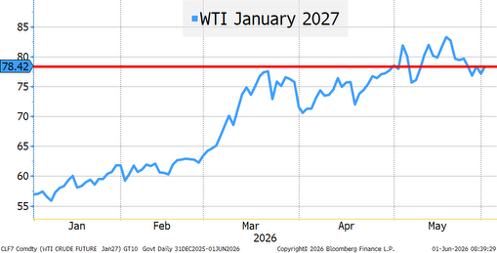
Enough damage has been done to the energy, oil, gasoline, diesel and LNG system that we will experience “higher for longer” on energy prices.
The “quick” return to “normal” is a myth. It will impact affordability.
With defense spending across the globe, combining with higher energy spending, we are seeing global bond yields rise. The U.S. will not be able to fight that.
Finally, prior to the war, I was confident the Federal Reserve could cut rates and manage the long end. The inflation and affordability story is too problematic to cut rates. Expect any extremely dovish sentiment by Fed Chair Kevin Warsh to be met with aggressive selling of the long end of the bond market.
I also expect 10-year bond yields to rise, let’s use 4.75% as a near term target:
- That will not impact the AI and data center build. Even a few hundred basis points are trivial in comparison to what the industry is trying to generate.
- It will hurt affordability and will hurt companies that depend on leverage for their returns, especially when their revenue is derived from consumers. Not alarmingly so, but it will be difficult for companies dependent on the consumer to thrive in this environment.
It remains, to a large degree, the tale of two economies and the tale of two markets – the AI/data center economy versus the rest.
There will be lots of jobs data coming this week, and we will try and help you prepare for that, as it is important, as we head into a Fed meeting, and complacence is the status quo on Iran.