Doug Kass: Warren Buffett, Berkshire Hathaway, and the XLF
Size and competition now represent bonafide challenges for Berkshire to repeat its successes of the past.
You've reached your free article limit
You've read 0 of 1 free Pro articles.
Thursday, on CNBC, three of the four Final Trades on "Halftime" were financial stocks (Berkshire Hathaway BRK.A BRK.B, Bank of America BAC and Citigroup C ).
That, in and of itself, might be a good reason to consider selling/shorting financials!
But I have more substantive reasons — as in a backdrop of "slugflation," and given the sharp share price appreciation over the last month and the extended overbought (and RSI readings) financials are likely vulnerable to a tradeable correction today.
Here are the components of the Financial Select Sector SPDR Fund XLF .
BAC, C and BRK.B account for 25% of XLF with Berkshire at 13% and JP Morgan Chase JPM at about 10%.
A decade ago I was the "credentialed bear" at Berkshire Hathaway's Annual Meeting asking tough questions sitting on the dais with Warren Buffett and Charlie Munger. I had the time of my life. I have written volumes about that experience and, in general, on Berkshire Hathaway since I began writing my Daily Diary on TheStreet Pro so there is no reason to recount my concerns that Berkshire Hathaway is, at best, a GDP grower.
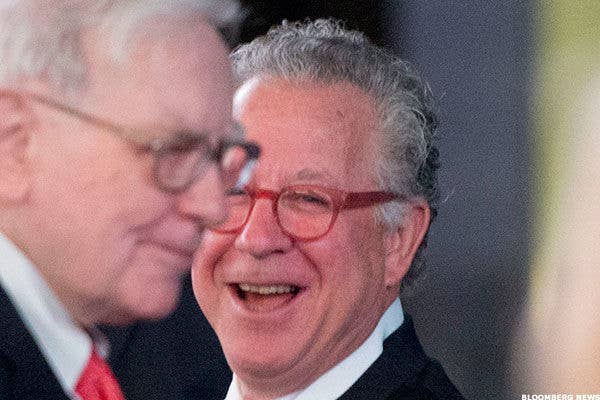
A lot of Berkshire's success over the last two decades has been Warren's ability to move quickly and invest sizeable sums "on the fly." Berkshire's investment in Bank of America - conceived while taking a bath - was a vivid example of this.
But size and competition now represent bonafide challenges for Berkshire to repeat its successes of the past.
* The company's past success and current size will be Berkshire's greatest enemy over the next decade. Berkshire is simply becoming too big for incremental acquisitions/investments to move the corporate needle. With an accumulated $200 billion in cash, Warren basically admitted recently at his Annual Meeting that the ability to employ large sums of capital have been markedly reduced.
* Berkshire now faces competition for deals that it never had before — private equity, private capital, etc.
* Greg Abel, Warren's successor is able, but with Charlie now gone and Warren getting older — the full input of this remarkable twosome will, in the fullness of time, be absent. Investors might consider getting prepared for this.
* The eventual passing of Warren Buffett will not be accompanied by a corporate paradigm shift (i.e., leading to divestitures, spinoffs or sales) as some holders may currently hope for. That plan is certainly not in Warren's DNA — nor is it in Greg Abel's.
Berkshire's shares have appreciated mightily over the last several years — in my view, some of that excellent performance was a sizeable and very timely purchase of Apple AAPL.
The Apple investment was Berkshire's most successful investment ever. It is not reasonable to expect that another Apple opportunity lies ahead — that was, simply stated, a once in a lifetime investment for Berkshire.
To summarize, despite CNBC's protestations, the fundamental and investing challenges now facing the company may represent risk to its shares over the next few years, which might result in a challenge for Berkshire to achieve growth in sales, profits and intrinsic value relative to the U.S. economy and S&P 500 Index.
Berkshire represents 13% of XLF.
I added to my XLF short on Thursday.
At the time of publication, Kass was short XLF.
This commentary was originally published May 17 in Doug's Daily Diary on TheStreet Pro.